
Animal Farm — Chapter 3 (George Orwell)
A Fairy story

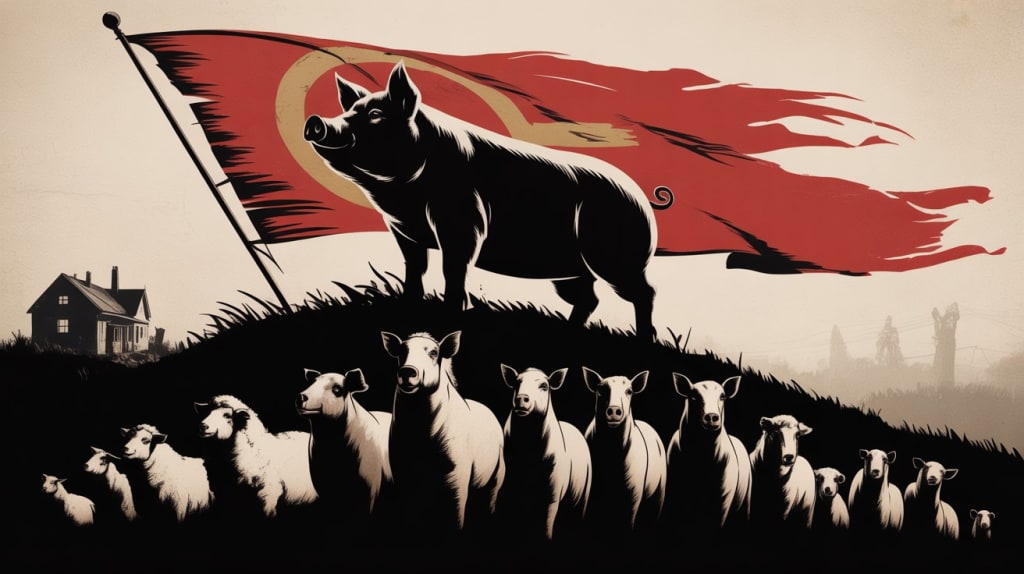
With Manor Farm now transformed into Animal Farm, the animals waste no time in putting their new society into practice. They begin working enthusiastically in the fields, more motivated than ever under Mr. Jones. The pigs, thanks to their superior intelligence, take on leadership and planning roles, while the other animals throw themselves into physical labor. Boxer, a huge cart horse, becomes the farm's workhorse in both name and spirit. His personal motto - "I will work harder" - inspires everyone around him. Even the ducks and chickens do their best, picking up stray kernels of corn to ensure that nothing goes to waste. Although harvesting is difficult without human tools and skills, they manage better than expected, with greater success than ever before. There is a sense of pride and ownership in every mouthful of food they produce, which drives them to work harder and cooperate more willingly. The animals, for the first time, feel that their labor is truly for their own benefit, not for some master who steals the fruits of their labor.
The pigs, meanwhile, deepen their education. Snowball takes charge of organizing “animal committees” to improve literacy, teaching the animals to read and write. Some animals learn only a little: the sheep, for example, can only remember the slogan “Four legs are good, two legs are bad” and repeat it constantly. Others, like Clover, manage to learn the alphabet but cannot read complete sentences. Benjamin the donkey apparently learns perfectly but claims to have nothing worth reading anyway, hinting at his skeptical, cynical personality.
Snowball is tireless in his ideas, drawing sketches to teach the animals about farming machinery and the future possibilities of animal freedom. Napoleon, on the other hand, focuses more on educating the young. He takes the dogs Jesse and Bluebell, claiming that he will raise them himself, away from the rest of the animals. Although this seems harmless at first, Napoleon's true plan for them remains a mystery.
Meanwhile, there are subtle signs of injustice. The pigs take apples and milk for themselves, explaining that pigs need nutrition to think properly and lead the farm. Squealer, the master persuader, argues that if the pigs do not remain healthy, Jones can return, scaring the animals into a deal. The animals accept this without protest, although deep down it feels wrong that some animals are given special treatment.
Snowball also conducts military exercises, which prepares the animals to defend themselves against any future human attacks. At the same time, rumors spread that Mr. Jones is telling the other farmers horror stories about Animal Farm, trying to incite opposition. Despite this, the animals feel increasingly confident and proud. They have run the farm all summer, the harvest is good, and no humans stand by and lash out at them.
Nevertheless, signs of tension emerge between Snowball and Napoleon. Snowball wants to spread the revolution to other farms and bring the ideas of bestiality to all the animals, while Napoleon is more focused on gaining power within Animal Farm. These differences do not yet erupt into open conflict, but a rivalry is clearly forming.
By the end of the chapter, the animals still sing “The Animals of England” every night, keeping their dream of equality alive. But beneath this dream, the seeds of future problems have been sown: the pigs are slowly gaining privileges, Napoleon has secretly isolated the puppies for training, and the other animals are too busy working or seem too naive to care.
The unity of the revolution seems solid on the surface, but a closer look reveals that cracks are beginning to appear. The pigs are the leaders, making the rules, and convincing the others that it’s all for their own good—even if it means shattering the idea that all animals are truly equal. The rest of the animals, full of hope and a desire to believe in their new society, fail to see how the pigs are slowly elevating themselves above the others.
In Chapter 3, George Orwell shows how ideal revolutions can almost immediately begin to degenerate into new forms of power and inequality, even among those who claim to stand for perfect equality. The hardworking animal, especially Boxer, who has immense faith in the cause, symbolizes the exploited working class, whose loyalty and effort can tragically be diverted to serve the ambitions of the new ruling group.
The farm seems peaceful and happy for the moment, but Orwell shrewdly predicts that true equality is already beginning to fade.
About the Creator
Echoes of Life
I’m a storyteller and lifelong learner who writes about history, human experiences, animals, and motivational lessons that spark change. Through true stories, thoughtful advice, and reflections on life.
Keep reading
More stories from Echoes of Life and writers in Fiction and other communities.
Animal Farm — Chapter 2 (George Orwell)
After the powerful barn meeting where Old Major sows the seeds of revolution, the animals of Manor Farm find themselves transformed. Although Old Major dies peacefully in his sleep just three nights later, his ideas flash through their minds. The pigs, being the most intelligent of the animals, quickly take on the task of spreading his vision. Of these, three stand out: Napoleon, Snowball, and Squealer. Napoleon is a large, fierce-looking Berkshire boar with a reputation for getting his own way. Snowball is more lively, quick-witted, and inventive, while Squealer is a brilliant talker who can twist any argument to convince others.
By Echoes of Life8 months ago in Fiction
Bomb Scare
It was 2027, and the world never thought it would happen. A missle hit the United States, but it wasn't where they had anticipated. A little town in the northeast was hit by a missile strike, they didn't know why, and they didn't know exactly where it hit, but they did know it was a coastal community, somewhere between Maine and Delaware.
By Gregory Payton8 days ago in Fiction
The Family Riches
According to family legend, our massive wealth originated from the creative genius and business acumen of my great-great-great, Grandfather Oliver Dooley. Ever since I was a young child, my parents and grandparents talked about this ancestor as though he were a cross between a conqueror and God himself. The older I got, the less believable I found these tales of his grand exploits to be. I began questioning the family lore. When I did, my elders would give me a disgusted look, point to our time- worn family bible, and exclaim, “If you don’t believe me, look it up. The family history is all in the book.”
By Mark Gagnon4 days ago in Fiction
My First Time Skiing and I Got Lost, Alone, in the French Alps
Looking back, I can trace some of my life’s biggest adventures to a simple action from my sister. She’d introduced me to Tommy (a very long time ago), a colleague of hers, who had overshared his penchant for Italian-looking women, and I ticked that box.
By Chantal Christie Weissabout 7 hours ago in Humans


Comments
There are no comments for this story
Be the first to respond and start the conversation.