
And Here, At the End of All Things
Isn't it funny, the things that remain?

The end of the world had come and gone, and it wasn’t as bad as we expected. That there were any survivors at all was a miracle, though whether it was mercy or vengeance was yet to be decided. We would never know who fired the first shot, if it was us or them, and ultimately it didn’t matter. We attacked each other without the desire to conquer, but with a lust for destruction. Four-fifths of the global population had been demolished to ashes after only a few days of nuclear warfare as governments held fast to their pride and their promises of mutually assured destruction.
There weren’t many of us left – humans, that is. Some people took to wandering the barren earth hoping to find other survivors, and their absent family among them. (And perhaps, if they could keep moving forward, they wouldn’t have to think of what they were leaving behind. A choice they had made, rather than one the world had taken away.) The wanderers kept away from the sites of what were once the greatest cities in the world, all too aware of the effects of radiation poisoning.
I fled my city with a blanket and the small bag I had prepared the day before, though I’d packed it with a camping trip in mind rather than the end times. I was faint from blood loss, my left arm having been nearly severed by a flying shard of window glass. I met a girl who reminded me of my sister (my beautiful sister, who had been living in New York City – one of the first places decimated.) She patched me up, sewing the wound on my arm shut. She couldn’t save my arm from nerve damage, but she did save my sanity. More importantly, she had a shortwave radio, one of the few pieces of technology that could still work after the destruction of the biggest internet exchange sites plunged us back into the metaphorical Dark Ages.
“Who even uses those, anymore?” I asked through gritted teeth.
“You better be thankful I do,” Kira replied. “And cool people, to answer your question.” I couldn’t admit that I found it endearing. My sister would have said something similar.
We listened together as the world we knew collapsed like a sandcastle under the tide. In the end, it wasn’t global warming or overpopulation or famine or a virus that destroyed us as predicted; it was ourselves, with the people paying the price in place of the powerful.
It was funny the things that no longer had value when the world collapsed. Some people looted museums and jewelry stores in the days after the first bombs dropped. While money may have been a manmade concept, there was nothing conceptual about hunger. Sapphires couldn’t feed us, and they couldn’t keep us warm in the cooling evenings. Net worth was a relic of a prior era, and our cashless society which had once seemed so convenient had become just another element of our downfall. So, the world reverted almost in concert back to the oldest method of payment: bartering. Chicken keepers and dairy farmers ruled the new economy. We traded whatever we had: items, food, favors. The only nonessential items in my possession were a book of letters from a long-dead author, which I had packed for my camping trip, and a necklace that didn’t belong to me.
“Hold on to it for me?” Kira asked, clutching my hand. “Let my family know, if you find them?” I wanted to tell her to tell them herself, but I wasn’t angry at her. Just angry that I couldn’t save her the way she had saved me.
By September, I had run out of things to barter. I had no gift for agriculture or medicine or anything useful in our new society, and my injured arm prevented hard labor. So I settled in the first ramshackle commune I came across and proceeded to trade the only thing I had left. Others traded in fruit or eggs or knitted hats. I traded in stories.
When I laid out my tattered quilt in the center of the not-quite-a-town’s designated trading center (we all called it the Market, like something out of a Renaissance festival) and failed to set out anything worth trading, I did it with the sole goal of attracting curiosity.
“What are you trading?” passersby would ask.
“Give me one of those rolls and I’ll tell you,” I’d reply. Some took the bait, others didn’t. I invited those who did to sit with me while I told them about spies and princes and peasants. The children – humanity's precious, revered beacons of hope – were always the most adamant, pulling on the sleeves of their designated adult until they relented, setting an apple or a slice of bread at the edge of my blanket like a temple offering. It was amazing, I learned, what people would give you in return for an escape. Vendors and smiths and the woman who knitted blankets for our little community stopped by, and I was never short on supplies. What I didn’t use, I gave to others in return for their time. One person alone cannot keep a story alive. I told every tale I could remember, though never with the right words. Recitation was never my forte. Sometimes I made up my own. The kids seemed to like those the best.
“Are you awake?”
I was, but I shouldn't have been. My arm ached like anything, and sleep would at least take that from me for a short while. I had grown to hate the open road.
“No,” I responded.
“Liar,” Kira said easily. “Tell me a story.”
“Your life isn’t enough of one right now?”
Kira laughed, a light in the dark. “A real story takes people away from the world. Come on, please?”
I sighed, turning to face her. “Any requests?”
“Anything, as long as it starts with ‘once upon a time.’”
The newcomers stood out by virtue of being unfamiliar. Our commune wasn’t on a map, and wayfaring strangers were rare. A young woman with a plaited braid and sharp, wary features accompanied her parents, an older man with a tired gait and silver hair, and a woman with lines around her eyes that might once have been laughter lines but now betrayed her exhaustion. Everyone at the Market watched them as they made their way to me. For a moment, it looked like they expected to see someone else.
“You are the storyteller?” the young woman asked. I raised my eyebrows.
“You know me?” It seemed unlikely, but stranger things had happened.
“We’ve been asking around,” she said, holding up an old amateur radio. I patted the blanket in invitation.
“What can I do for you?”
“We’re looking for answers,” she said. “We hoped you might have some.”
“What do you have to barter?” I asked. After all, business is business. The older woman held out a bag. A dozen apples sat nestled within it, gleaming pink and gold. My mouth watered. Fruit was a luxury on this radiation-poisoned planet.
“Let me tell you a tale, then,” I said. “Is there one you would like?”
“Tell me something true,” the girl said. “Where did you get your locket?”
“Where did you get your necklace, Kira?”
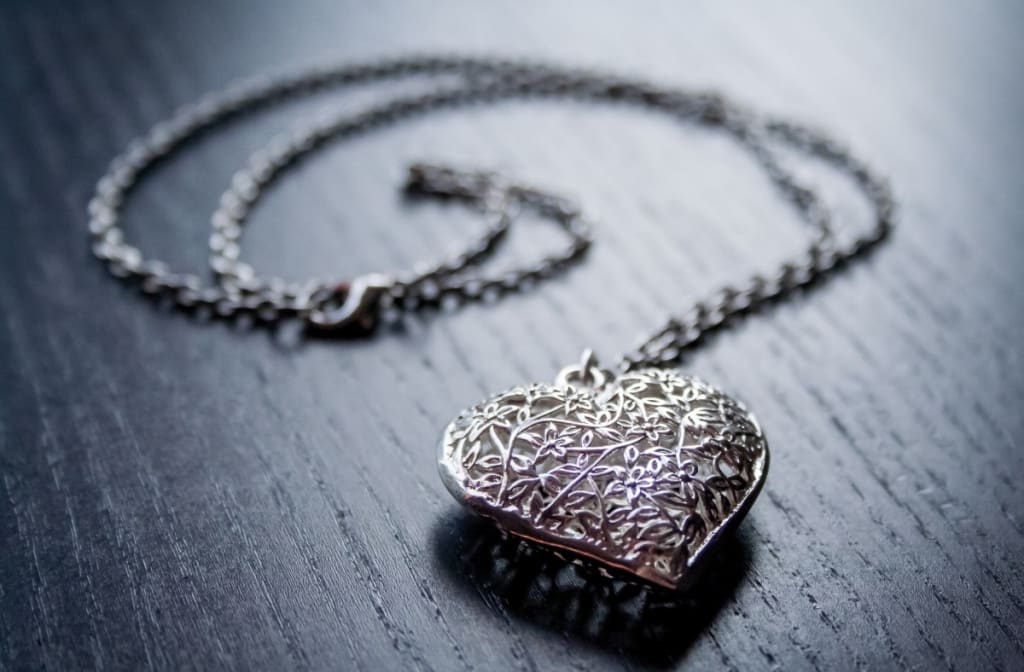
The trinket in question was a gold, heart-shaped, sentimental thing, the kind a parent would give their young daughter as a keepsake: solid, nostalgic, sweet. Frivolous items stood out; this was not the first time I had been asked about it. Normally though, when small children or even curious adults questioned it, I told them…not a lie, exactly. But they were trading me my survival for a story, and my own seemed unworthy as payment. So I gave them a better one.
“Once upon a time…”
The young woman’s face held something desperate, a hunger that only an honest answer would satisfy. And for the first time, rather than telling the story of someone else, I told my own, and that of a girl who saved me at the end of the world. I told them about someone who made me laugh as the skies fell around us. I told them about holding her hand as she bled out in my place.
Once upon a time, there was a girl like sunshine breaking through gray skies. And a bit like a scrap of driftwood in a hurricane, she saved me.
It should have been me. The gunshot was too fast, and I couldn’t stop it any more than I could stop the bomb that took my sister or any of the other eight million people in her city. Kira had survived the bombing of our town, and a common criminal was her downfall.
“Stay with me,” I said. “Come on, talk to me.”
“You’re the storyteller, you talk,” Kira muttered. “What should I say?”
“Where did you get your necklace, Kira?” That made her smile. She always smiled when she talked about her family.
“My parents,” she said. “On my twelfth birthday. We couldn’t afford it, but I wanted one so much.” She coughed. There was blood on her lips. I wiped it away. “I still don’t know how they managed that.” She sounded surprised. I wasn’t. I had known her a month, and I would do anything for her.
“That’s lovely,” I said. “Here, hold still.” I reached for my shirt, prepared to rip it into a makeshift bandage. Before I could, she took my hands, still wet with her blood, and held on. Shaking fingers grasped at the necklace, opened it.
“I never showed you what they look like,” she said. Four faces, one of them hers, looked back at me, all caught in the middle of a laugh.
“They look like they love you very much,” I said. My hands rested uselessly in her own.
“They do.” She coughed and pressed the locket into my hands.
“Hold on to it for me? Let my family know, if you find them?”
I closed my fingers over hers.
“Of course.” She didn’t speak after that, but I did. She had asked for a story, and if that was all I could give her, she would have one.
Dawn came. She left.
And I was alone with my own empty words.
They were quiet as I trailed off, and I clumsily unclasped the chain and gave it to the daughter.
I could have spun them a story, let them hold on to hope. But hope can be crueler than truth and besides, they already knew. Family is like that.
They didn’t cry when I told them. The mother opened the locket and they crowded around it to stare at the picture inside. I had opened it only once while holding the hand of a dying girl as she smiled around a mouthful of blood. The photo was a little charred at the edges, but its subjects were smiling. It was them, I knew, but a different them from a lifetime ago.
“May we?” started the daughter.
“No need to ask,” I said. “I’m just returning it.” They stood.
“You didn’t say ‘the end,’” the daughter said.
“Because it’s not,” I replied. Her end wouldn’t come until her name was forgotten by those who knew her and by those who did not, but knew of her nonetheless.
I watched them leave with apple juice dripping from the corner of my mouth. My tongue caught a drop. The tang of the acid tasted sweet. They walked away and did not look back. The world would put itself back together or it would collapse. And I would be here until the end of all things, telling stories that may yet last until the sun explodes.
What do you have to barter? Come a little closer – I’ll tell you a tale.
About the Creator
K. Elizabeth Fitzgerald
K. Elizabeth Fitzgerald is a freelance writer, avid reader, and tea drinker. Occasionally she writes stories. She prefers the world in her head to the one outside of it.
Keep reading
More stories from writers in Fiction and other communities.
The House at the End of Hawthorn Lane
Gail Sullivan’s house sat like a sealed envelope at the end of Hawthorn Lane, addressed to no one and opened by none. The curtains never moved. The gate never creaked. After her husband died—suddenly, mysteriously—Gail withdrew behind the tall fence that ringed her property and never crossed it again. The neighborhood filled the silence with its own explanations. They said she had learned of his betrayal and answered it with precision, increasing the dosage of his daily medications until his heart complied. They noted her grief had sharpened into something dark.
By Anthony Chan4 days ago in Fiction



Comments
There are no comments for this story
Be the first to respond and start the conversation.