
A New Territory...again
A Return to the Discarded by the Unwanted.
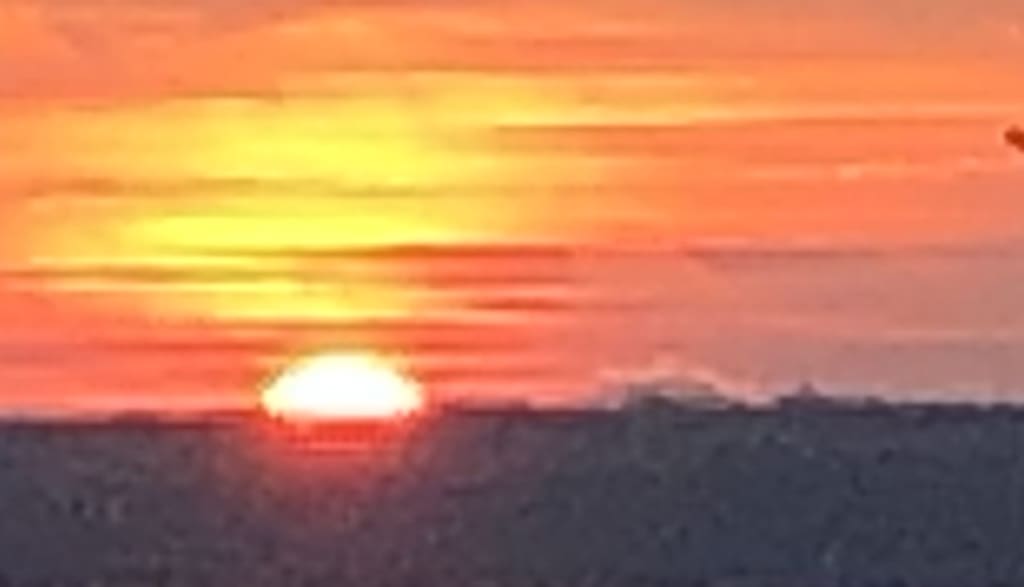
The sun was low now; its intensity piercing even the mirror sunglasses the driver wore. He adjusted the interior visor but knew, in 20 minutes, 30 tops, it would be glaring into his eyes again.
Time to make camp, he thought as he glanced over to his gauges, 120 degrees Fahrenheit, power down to one quarter and trending low fast.
He brought the van to a stop at the crest of a small hill to scan the horizon. The cloud of red dust trailing his van caught up and enveloped him. He pulled the bandana around his neck up to cover his mouth and nose.
The dust still penetrated, causing him to cough.
"Damn!" He said aloud, to no one but himself.
As the dust settled he could make out the land. The same as this morning, the same as this afternoon; low rolling hills of tall, brown grass, broken by red patches of cracked but hard earth. Scattered about the horizon were the skeletons of dead trees, their leafless branches broken and gnarled against a purplish horizon.
Then he saw it.
At the base of one of the hills … a living tree!
Not just any tree, a towering cottonwood that he had missed at first glance because he thought it to be a smaller hill.
"That's it!" He proclaimed as he spun the steering wheel toward the tree and left the relative flatness of the old concrete road. The van pitched from side to side over the uneven ground. He hung out the driver’s window watching for rocks and other obstruction that could break an axis, with glances to the power gauge.
The batteries were almost out.
The indicator was blinking red.
Finally, he was there. The massive Cottonwood had certainly seen better days, it's leaves crisp around the edges but its roots obviously ran very deep, or it would be dead like so many of it's surrounding fellows.
Not much time, he thought as he pulled up to the drooping canopy of branches. He backed the van up so its tail was facing south, or at least what he hoped was south.
Looking around one last time, he turned the van off, the quiet hum of the electric engine immediately ceased, and he thought, For better or worse, this is it for at least a day.
Swinging out of the driver’s seat into the van’s interior he crouched as he unlatched the roof. It popped loose and, with the help of the grab bar, he pushed it to its full height. As he did a faint new hum began, the sound of the photovoltaic cells on the roof absorbing the setting sunlight.
Sliding open the side door he stepped out of the camper van and walked under the cottonwood canopy, brushing aside low hanging branches as he entered.
It must be 20 degrees cooler, he thought, Thank God.
He took off his bandana and wiped the sweat and red grim from his face. Pulling himself up into the tree he found a place where two branches fanned out from the trunk, wide enough to cradle him.
His last thought, as he drifted off to sleep, No scorpions, no snakes...good...another day.
***
He awoke in a sweat…
… Of course, he always woke up in a sweat.
Climbing down from the low branches where he had made his bed, he walked over to the van. It was night now but the heavy heat lingered, held in the earth.
Opening the mid-van door, he sat in the doorway looking back under the tree canopy. Pulling out a container he munched on wheat and rye sprouts, then took a sip of precious water from a nearby jug. "You're all that remains,” he said to himself as he popped more of the sprouts into his mouth.
***
Theirs was a modest farm, in the wheat country near Woodward, OK. His family had farmed this land since the early 1900s. It had survived the Great Depression, two world wars, tornadoes, blizzards, and droughts.
But, it would not survived "The Change," climate change.
It had begun long before he was born. Warnings about climate change had been made since late in the last century. But with the start of the Twenty-First Century the summers became more intense, and ever longer, winters milder with occasional freakishly heavy blizzards followed by incredibly intense "storm seasons” season in the spring.
Scientists were unified, speaking clearly in paper after paper, conference after conference, treaty after treaty. But, the world went about its way, burning more of the very fossil fuels everyone knew was causing the problem.
"National leaders" in the Senate, Congress and even the Presidency denounced climate change theory, calling it "the greatest hoax".
The clock ticked.
The climate changed.
Then one night, just a few weeks earlier, the President went on national television to make “The Announcement”.
With the country facing wide spread public utilities collapse and a corresponding decrease in available fresh water, the Congress and President had determined that the lesser populated interior states of the Great Plains region were expendable … except for their oil and gas resources, of course.
All of what was once known as the “Plains States," except Texas, would loss their status as sovereign states and be reconfigured as territories, the same as they had been throughout the 19th Century. From small rural communities to major cities, the populace was “evacuated” to the Border States, or Borderlands, such as Arkansas, Missouri or even Colorado, where large refugees camps were established.
Oklahomans had a unique familiarity, historically, with this type of regressive policies.
Once know as the “Indian Nations," or, simply, the “Nations," in the 19th century, Oklahoma had been a territory populated by nearly 40 sovereign tribal nations well into the 20th century before becoming one of the last states. In the 1930s, in the midst of the “Dust Bowl," the first ecological disaster, thousands of Oklahomans, “Okies” as they became known, migrated to camps in California and other western states, where they worked as underpaid migrant workers in their own country.
For him, away at the University, messages from The Farm had become more dire. The wells had dried up, the wheat would not grow, the cattle began to die...there was no water to be had, except what the occasional rains brought. The ancient deep aquifer the farmers had relied upon for over a century had ceased to yield, some people said the underground aquatic caverns had collapsed from being drained so completely.
When the messages stopped, he left the University for home.
Too late.
After hitchhiking west from Norman, he found the old farm eerily quiet as he walked up the red dirt road. He found his parents in their bedroom, lying side by side. His Father was cradling his Mother's hand in his own. Next to his Father, on the nightstand, was a note.
"Son,
If you are reading this then you can see what happened,
Your Momma came in this morning and said, between coughs, “The last hog is dead.”
After the wheat, the cattle, your Momma's garden, and everything else, that hog was just the last straw. Your Great Grandpa always said, “As long as you got a sow, you can make it.” That was what got the family through the Dust Bowl days, but now we don’t even have that hog now!
Your Momma wandered out the back door. I thought she was checking on her garden.
That’s where I found her. The heat, lack of water and dust pneumonia was finally just too much for her good heart.
I laid her out here on the bed.
I must have sat in that kitchen, staring out the window, for a day and a night.
That was when I heard the President’s Announcement on the radio. We are not Americans, not people, anymore. Someone, somewhere had declared us expendable… just empty land. Oh, they said it more nicely than that but that is what they meant.
Well, Son, that was just it for me.
Your Momma is with the Lord, in the Bosom of Abraham.
Our way of life is gone.
I suppose its time for me to go too. I think I just lay here next to your Momma for a while.
As your Momma always said, "You must find your place in the circle.” I hope you do, Son.
We love you.
God Bless and keep you.
Dad."
He buried them in the red earth of the garden. In muttering a prayer the last words seemed particularly poignant to him, “ …Dust to dust…”.
After attending to his parents, he wandered about the farm, eventually finding himself in the barn.
What now? He thought.
He sat on the dirt floor in the stifling heat of the barn, thinking of his parents, the farm, and everything lost.
The world was spinning beyond his control, beyond humankind’s control...beyond comprehension. Events set in motion by humanity's indifference and inability to live within its own means...its own world …had now come down to him on this dirt floor in the barn of a failed farm in a state that was no longer a state.
Looking up, his eyes fell on the family's old VW electric camper van. Inside, he saw the small dream catcher hanging behind the front seats, the heart shaped locket tied to its base glittered for a moment in a ray of sunlight through an opening in the barn wall.
His mother was descended from an Arapaho family near Seiling. Her Grandmother had brought the dream catcher to their family, when she was active in what was then known as the Pan-Indian Movement of the 1970s. Originally from Ojibwa Nation, dream catchers were one of several items spread throughout other Nations by the movement.
His Mother had placed the dream catcher in the van for their family trips…to protect them and to remind the young boy/man of his place in the circle. In ancient times, a young man was expected to determine his place in the circle, the life, of his people.
Some time later, his Mother had attached the heart shaped locket as a reminder of their journeys together as a family. Inside the locket was a photo of the three of them, with the van in the background, taken at nearby Roman Nose State Park.
Rising, he walked to the van, opened the driver side door and cradled the dream catcher, with the locket, in his hand. Taking out his knife, he sliced the strong holding he locket and let the dream catcher swing back into place. Opening it, he stared at the photo for a long time. Finally, closing it, he pulled up the chain around his neck and clipped the locket next the Celtic cross he always wore.
Walking away from the van he saw two large sacks of seed, wheat and rye, and noticed the hum of the solar panels on the roof of the barn.
And, in that moment … he knew.
"Thank you, Momma,” he said softly, almost reverently.
The way was clear now.
He would become like the People of the First Nations, who knew the land they called home.
He would combine that ancient knowledge with contemporary technology, retrofitting some of the solar panels from the barn roof to the van, making it into a portable charging station. He could not travel more than a few hundred miles on a charge, but he could traverse this land, finding water and sustenance where he could, a modern version of the ancient ways.
There would be no “Okie” refugee camp for him.
He would not become another refugee in his own country.
Looking down the road toward the Gloss Mountains to the east, its crystals glittering in the setting Sun of the west, he knew what he would become…
… a wanderer upon the land, never stopping anywhere for more than a few days…
…a sojourner.
About the Creator
N. Harold Donley
N. Harold Donley is a free lance writer based in Norman, OK. Author of OUTWORLD, a novella set in a climate altered future, N. Harold has also written a number of short stories. He is currently working on a sequel to OUTWORLD.
Keep reading
More stories from N. Harold Donley and writers in Fiction and other communities.
How to Succeed at the Benson Directory®
Congratulations and welcome to the Benson Directory® employee #22391! As our newest call handler, you will have the privilege of speaking with dozens of unique and interesting people on a daily basis as well as the opportunity to earn bonuses for high performance. Contained within this handbook you will find a set of ease to follow instructions designed to help you settle in to your new role and begin paving the way to success.
By S. A. Crawfordabout 23 hours ago in Fiction




Comments
There are no comments for this story
Be the first to respond and start the conversation.