
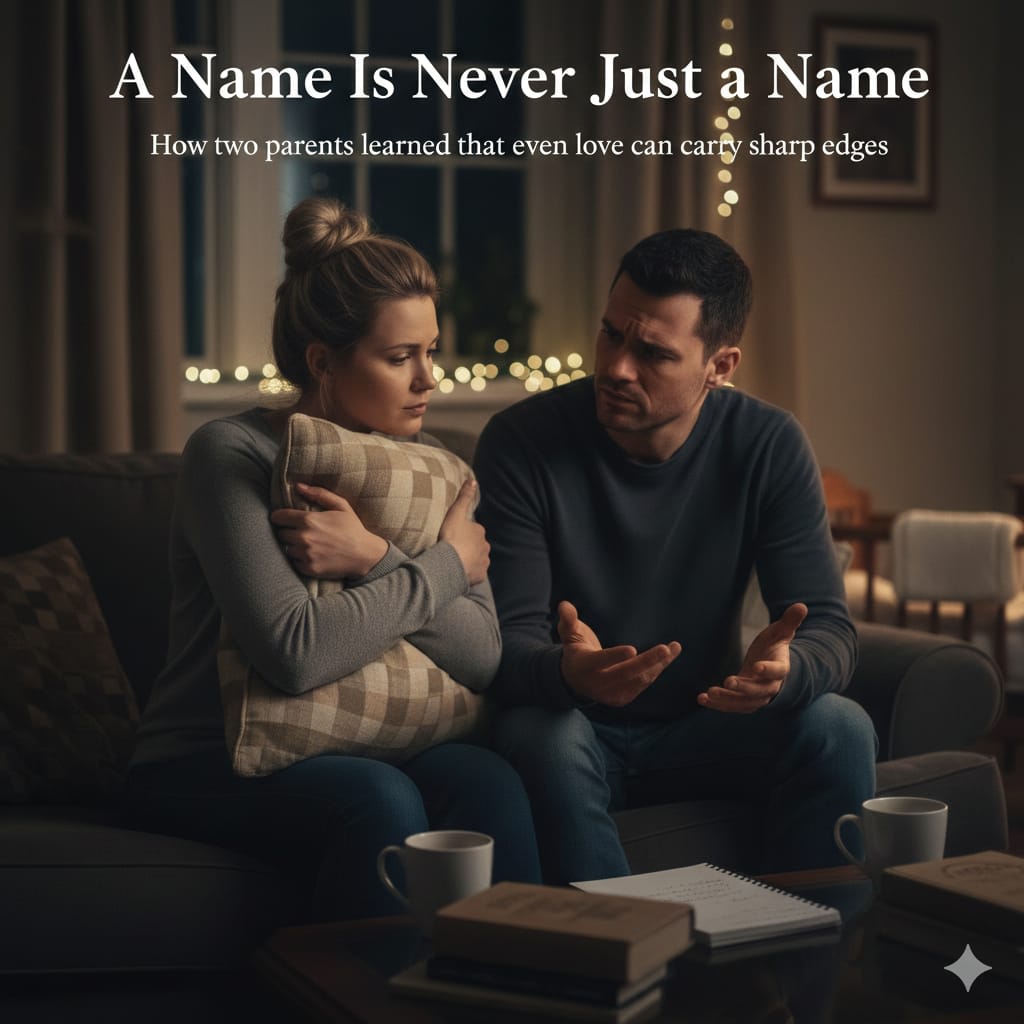
A Name Is Never Just a Name
How two parents learned that even love can carry sharp edges
Before she even existed, our daughter was already being argued over.
Not about religion.
Not about schools.
Not about politics or screen time or whether she’d grow up liking dogs or cats.
About her name.
Names are strange things. They sound small, almost decorative, until you realize how much weight we quietly stack on them. Expectations. Memories. Old grudges. Old love. Names remember things even when we pretend we don’t.
“Emma?” I said one night.
He didn’t even look up.
“Every other baby girl since ’93 has been named Emma.”
“I don’t mean like Rachel’s Emma. I mean like Austen’s Emma.”
“Austin?”
“Austen. Jane Austen.”
He sighed. “Too literary. Too… college-y.”
“Is there a more trade-union name you’d prefer?”
“Don’t be an ass, Lis. What about Rebecca?”
And just like that, we weren’t talking about a baby anymore.
We were talking about his aunt. My high school enemy. His mom’s sister. My mom’s sister. Old wounds. Old air fryers. Old betrayals dressed up as polite family dinners.
Rebecca was too vintage.
Danielle reminded him of fantasy romance covers.
Jenna was a betrayal in grade ten.
Kaycee was another betrayal, same year, different flavor.
Every name came with a ghost.
“Beatrix?” I tried. “Like Beatrix Potter. Bea for short.”
“Is she coming out with wrinkles and grey hair?”
“Do you have any female role models?” I asked. “And don’t say your mother.”
“Veronica?”
“Absolutely not.”
“Angelina?”
“When my name’s Lisa? No.”
We kept circling the same truth without saying it out loud:
We weren’t choosing a name.
We were negotiating our pasts.
At some point, I said the quiet part out loud.
“A name can be a weapon. Or it can be a balm.”
He looked at me then. Really looked.
When I suggested Beth, I knew exactly what I was doing. Beth was history. Beth was betrayal. Beth was unfinished business my mother never asked to reopen.
He shut it down immediately.
“I hope this is hormones,” he said carefully, “and not you trying to use our daughter to get even with your mom.”
That stung because it was uncomfortably close to the truth.
Carla came later. His sister. The one who never made it. A miscarriage that still lived quietly in the family like an empty chair no one mentioned.
“It could be healing,” he said.
“It feels morbid,” I said.
And then we both stopped talking.
Because suddenly we understood something at the same time:
If a name couldn’t be a weapon, it also couldn’t be a balm.
It couldn’t fix anything.
It couldn’t punish anyone.
It couldn’t heal what we hadn’t healed ourselves.
“What if we’re thinking too much?” he said.
“She’s going to be who she’s going to be.”
That landed.
Names don’t save children.
Parents don’t get that kind of power.
In the end, we chose Carla.
Not because it was perfect.
Not because it was lucky.
But because it was offered gently.
I don’t believe in luck.
I believe in choosing not to pass pain forward.
“Carla,” I said again, testing it in the air.
And for the first time, the name didn’t carry anyone else with it.
About the Creator
Iqbal
Iqbal was a visionary poet
Runemaster 10
(Click here to read the previous chapter) Nyssha narrowed her eyes at the glowing text before her, wondering where it had come from. At first, she thought she must've snapped from the stress of this little adventure. But the message reminded her of the disembodied voice that had spoken to her when the little god tried to control her. Either way, it was probably worth considering.
By Mark Stoneabout 24 hours ago in Fiction



Comments
There are no comments for this story
Be the first to respond and start the conversation.