
A Goat Called Lester
A travelling barn pulled by a semiaquatic goat acquires an unexpected following while roaming the canals and byways of rural England.
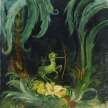

From the wonky veranda of the barn-on-wheels, a young woman with cascading blue hair sat in a rocking chair, one leg flung over the arm and the other resting lazily on the wooden stool before her, upon which also sat a travelling mug of cold pea and ham soup. A small goat with beady yellow eyes stood grazing nearby, and upon her shoulder, a tiny black kitten with tufty fur and a petrified expression clung to the folds of her hair. The small boy and girl from the neighbouring caravan, who had come to sit on the grass in front of the barn, watched in fascination as she wiggled her bare toes atop the stool and dimpled cheekily. Addressing them, she told of her daring rescue of Caspar the Cosmic Kitten from the nearby canal, and from some horrible boys who had thought it funny to subject a defenceless animal to the cold water. They had ended up in it themselves it was true, but she’d made sure they had got out again and left them spluttering and cursing girls and cats, before marching back to the campsite with the little dripping animal tucked in her bra. Agnes had helped dry and swaddle it, even fed it with the tinned milk, worry though she might about the dubious claims made on the wrapper of its superior nutritional value. Agnes whom they would meet later, as she was currently communing with nature because she found the barn stuffy and objected to the chamber pot.
Lack of plumbing within the barn-on-wheels had led to the unfortunate presence of the chamber pot, but even this, found by one of the blue-haired girl’s rotating roster of girlfriends (this was perhaps what Agnes objected to) at a car-boot sale in Battersea, was Victorian porcelain. On it was painted a rosy-cheeked shepherdess in a field of lambs who, though she simpered at you as you prepared to relieve yourself over her bonnet, did at least lend herself to the general pastoral tone of the outing. A pastoral outing was what they were on, the blue-haired girl clarified, and her own name, which being excited about her gallant rescue she had thoughtlessly omitted to tell them, was Cora and she dyed her hair with food colouring. The goat did not have a name for he was a mode of transport and a shapeshifter at that. Cora had conceded to Agnes that he might well have a name for himself, but it was difficult to give one to a goat that was always changing the length of his horns and the devilishness of his eyes. He had once managed, she stated seriously, to retract all of his hairs back into his skin and morph into a seal or porpoise-like creature, like the caprine equivalent of a Selkie. This had been a particularly hot day in July and he’d been pulling the barn-on-the-barge along the canal, when all of a sudden he’d leapt in, cloven hooves a-clatter. Cora, Agnes and Cora’s grandmother Annie (who was an invalid and resided strictly, therefore, inside the barn on a fourposter bed) had been surprised, but soon a sleek and bewhiskered head emerging majestically from the murky water had brought reassurance, and they had worried no more.
Cora and the goat held court, now, to a small gathering, as the parents of the boy and girl had wandered over and others, it seemed, had recognised either them or the barn-on-wheels and allowed curiosity to lead them from distant corners of the campsite. They had heard of the goat, and of the barn and the blue-haired girl, for this collection of people and animals had been conquering the dirt tracks and leafy waterways of the English countryside now for some time. There was even, had Cora and Agnes and Annie known it, such thing as a barn-spotter: these eccentrics (as their fellow campers dismissed them) had begun to follow the barn about the country. Many hoped for a glimpse of the goat, who’s species was hotly debated by those who tracked its progress and wondered feverishly where it was going. Some said quite fiercely that it was a common-or-garden goat, and never mind those ridiculous tales of huge spiralling horns. Those with more imagination insisted it was a Scimitar-Horned Oryx (the ones who took this view also had to account for how it got over from North Africa; the common-or-gardeners here at least have logistics on their side). A recent detractor had arrived in the form of a young barn-spotter called Zerdan who, laying eyes on the animal as it stood soddenly in a lay-by near the village of Blisland in Cornwall where it had been raining, cried happily that it was a Himalayan Blue Sheep from his native Tibet.
Cora, oblivious to such silliness and catching sight of beautiful Agnes returning from her wood, remembered her bed-bound grandmother who had fancied adventure, been denied it by the demands of adulthood, motherhood and now, in her dotage, having requested of her blue-haired granddaughter that such an adventure be forthcoming, must be attended to. The old garden shed, busily converted into makeshift boudoir complete with Annie’s own quilt, sewn during her illness, would do for them all. She had decided to name the goat Lester for its sullen expression that persisted, she realised, through his metamorphoses.
About the Creator
Angelica Austin
Just starting out writing short stories & really enjoying it! Hoping to get published one day...
Keep reading
More stories from Angelica Austin and writers in Fiction and other communities.
The Locked Heart Society
At the mouth of the tent, a small fire crackled and a figure sat slouched over the prickly remains of its dinner- an undersized and bony fish likely snatched from the slimy trickle that was a stream half encircling the campsite. Legend had it that this particular bend in an otherwise unimpressive body of water, mere perspiration on the brow of this parched and puckered piece of desert, had once seen the end of an entire civilisation. The slouched figure raised its head and cared to elaborate: it sat before a semicircle, rows deep, of other figures similarly decked in raggedy cloth. This was stained and burnt as though they had been wearing it for years before reaching the present moment breathless and sun-beaten, to gaze at the scrawny person in front of them who inhabited it. This waifish individual had an odd sense of being less there than the others, but seemed yet to conduct their attention so masterfully that it did not so much inhabit the moment as command it to sit still and listen.
By Angelica Austin5 years ago in Fiction
How to Succeed at the Benson Directory®
Congratulations and welcome to the Benson Directory® employee #22391! As our newest call handler, you will have the privilege of speaking with dozens of unique and interesting people on a daily basis as well as the opportunity to earn bonuses for high performance. Contained within this handbook you will find a set of ease to follow instructions designed to help you settle in to your new role and begin paving the way to success.
By S. A. Crawford5 days ago in Fiction




Comments
There are no comments for this story
Be the first to respond and start the conversation.