
A Father's Legacy: Teaching Situational Awareness in the Urban Jungle
The art of seeing the unseen in the urban landscape.

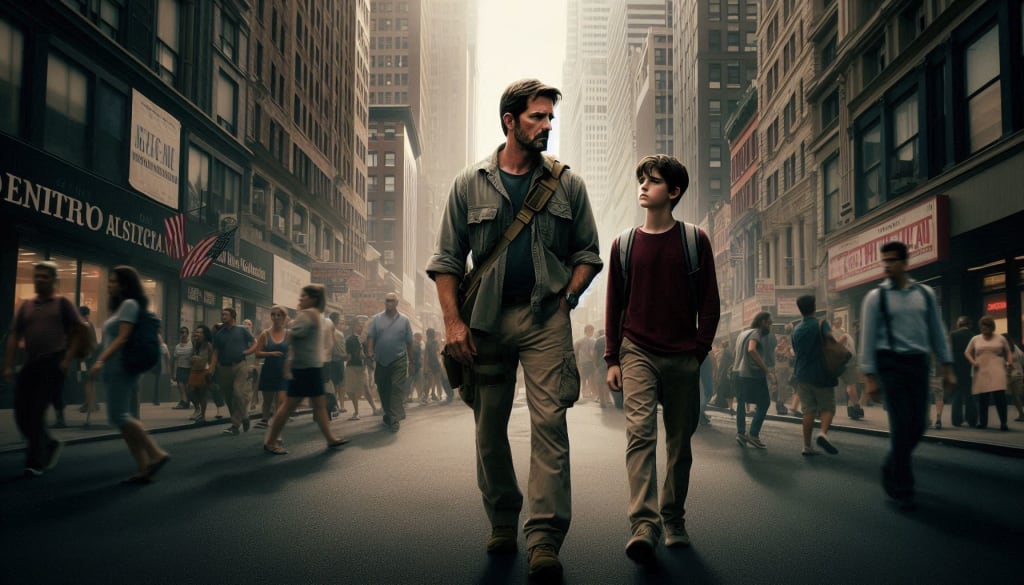
In the concrete jungle of New York City, danger lurks around every corner. A retired Special Forces veteran, determined to protect his son, embarks on a rigorous training program, teaching him the art of urban survival. From bustling sidewalks to shadowy alleyways, they learn to read the city's rhythm, anticipate threats, and react with precision and speed.
The rumble of the subway echoed through the concrete canyon, a constant undercurrent to the cacophony of New York City. Rain lashed down, mirroring the storm brewing inside Sergeant Marcus "Mac" Reilly. After years of navigating warzones, he was back on familiar ground, yet it felt alien. The city that pulsed with life now throbbed with a different kind of energy, a simmering tension beneath the surface.
His son, Finn, a lanky teenager with a mop of unruly hair, trailed behind him, his gaze glued to the puddles swirling beneath his boots. "Dad," Finn mumbled, "Why are we walking so slow? I wanna get to the comic book store."
Mac stopped, his gaze sweeping the street. "Finn, look around you."
Finn, startled, jerked his head up. "What?"
"Observe," Mac corrected. "Observe the people, the cars, the buildings. Notice the patterns, the anomalies."
Finn, confused, scanned the street. "What anomalies? Everyone's just… walking."
Mac chuckled, a dry, humorless sound. "That's the point, Finn. In this city, blending in is the most dangerous thing you can do. You have to stand out, not to be seen, but to see."
He pointed to a group of teenagers huddled under a doorway, their eyes darting nervously. "See how they're clustered together, like a flock of birds? They're probably up to no good. Maybe a drug deal, maybe worse."
Finn frowned. "How do you know?"
"Intuition, son. Years of it. You learn to read the subtle cues, the body language, the way people interact. It's like a sixth sense."
They continued walking, Mac guiding Finn's attention to every detail: the overflowing trash cans that could harbor rats, the broken streetlight casting a long, ominous shadow, the alleyway shrouded in darkness, a potential hiding spot for a mugger.
"This is called situational awareness, Finn," Mac explained. "It's about understanding your environment, identifying potential threats, and knowing how to react."
He categorized the threats:
Level 1: Low Threat. A harmless passerby, a stray dog, a loud argument – situations that require minimal attention.
Level 2: Medium Threat. The teenagers, the overflowing trash, the dark alleyway – situations that require increased vigilance and a plan of action.
Level 3: High Threat. A suspicious vehicle, a man with a bulging coat, a sudden surge of the crowd – situations that demand immediate assessment and potential evasive action.
"Your job," Mac said, "is to constantly assess the situation, categorize the threats, and adjust your behavior accordingly. You never let your guard down."
Finn, starting to grasp the concept, pointed to a man sitting on a park bench, his gaze fixed on the street. "Level 2?"
Mac nodded. "Possibly. He might be homeless, lost, or simply enjoying the rain. But his posture is tense, his eyes darting. Could be a lookout, could be waiting for someone. We need to maintain distance and keep an eye on him."
They continued their walk, Mac becoming a human sensor, his senses hyper-alert to every sound, every movement, every flicker of emotion. He taught Finn to observe the flow of traffic, to predict the movements of pedestrians, to anticipate potential chokepoints. He showed him how to use the cityscape to his advantage, to utilize corners and doorways for cover, to maintain a safe distance from strangers.
As they passed a group of tourists, Mac whispered, "See how they're oblivious? They're walking in a straight line, heads down, cameras out. They're easy targets."
Finn shivered. "I don't want to be like them."
"Good," Mac said. "You have to be aware, always aware. This city will eat you alive if you let your guard down."
They reached the comic book store, a haven of vibrant colors and fantastical imagery. Finn, eager to escape the grim reality of the streets, rushed inside. Mac lingered outside, his gaze sweeping the street, his senses still on high alert. He knew this was just the beginning, that the city would continue to test his son, to push him to his limits. But he also knew that Finn, with his guidance, would learn to navigate this urban jungle, to survive and even thrive.
Later that night, as Finn slept soundly, Mac sat on the edge of his bed, the city noises a distant hum. He thought of his own training, the years spent honing his skills, the sacrifices he had made. He had come back to this city not just to reconnect with his family, but to prepare his son for a world that was far more dangerous than he had ever imagined.
The next day, they continued their training. Mac took Finn to the subway, the labyrinthine tunnels a whole new level of complexity. He taught him to identify potential threats – the man with the shifty eyes, the group of teenagers cornering a lone passenger, the overflowing trash cans that could hide a weapon. He showed him how to navigate the crowds, to maintain a low profile, to be prepared to react at a moment's notice.
They practiced in the park, honing their observational skills. Mac would point out a specific person and ask Finn to predict their next move, to analyze their body language, to assess their level of threat. Finn, initially hesitant, gradually improved, his senses sharpening, his mind becoming more attuned to the subtle cues of the urban environment.
As the days turned into weeks, Mac began to see a change in Finn. He was more alert, more aware of his surroundings. He moved with a newfound confidence, his movements more deliberate, more purposeful. He had become a shadow, a silent observer, a predator in a world of prey.
One evening, as they were walking home, they encountered a group of teenagers blocking the sidewalk. One of them, a hulking figure with a menacing grin, stepped forward. "Hey, kid," he sneered, "Got any money?"
Finn, without hesitation, sidestepped the teenager, his eyes locked on the others, assessing their movements, their intentions. "I don't think so," he said calmly, his voice firm.
The teenager lunged, but Finn was too quick. He sidestepped the attack, his movements fluid and precise. He then used the teenager's momentum against him, sending him sprawling onto the pavement. The other teenagers, intimidated by Finn's unexpected agility, quickly dispersed.
Finn turned to Mac, a mixture of adrenaline and disbelief on his face. "I did it," he whispered.
Mac smiled, a genuine smile this time. "You did, son. You did."
He knew this was just one small victory, a single skirmish in a long and ongoing battle. But it was a victory nonetheless, a testament to the power of awareness, the importance of preparation, and the enduring bond between father and son.
As they walked away, Mac glanced back at the scene, the fallen teenager slowly rising to his feet. He knew this incident would not be forgotten. The teenagers would spread the word about the kid who fought back, the kid who knew how to defend himself. And Finn, in the eyes of the city, would no longer be just another face in the crowd. He would be a force to be reckoned with.
About the Creator
Keep reading
More stories from Vishnu venugopal and writers in Fiction and other communities.
The Warrior's Path: Overcoming Fate and Embracing Destiny
Liang, a skilled warrior from a humble background, faced constant misfortune in battles, leading him to believe he was forsaken by the gods. After abandoning his homeland, he met a wise monk who revealed the value of failure and resilience. Inspired, Liang returned home, refined his tactics, and transformed into the greatest warrior of his era. Discover Liang's extraordinary journey from adversity to greatness.
By Vishnu venugopal about a year ago in Fiction
A Prince and his Pauper - Epilogue
The movie dropped in late spring here in Australia, which meant it was coming into winter for the northern-hemisphere countries – which were considered to be the main market, apparently – and for a while there, it felt like the whole world was watching us. Or more specifically, watching Charlie.
By Mark 'Ponyboy' Petersabout 9 hours ago in Fiction


Comments (1)
Heyo✨ Let's do a teamwork I like your stories and you gonna like mine 🫶🏻♥️