
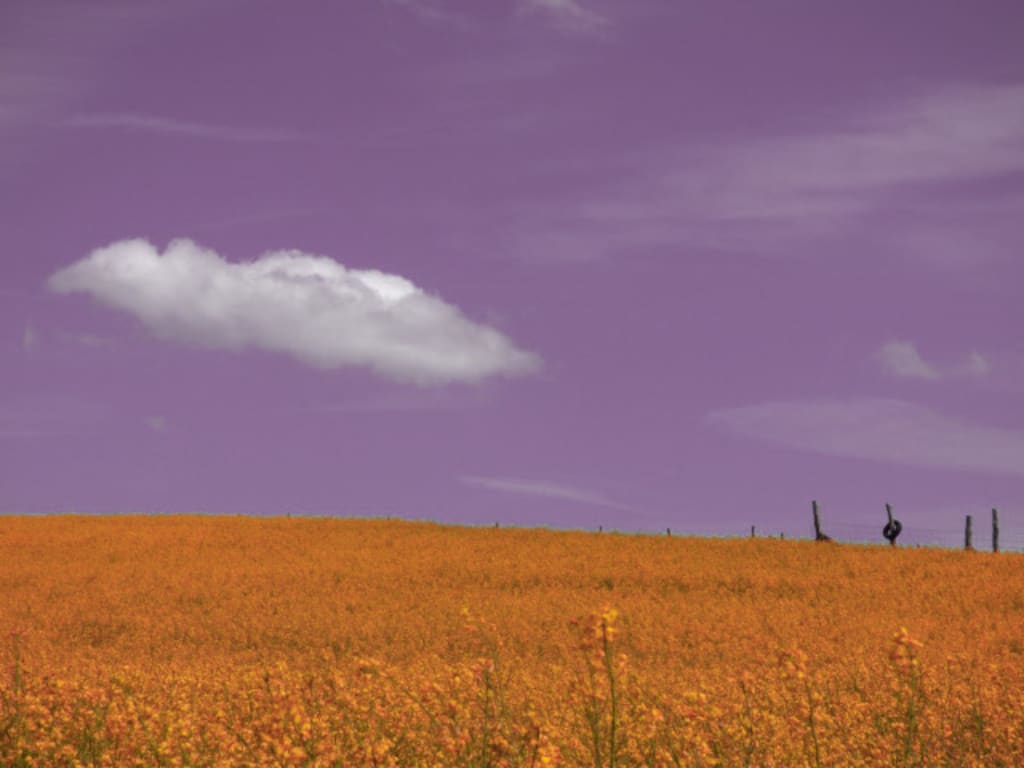
It was April 23rd, and David Aubergine was lost. He had been out walking for eight hours and was at his end, tired and on strange ground. In the distance, black rain clouds loomed, and against the starched gold of the close sun, the afternoon was hot and shallowly backed, the light a veneer over the coming storm. The wind was absent, and the air was heavy with dust, electric and humid. Rolling hills splayed out before him, dotted with forests and bushy undergrowth. Rusted barb-wire fences with leering posts lined the landscape, cutting through wild oats and grasses and the remains of curbs and old lightposts waited, strewn across the fields. Years ago someone had tried developing the land, but had run out of money and abandoned the project. He wondered if he wasn’t trespassing.
David walked in his work boots. They fit him well. His girlfriend had picked them out for him. They’d been together since high school, and now she was pregnant and had decided to keep the baby. He hadn’t known that was an option. She was the only girl he had ever had sex with and some part of him was worried there were important experiences in life he’d been kept out of. Other women, for instance. He couldn’t help but feel he’d been promised more.
The couple lived with her parents in her childhood bedroom. Yesterday, her father had finished building a white crib, placed it at the foot of their bed, and filled it with blankets and toys and diapers and all the other things a baby needs. David had found it when he’d gotten home yesterday afternoon. It had scared him. When the four had eaten dinner together, no one said a word about it.
Scattered across the rolling fields were patches of trees, full of bushes and leaves and streams. David preferred walking in these patches of semi-forest to walking in the fields. The air felt different, as if he’d stumbled into another world. The first hints of a breeze began to blow. He crossed to one a short distance away.
In the forest, he stopped walking for a second, put out the remainder of his cigarette against his steel toes, then slipped the butt into the coat of his work jacket. Littering made him anxious, since it left an unwelcome mark. It could cause a fire. He took a deep breath. The light through the trees was mottled, speckled and twisted in the overbearing sun, cut by the beginnings of encroaching storm clouds. There was no real reason for him to smoke, he hated it, but he needed it now, the sour taste in his mouth. The first time he had gone to buy cigarettes he had stuttered and blushed.
Using trees as guides, he stumbled along. The bark was rough. The air was humid and warm and licking his face it smelled fresh. It took forever to get through; it only took a moment, then he was out, the same as if he had never been in it. Before him waited a strange sight.
A white church stood at the top of a small fold. It had a steeple above the front door, and the siding of the building shone like snow in the hot April sun. Against the backdrop of the shadowed clouds, it felt flat, as if it were drawn by some hand only just disappeared.
Around the building, there were no paths, no driveways. The paint was in good condition, only slightly chipped in the highest wear areas. The building was not rotting. It was healthy, well-loved, and well-maintained, yet lost in the middle of rolling nowhere, old fields miles from anything else. He figured he might as well explore.
David wiped his hands against his jeans and pulled open the front doors. They were made of a heavy wood, painted in the same white as the rest of the building, trimmed with black and furnished with brass knobs worn bright. A rush of cool air escaped, silk against the sweat on his face, upper lip, around his neck. The interior was lit yellow by the sun, muted in the simple grey of the interior. David stepped inside. His boots echoed against the hardwood floor.
The church was bare and it’d been built in a small town Puritan style. Austere, simple, carved from granite. Cold. The building was empty aside from some rows of pews, a pulpit centered upfront, and a small wooden cross. There was nothing on the walls but fading paint. The silence had a sweetness to it, tangible like cloth, like you could drag it through your fingers.
David stepped to the front of the church, a few feet before the pulpit, looked up at the crucifix, then down at his boots. There was cigarette ash and dirt all along the toes, and in haste, he wiped them clean. He fixed his pants similarly, then his jacket, then his hair, then apologized for having to fix them at all, and for not doing it before he came in. Then he apologized for not apologizing sooner. A moment passed. He decided to sit down.
He thought it would be presumptuous to sit in the first row of pews. He was, perhaps, after all, trespassing. The church was cool and dim, awaiting the next gathering. It had been expecting silence. In either case, entering a church for the first time and commanding the first row was arrogant on a level he wasn’t comfortable with. David had never spent a single moment inside of a church before. It’d be obnoxious.
He walked to the middle row, slid along sideways, and stopped in a spot where he felt someone might pray. He’d seen people pray in movies before so he sat down on the pew, looked up at the cross, and folded his hands together and closed his eyes and realized he didn’t know how to pray. People who sat in the middle row should know how to pray, he figured. They form, after all, the core of the church, the spine of it all. David didn’t know a single prayer. His mother hadn’t believed it was worthwhile to visit church. She didn’t understand the purpose of priests or of churches or praying. ‘Life is playing what you’re dealt.’ She didn’t understand the point of begging for help. Confessing was egoism. It was demanding an ear to problems that matter only to you, trifles insignificant and paltry compared to the true suffering others went through. It was assuming you had the right to complain. He had agreed with her then and now felt guilty, so he stood up and stepped out of the row.
David then walked to the last row and slid in. It was shadowed back here, lost and left out, untouched by the sun’s rays. Through the back doors, the wind whistled. He folded his hands together and leaned forward, resting them against the back of the pew in front of him. He asked for help.
His girlfriend was at home, pregnant, without him. When he was at the house, he felt like he was dangling over a cliff, weightless, overlooking a silent waste of black tar. His chest would tighten, as if he were about to have a heart attack, as if his neck were anchored through his body and into the pit below, as if he were standing over nothing, watching confusion and boredom and death approach. Her parents disliked him and they rarely talked to him, never asked after him, never checked in with him. David’s mother did not like what he had chosen for himself, but she was proud he didn’t complain. ‘Life is suffering love.’ He hated his job but couldn’t leave it now. There was a baby on the way. He hated it there.
He wanted to fuck, deep down in his balls, in the space between his thighs and his dick, raw and wet and tense, other women. He wanted to fuck and tear and eat and spit and shit and cry and get blown by a hooker and get punched in the face and kicked in the ribs and drink to sick ignorance and be nothing. He wanted to be mud. It didn’t matter who he had sex with, so long as it wasn’t his girlfriend. Anyone else. To get away, to head in any direction, so long as it was south.
But David Aubergine would never cheat on his girlfriend. He could never. But sometimes he dreamt that if he did, life would be easier. If he was out having sex with other women, he could explain why he wasn’t at home. Inside another girl, there’d be peace, or something new, something exciting and sour and sweet like cloth. Maybe he was missing out. But the real wound was deeper. There was no reason for him not to be home right now. It was nice and easy and he would be set for a comfortable life with a loving wife. It was just that being there made him feel lost and scared and confused. He was floating in the guilt of ambivalence and cheating could chain him to a justification to feel like shit. Leaving wasn’t an option either. Then, he’d be abandoning a pregnant woman. He’d be worthless. But fucking other women, then, she could be comforted by hating him and he could get back at her for being good to him. He could leave, not flee. A cheater, not a child.
But he couldn’t and he never would. David didn’t think he was capable of actually fucking. He could occasionally have sex, but there was no raw urge in him. He felt like an overgrown child, playing at life, untested and unbroken, only pretending to have sex, pretending to be a man, pretending to be alive. His chest hurt.
David stood up and slid out of the pew and pushed through the doors into the day, into the sun, into the storm. The wind had picked up, the storm clouds had moved closer. He felt no rush.
He walked around the building. An old bench sat along the back wall, facing an endless bed of hills that was spotted with trees, with a golden sun breaking through the grasping fronts of the storm. It was well worn, with birchwood slats stained black, and green metal arms and legs.
David Aubergine sat down and looked out. Behind him, the white church. To his right, the path back home, warm and sunlit and sleeping, soft plains and rolling hills. To the left, wild oats and storm winds and cold air and black clouds and mottled forests.
Where was his father? He sat there, waiting.
About the Creator
Thomas Marston
Author and poet.
Keep reading
More stories from Thomas Marston and writers in Fiction and other communities.
Red Moon. Runner-Up in New Worlds Challenge.
“Nobody can hear a scream in the vacuum of space... or so they say,” the hologram echoed. The hue of the digi-board’s synthetic lights electrified the miner’s byway, silhouetting the rush-hour crowd. McParlane turned away from the advertisement and limped down the tunnel street.
By Thomas Marston3 years ago in Fiction
TUS NUA - ch 49
TUS NUA – ch 49 New Beginnings – Mia and Midnight (*)(*)(*) As Mia spoke on the phone to Ali’s sister, Ellen, Finola slipped quietly away and walked to the stream behind Tus Nua. Carefully, she put a block on her family so no one could know what she was about to do.
By Margaret Brennana day ago in Fiction



Comments
There are no comments for this story
Be the first to respond and start the conversation.