
A Cruel King:The King's Wrath
The Darkness Beneath the Crown "
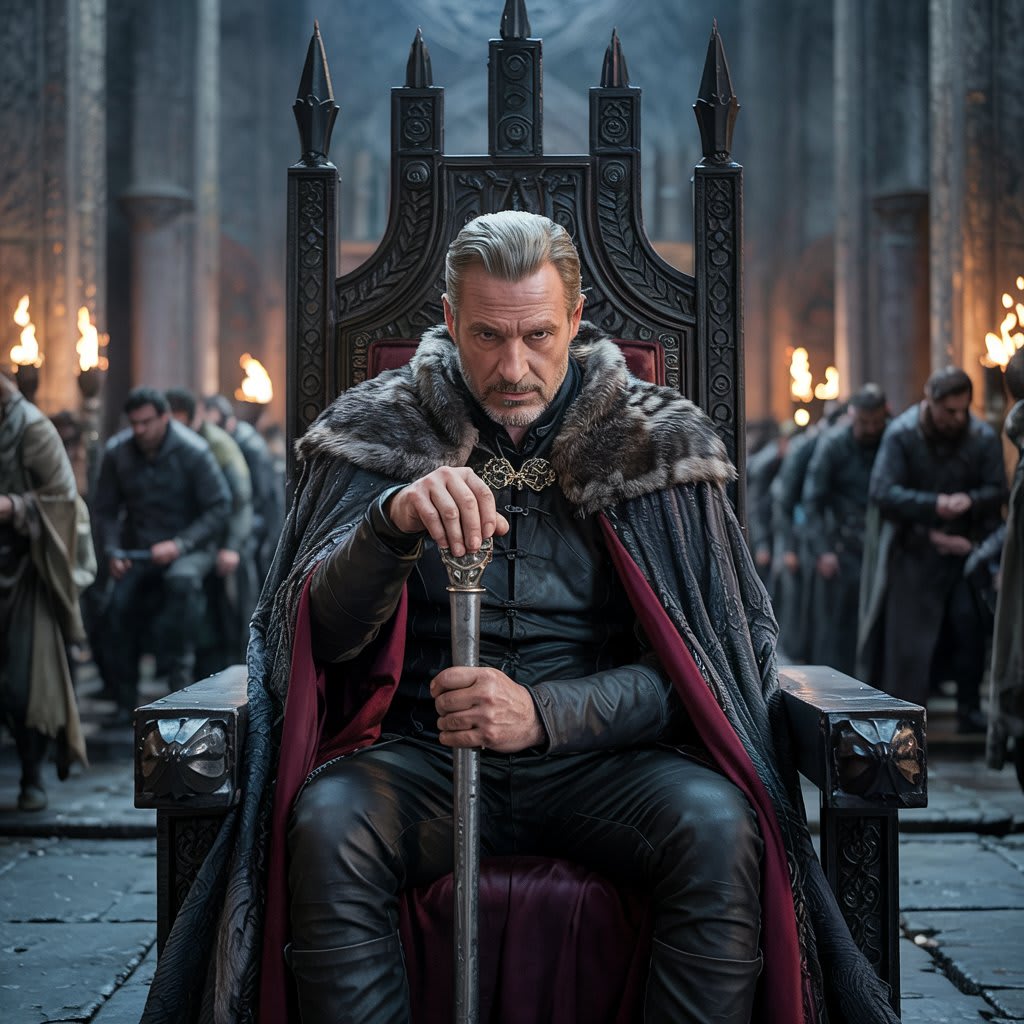
Once upon a time, in a land far to the east, there ruled a king whose heart was as cold as the winter winds that swept through his kingdom. His name was King Malak, and his reign was marked by fear, sorrow, and a relentless thirst for power. The people of the land spoke his name in hushed whispers, for none dared to defy him. He was a man of great stature, both in height and in influence, his dark eyes always glimmering with malice and ambition.
King Malak had inherited his throne from his father, King Darion, a ruler whose strength had been tempered by wisdom and compassion. Under King Darion's rule, the kingdom had flourished, its fields rich with harvest, its people content and peaceful. But that was before Malak came to power. As soon as his father passed, Malak’s cruelty began to show itself.
He had no interest in the welfare of his people. His only desire was to expand his kingdom, to build a legacy that would be feared and remembered for generations to come. But in his quest for power, he sacrificed the very souls he ruled over.
The first sign of his cruelty appeared soon after his coronation. The kingdom was home to many small villages, each with its own traditions, customs, and ways of life. King Malak, however, viewed these villages as nothing more than obstacles in his pursuit of grandeur. He sent his armies to raze the villages that lay on the borders of his kingdom, seeking to expand his realm into the untamed lands beyond.
Hundreds of families were displaced, their homes burned to the ground, and their livelihoods destroyed. The king showed no mercy, claiming that it was for the greater good of his kingdom. Those who resisted were tortured, and those who fled were hunted down. The cries of mothers searching for their children, the wails of fathers mourning the loss of their homes, echoed through the night, but the king’s heart remained unmoved.
As Malak’s thirst for control grew, so did his cruelty. He decreed that all the farmers of his land, who had once been free to work their fields as they saw fit, now had to give a large portion of their harvest to the royal treasury. Those who could not meet the king’s demands were imprisoned, and their families forced to work in the royal mines, digging for gold and silver. The king believed that wealth was the key to power, and he would stop at nothing to accumulate it.
There was no joy in the kingdom. The once vibrant streets were now empty, as people stayed locked behind closed doors, afraid of the king’s enforcers who patrolled the land with swords drawn. The markets, once bustling with trade, were now quiet, save for the occasional merchant who dared to sell his wares in fear of the king’s wrath. The people lived in constant dread, knowing that at any moment, they could be dragged away to the dungeons for the smallest of offenses.
But perhaps the most cruel act of King Malak’s reign was his treatment of his own family. He had no use for love, loyalty, or honor. He viewed people as tools to be used, discarded when no longer useful. His queen, Aeliana, was a kind and gentle woman, beloved by the people for her charitable works and her wisdom. But to Malak, she was little more than a trophy—an ornament to showcase his power.
In a fit of rage one evening, Malak accused Aeliana of betraying him. There was no evidence, no cause, only his paranoia. He threw her into the darkest cell of the castle, accusing her of treason and ordering that she be starved and beaten. The queen, once a beacon of hope for the people, withered away in that cell, her once radiant beauty faded to a shadow of what it had been.
Despite her suffering, Aeliana never lost her kindness. She would often speak of peace, of forgiveness, of the need to end the cruelty that had gripped the kingdom. Her words were a soft light in the darkness, a reminder of what could have been. But the king was deaf to her pleas, his heart hardened by ambition and pride.
The cruelty of King Malak extended even to his own children. His son, Prince Eldric, was a young man with a heart full of potential—a warrior at heart, but also a leader who cared for the welfare of his people. Eldric saw the suffering that his father’s rule had caused and secretly plotted to overthrow him. But when Malak discovered his son’s intentions, he reacted with fury.
He locked Eldric in a tower and forbade anyone from speaking to him. The prince, once full of hope and courage, became a mere shadow of himself, his spirit broken by the isolation and cruelty of his father’s rule. No one could visit him, no one could offer him comfort, for the king had ordered that no one speak of his son’s plight.
Years passed, and the kingdom continued to wither under King Malak’s reign. But as all tyrants eventually do, Malak’s downfall came. It came in the form of a rebellion, led not by warriors, but by the very people he had crushed beneath his heel. The peasants, the farmers, the common folk who had suffered for so long, rose up together. They were led by a woman—an unknown figure who had once been a simple servant in the royal palace, but who had grown disillusioned with the king’s cruelty.
With the support of the people, the woman and her followers stormed the castle, capturing the king and dragging him before the masses. The streets were filled with the roar of the crowd, the cries of those who had suffered for so long.
King Malak, once so powerful and feared, stood before the people—alone, broken, and terrified. He begged for mercy, his arrogance replaced by the stark realization that he was no longer invincible. But there was no mercy to be found. The people had suffered too much, and they would no longer allow his cruelty to continue.
In the end, King Malak was dethroned and cast out of his own kingdom. The people rebuilt their lives, and under new leadership, the kingdom flourished once more. The memory of Malak’s reign became a dark chapter in the kingdom’s history, a lesson in the dangers of unchecked power and the cruelty of rulers who forget that the people are the true foundation of any kingdom.
And so, King Malak’s name became a warning to all who would seek to rule with cruelty—an echo of a tyrant who fell because he had forgotten the one thing that mattered most: the hearts of the people.
About the Creator
Keep reading
More stories from writers in Fiction and other communities.
The Duelist
The rays of a dying red sun flashed against the onrushing blade. The grey beards say the key to dueling lies in size, speed, reach, righteous fury, whatever the person in front of them pays them to say. Matteo knew better than any it was none of these and had an undefeated record on these sands to prove it.
By Matthew J. Fromm7 days ago in Fiction
The Sheriff
"Move aside. I say, move aside!" My deputy barks at the crowd. "It's the sheriff," people whisper. "Move, make way." I usually hate when people whisper like this - like I'm dangerous, like I'm going to harm anyone for standing in the wrong place at the wrong time.
By Noelle Spaulding 5 days ago in Fiction
Time to change your life.
Is it even possible for you to change your life? A lot of people, more than there should be, are unhappy with their lives. But what are they doing about it? Usually nothing. People talk about how shitty their lives are and want change, but are they not taking the actions to change?
By Jen Phillipsa day ago in Humans
Not Just For Clean Up: A History Of The MCU's Department of Damage Control
Initially an organisation that seemed to exist to help the heroes of the Marvel Cinematic Universe, from Phase Four onwards, the Department of Damage Control has shifted into a more antagonistic role. Most recently seen in the Wonder Man series, the current incarnation of Damage Control seems to target superpowered individuals, regardless of whether that person poses an active or intentional threat.
By Kristy Andersonabout 10 hours ago in Geeks


Comments
There are no comments for this story
Be the first to respond and start the conversation.