

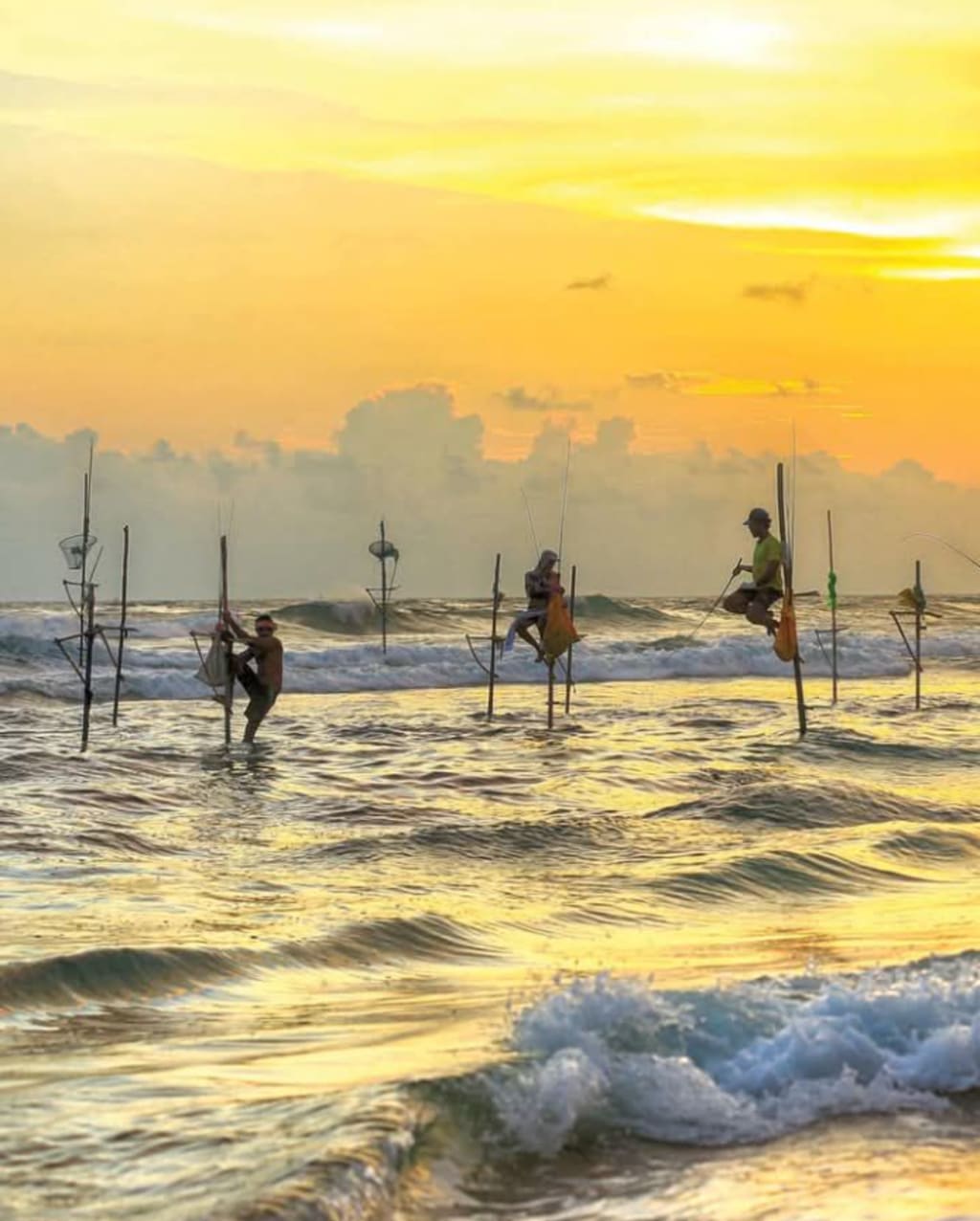
This photo is related to the fishing industry on the southern coast of the world
This has been etched in my mind since I can remember. I still remember that beautiful past when I go to that area.
I lived in Ahangama until I was ten years old. When school was over and I came home and had lunch, I would run to find my son's net. Jumping in someone's yard.
Playing hangi muttam (a game of hide and seek). When there were mango, guava, bakmi, cashew nuts, etc., it was our custom to stay among those trees. We also went to the beach occasionally to play. Collecting colorful shells was one of our games. When someone pulled up a net, we would participate in saving the fish from the net.
The children who participated would get a share of the fish.
I did not take them because my mother would scold me.
The other children took them home.
Sometimes, we would get money from home to bring fish, but then we would not have a net. If we wanted to fish, we would buy fish from our uncles who had fishing gear. Anyway, we could get a lot of fish for twenty-five cents, which we could tie up in a net and take home.
Sometimes, we would join hands with someone who was fishing and pull a big fish ashore. Even if we didn't catch any fish from the seashore, when the curfew fell, the fishmongers would come right to our houses shouting, "Malo, malo!" The fish was so cheap because there was no way to preserve it. My father had told me that they would wrap the fish in a piece of paper to match the price they asked for.
They didn't have scales. They even gave us fish and shrimp on a whim. An average fish cost about a rupee. There were only two government employees in the Apegam area, and they were teachers. Carpenters, bricklayers, and drivers. And the shop assistants also made a living by doing some kind of hired work, so theft, hooliganism or bad habits were rare in the village. The women did not work at all. They worked at home, grinding rice and onions, weaving cloth, sewing clothes, etc. Our father also started the coconut oil business with his grandfather.
After the coconut oil mill was started, he had to give up the use of the coconut oil mill because it was losing money. After that, my father did business in various provinces. He ran a bookstore near Ginigathhena and closed it after losing money. There was a rubber seal in our house that said Ranasinghe Stores Mahadeniya Ginigathhena. Two boxes of books that were left from the bookstore were brought.
Later, my father handed them over to the elder monk of the temple. I became addicted to reading books because of those books. When I was in the third grade, I read Ramayana by Vanasarana and W. A. Dasilva. I even read Piyadasa Sirisena's books, surprising my teachers. The teachers said that I had knowledge beyond my years. My mother had passed the senior secondary school examination at that time, but her parents opposed it, so she did not get a job. At that time, it was a rare sight for women to work. My father was also an eighth-grader.
I was able to listen to stories of legends and Jatakas from Asma, and stories about kings, warriors and national heroes from my father. Both of them liked poetry. When I was in the third and fourth grades, I had memorized most of the poems in books such as Loweda Magazine, Subhasithaya, Sirith Mal Dama Vadan, and Kavi Potha. I memorized poems without any effort. When the venerable Vajiranana Thero passed away, Madihe Pannaseeha Thero took over as the chief monk. Small advertisements with his photo and a poem were everywhere. I quickly memorized the poem in Doheruni. May the light of the Vajira Aram rise from the sky and illuminate the whole world.
May the Amarapura Maha Nika Ambarata Madihe Thero be full of blessings. May the Vajira Nena Thero erase the loss and belong to that place. May the Pawara Panasiha Mahanayake Thero win for a long time. In the same way, after the death of D.S. Senanayake, an advertisement with three poems was spread everywhere along with the photo of Mr. Dudley Senanayake, who became the Prime Minister. Two of its poems are still memorized by me. Poor hut to the palace. To the forest of Mahagana, which was once loved. To the eldest son of the Sinhalese Prime Minister. The nation where I was born is my country. A great king who did not wear the crown of Wejambuna. The father who had a chest that rested on the Sinhalese chest. On the day he died, my motherland was left to his son. Do you remember my son from your eyes? Tears flowed
These were distributed by a school teacher named Amarius Silva, who was also a poet and a viridu singer on the radio. His son Upali Am de Silva, who was in my class, also sometimes helped with viridu singing.
If anyone reading this knows him, who is about 100 years old and is still alive, please let me know.
About the Creator
Keep reading
More stories from Rohitha Lanka and writers in Fiction and other communities.
Miss Persephone's Manual to a Seemingly Ordinary Life
Miss Persephone was found at the dining table, her blue eyes swollen, her tears arriving and retreating like the tides of the ocean. Earlier that day, her family had visited her in the retirement home where she had lived for eight years. It was her eightieth birthday.
By Imola Tótha day ago in Fiction
Center Stage with Paul Stewart
*** I'm keen to republish the interviews I did for my series with Vocal creators. It's been a few years and I thought it might be nice to revisit these wonderful conversations. I'll be releasing them one at a time for a few weeks/months.
By Heather Hublera day ago in Interview



Comments (2)
Very good work 👏
Nice work