
A Charm of Finches
Survival in the Galapagos Islands


You can’t comprehend isolation until you’ve lived on an island in the middle of nowhere. In the beginning, I don’t think I understood the reality of it. A naïve American ornithologist who fell in love with the idea of this brilliant, tropical place and had forgotten the fact that The Galapagos are harsh and unforgiving to those who are not fit to survive. Shortly after my arrival to Santa Cruz, I was introduced by a local friend to one of the town elders, another American who told me about how he came when he was twenty, how unbelievably tough it was working in a village where there were slim pickings in terms of a menu, no doctors, no plumbers, and little communication with the outside world. He told me how they partied whenever they could, that made me smile. He also told me that even the best survivalists could die and disappear out in the wilderness. I kind of shrugged and promised I wouldn’t go out there.
A year passed. Everything was great. I’d come for a job at the Charles Darwin Research Station and not too long afterwards met my girlfriend Sasha, a local artist and jeweler. Her kind are particularly eccentric, but combine that with an island environment and you have a whole new breed. I’ve never met anyone quite like her, and I love her, and it was the hardest thing ever when I had to leave her for a scientific trip up to Isabela Island. Sasha, the weirdo, rather than snap a Polaroid of us decided to ask for a short lock of my hair so she could loop it inside a locket she’d made. It was a heart, and it was anatomically correct. I obliged her and snipped off a bit of hair, handed it in front of her smiling face.
“I’m dying to see that smile again,” I told Ingrid, who’d become one of my best friends on this journey to rescue the mangrove finch from extinction. We spent four months in Isabela, miles away from the only town, with no Internet and no radio. It was truly isolating. We partied whenever we could. Last night we held a farewell bash to the island, and early this morning we all happily jumped onto our boat to report back to the Station. Ingrid took my hand when I helped her inside. “Thank you. Yeah, I’m looking forward to meeting her. I’ve seen some of her murals around Puerto Ayora but I don’t think I’ve ever run into Sasha.”
“Two peas in a pod. She’s weird like you,” I tousled my shorter friend’s hair. “You’ll love her.”
She slapped my arm away. “Can’t imagine that she misses you very much.”
“Shush.”
“You know, it’s a little crazy but I’m kind of gonna miss this place.”
“After four months of bunking with all you jerks? I’m out of here.”
“Yeah, but you can’t deny how beautiful it is up here. There’s no light pollution, we got to see stars almost every night, I fell asleep to the sound of rolling waves. It’s charming.” She leaned over the side of the boat and grinned. “You know how they call ’em a murder of crows, a gaggle of geese?”
“Yeah?”
She nodded over at a flock of little round birds on the sesuvium. “A charm of finches.”
“Oh, I’m telling Sasha that when I get home. She’ll love that.”
We all cheered when we approached Santa Cruz but the relief to see our home was met with feelings of uncertainty after finally reaching someone at the Station over the radio. The frantic voice on the other end did not seem to belong to Jefferson Torres, who I’d always known as rather stiff and borderline bureaucratic. He gave no explanations, just told us to meet him at the Station’s dock quickly. When we got there, he was alone, wearing a mask, and armed with a goat-hunting rifle.
“Jeff, what’s the deal? Why do you have a gun?”
“Hi, everyone. Um… sorry, I just can’t believe this is happening now. We’d forgotten about you.”
“Forgot--what do you mean forgot? What’s going on?”
“Get in the Jeep, I’ll explain on the way.”
Instead of turning the car around to go to the Station, Jefferson headed down the road towards Puerto Ayora. When one of my colleagues asked where all the tourists who usually came to the beach were, Jefferson sighed and told us that about a week after we left, a novel disease had started infecting people around the globe. They named it the Gaiavirus and only a month passed before the world went crazy. Nobody could band together. Economies fell apart. Lives were extinguished and there are still people dying. Apparently there isn’t a person left in town who hasn’t lose a friend, family member, or even coworker to the virus. Ingrid threw up over the side of the Jeep and mumbled something in her native Dutch, then switched to Spanish and said she needed a phone.
Jefferson shook his head. “No phones, no Internet. That’s all gone. The Ecuadorian government sent a cargo ship with enough food and supplies for half a year, but we can’t be sure that there is a government anymore. Not that there really ever was, but--”
“Jeff, I need you to tell me what’s happening very simply, because I’m freaking out.”
He thought quickly and responded, “Have you read any George Orwell? We might be in one of his books now.”
But in no way did Nineteen Eighty-Four prepare me for what I saw when we got into town, because our dystopia was way different from most depictions in stories: a cyberpunk landscape, first of all. At first it seemed like the town had barely changed, but as we drove further down the main drag we realized that many buildings had been vandalized. The fish market was abandoned save for a few piles of sunbathing iguanas. After passing the market, we noticed the smell. It wasn’t open sewer, it was worse. And when we got to the docks, there were truckloads of bags being moved onto probably every boat in the harbor. Every person running around was wearing a mask. The first people I recognized were the Rosales family from my girlfriend’s neighborhood. They got out of a pickup truck sobbing and carried a bag from the back over to the docks. When I noticed that the family’s father was missing, I realized what was in the bags.
Ingrid followed me shortly after jumping out of the car and running after Mrs. Rosales, who initially didn’t know who I was but then she said “It’s young Sammy,” and her eyes widened. “When did you get back? Where’s your mask?”
“About ten minutes ago. I don’t have a--we all just found out--is Sasha home? Do you know where she is?”
“Son, I don’t know. Nobody who’s healthy lives in town anymore. They’ve got the rest of us building camps up in the highland wilds. We’re like creatures now.”
“Sam! Sam!”
That was the voice of Eva, one of Sasha’s friends. I turned and left the Rosales to their mourning. Eva and her cousin Valery opened their arms for a hug but quickly threw them down and backed away.
“I’m not sick,” I said.
“Well yeah, but we don’t know where we’re at. Did you just return from Isabela?”
“Yes Eva, now please tell me where Sasha is. Where is she?”
Valery took a deep breath and held onto Eva, who was shaking uncontrollably. Only then did I see that they were standing near a bag. I can’t remember now if I had any thoughts in my head when I got on my knees and tore the bag open. I remember hearing Eva scream and Valery leading her away, but I can’t remember what I thought when I saw Sasha. She was no longer moving. The person who taught me to dance and dream was completely motionless and I couldn’t handle it. Next thing I knew, Ingrid was rocking me back and forth on the ground.
I looked again at Sasha’s body and saw it wrapped around her neck, that locket. I remembered the sound of my girlfriend’s beating heart and lamented over never hearing it again.
“Is that the locket you told me about?” Ingrid finally said.
“Yeah.”
“It’s prettier than you described.”
“It’s got my hair inside it.”
“Oh?”
I reached in and gently opened the locket to show her, blinking when I saw the contents. A wisp of dark brown hair. I have always been blond.
Eva was too distraught to answer my questions and Valery had no answers anyway but she instructed me to go up to the farming village of Bellavista, where someone could take us to one of the camps in the forest. I was irrationally bent on staying with Sasha, but a guy resembling a mandrill with a gun finally noticed that Ingrid and I were unmasked. He barked at us in quick Spanish and we were ushered onto a bus with the rest of our colleagues. Ingrid held my hand in silence the whole way up to Bellavista, now a ghost town. It only serves as a checkpoint between the port and the new settlement, called Indefatigable. The trek through the woods after getting out of the bus took half an hour.
I remembered the old American I met last year and what he told me about surviving in even the most remote places. But that the Galapagos wilderness was harsh. As soon as I stepped into Indefatigable, I witnessed survival of the fittest. Even though they’re all terrified, there’s a thriving little community up here. Sometimes I don’t understand how humans just keep on going.
Jefferson was still with us, and he made sure we all knew where to go if we wanted to reunite with friends and family, if there were any left. Ingrid, having left everyone important to her back in the Netherlands, followed me. Asking around finally led me to Bruce Wright, a childhood friend who’d grown up to be a carpenter and moved out here several years before I did. Bruce exclaimed in relief when he saw me and didn’t let go when we hugged, because that’s when I cried.
“Sasha’s dead.”
“I know.”
“When did it happen?”
“Last night. Sam, I’m sorry. I couldn’t do anything.”
“You took care of her?”
“Yeah, while you were gone, I--”
“Explain something to me,” I said fiddling through my pockets and staring at my friend’s dark hair. I took out the locket and opened it. “Sasha made me cut off a bit of my hair so she could keep it here. Now, I don’t think I ever went through a Goth phase before I left, did I?”
“Oh Sam…” he drawled out, looking at the locket. “Come with me.”
He walked away. I looked at Ingrid with confusion. She shrugged and walked after Bruce, introducing herself to my friend. A couple paces behind them, I couldn’t believe I thought my best friend and my girlfriend were having an affair. It was impossible. There had to be something else going on.
We got to a cabin. It was the nicest one among many yurts. “It’s almost finished. C’mon inside.”
I immediately saw our friend Magdalena, her infant son Richard, and a newborn baby in Maggie’s arms, heartily breastfeeding.
“He’s a couple weeks old,” said Bruce. “Sasha never named him. She wanted you to decide.”
“What?”
“Sam, this is your son. It’s okay, she didn’t know she was pregnant either until after you left.”
I looked at the boy. He was a newborn but had so much dark hair, just like Sasha. He even looked just like her and when he opened his eyes I saw myself in him.
“He’s beautiful,” Ingrid laughed.
I’m still in shock. But I realized then that we must carry on regardless. We are human, after all.
About the Creator
Jay Sterling
I grew up in the Galapagos Islands, but now I'm in southern California. Sometimes I write.
Keep reading
More stories from writers in Fiction and other communities.
🅼🅸🅳🅽🅸🅶🅷🆃 🆂🅽🅰🅲🅺🆂
"It's 10 in Tuscon! We all know what that means... It's Time for Midnight Snacks with your man, Gerald Gee! Ready to spend the night together? Me too! I'm full of snacks and can't wait to regurgitate them all back into your hungry ears. Crack a brew! Pop some corn! Anything to get ready for one hell of a show where the talk maybe cheap but the words cut deep...
By Lamar Wiggins7 days ago in Fiction
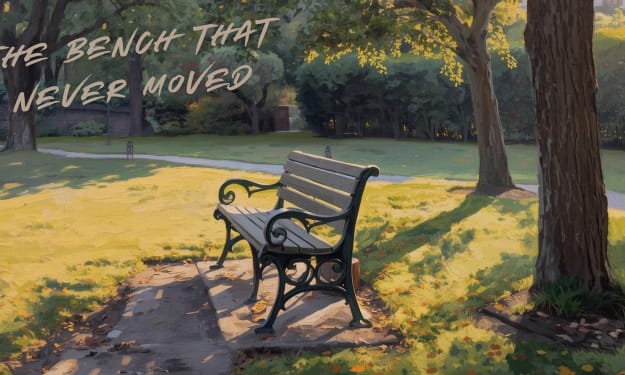
The Bench That Never Moved
The bench had been there longer than anyone could remember. It sat beneath a wide banyan tree at the edge of the park, its wooden slats worn smooth by decades of waiting. Paint peeled from its iron legs, and one corner leaned slightly, as if tired but unwilling to fall. People passed it every day, yet few stopped long enough to notice it.
By ORM_Specialist5 days ago in Fiction



Comments
There are no comments for this story
Be the first to respond and start the conversation.