
A Believer Among the Faithless
A Clash of Beliefs: Faith vs. Logic

As soon as I entered the room, I saw Sajid hunched over in front of the computer, typing away at something. I poured myself some water from the jug, feeling intensely thirsty, like my chest was about to burst from the dryness. Sajid turned away from the computer, looked at me, and asked, "What's up? Anything happen?"
In a disappointed voice, I replied, "No."
"So, you’ll have to take a one-year drop?" Sajid asked.
I said, "What else can I do? Whatever Allah does, He does for the best."
Sajid said, "That's your problem, you know? You're seeing that you're getting a one-year drop because of poor attendance, and still, you're saying 'Whatever Allah does, He does for the best.' Bro, where exactly do you see the good in this?"
A bit of background on Sajid is necessary. Sajid and I are roommates. He’s studying microbiology at Dhaka University. He used to be very religious in his early life, praying regularly and all. But somehow, after coming to university, he turned agnostic and gradually lost his belief in a creator. Now, he's a full-blown atheist, viewing religion as trash. According to him, religion is a man-made concept, and the idea of 'God' is a construct created by some self-serving group.
I had no intention of arguing with him at this moment, but I couldn’t just ignore him either.
I said, "It could’ve been worse for me, right?"
"Is there anything worse left?" he replied sarcastically.
"Maybe," I responded.
"Like what?"
"For example, let’s say I didn’t study at all the entire year and failed the exams. If I failed, I’d still have lost a year. Maybe the shame of failing would have been unbearable for me, and I’d have ended up committing suicide."
Sajid burst out laughing, "What a bizarre belief system you live by, man!"
He laughed again, this time mockingly.
That night, we had another round of arguments.
He asked, "Okay, so you believe in a creator, but on what basis?"
I replied, "There are two types of belief. One is based on evidence, which you could call conditional belief. The other is belief without evidence."
Sajid smirked and said, "The second one, bro, is called blind faith in simple Bengali."
I didn’t pay attention to his mocking and continued, "Belief based on evidence isn’t really belief. Even if it is, it’s very temporary. It’s so fragile that it changes frequently."
Sajid sat up straight, intrigued. "Like how?" he asked.
I said, "Take, for example, the human curiosity about the sun and the Earth. Since ancient times, we’ve wanted to know the truth about them, right?"
"Hmm, yeah," Sajid nodded.
"Science has tried its best to satisfy our curiosity, right?"
"Yeah, true."
"We were united in our quest for the truth about the sun and Earth. So, over time, scientists presented us with various theories. The first person to offer a theory about the sun and Earth was the Greek astronomer Ptolemy. You know what he said, right?"
"Yeah," Sajid said. "He said the sun revolves around the Earth."
"Exactly. But does science still stick to Ptolemy’s theory today? No. But do you know that Ptolemy’s theory was accepted for 250 years? Can you imagine? For 250 years, people—great scientists, doctors, engineers—believed that the sun revolved around the Earth. Many of those who died during that time died believing the sun revolved around the Earth."
Sajid lit a cigarette, exhaling smoke, and said, "So what? They didn’t have telescopes back then, so they gave a wrong theory. Later, Nicolaus Copernicus came along and disproved Ptolemy’s theory, right?"
"Yeah, but Copernicus also made a huge mistake."
Sajid asked, "Like what?"
"Strange, you should know this. Even though Copernicus proved that the Earth revolves around the sun, he made one big error. And that error persisted in the scientific community for another 50 years."
"What mistake?"
"He said the Earth revolves around the sun, but the sun doesn’t move. The sun is stationary. But today’s science says, ‘No, the sun isn’t stationary; it’s constantly rotating in its orbit.’"
Sajid said, "Yeah, you’re right. But that’s how science works—it’s always evolving. There’s no finality in science."
"Exactly. There’s no final or absolute truth in science. Some theories last for two seconds, while others last for 200 years. So, we can’t really call something we believe in based on evidence 'belief.' At best, it’s like a contract. The contract goes like this: ‘We’ll believe in you until something more authentic comes along.’"
Sajid seemed to agree somewhat, shifting in his seat.
I continued, "The concept of God or religion is the opposite of this. Look, this is why there’s such a profound difference between belief and disbelief. That’s why, at the very beginning of the Quran, it says, ‘This is a book for those who believe’ (Surah Baqarah, 2:02)."
"If science had finality, maybe the holy books would have started by saying, ‘This is for those who are scientific-minded.’ But science is ever-changing; even science doesn’t fully trust itself, so how can we trust it completely?"
Sajid said, "But how can we believe in something we can’t see, something we have no proof of?"
"There’s a lot of evidence for the existence of a creator, but science can’t fully provide it. That’s a limitation of science, not of the creator. There are many things science can’t answer. If I started listing them, it’d be a long list."
Sajid replied angrily, "Are you messing with me?"
I laughed and said, "Okay, listen. Isn’t your girlfriend’s name Mitu?"
"Why are you bringing up my girlfriend now?" Sajid asked, annoyed.
"Just answer the question."
"Yeah."
"Alright, don’t take offense. Just an example. Suppose I raped Mitu, and she’s lying on her bed, bloodied. Let’s say you found out somehow."
"Hmm," Sajid replied.
"Now, explain to me using science why I should be punished for raping Mitu?"
Sajid said, "That’s a critical question. How can I explain that using science?"
I laughed, "I told you before, there are many things science can’t explain."
"But what does this have to do with belief in a creator?"
"It’s related. The belief in a creator is also something we humans can’t prove with our sensory evidence. The creator can’t be seen through a telescope or found through a microscope. You just have to 'believe.'"
Sajid twisted in his seat, saying, "Nonsense! You’re telling me to believe in something I can’t see?"
I said, "Yes. There’s no such thing as a complete non-believer. Everyone believes in something they haven’t seen or will never see. They just don’t question it. You’re the same."
Sajid said, "Me? Are you crazy? I don’t believe in anything I can’t see."
"You do, and you’ve never questioned it. If we hadn’t had this discussion today, maybe you never would have."
He stared at me.
"Do you want to know?" I asked.
"Hmm," he replied.
"Again, don’t take offense. This is just for the sake of argument."
"Go on."
"Alright, did you see your parents’ union that led to your birth? Or do you have any evidence right now? It’s possible that your mother had relations with someone other than your father before you were born, and you’re actually the result of that. You didn’t see it happen. But have you ever questioned your mother about it? You haven’t. Since childhood, you’ve been calling the man you see as your father, 'Dad.' The same with your brother and sister. Without seeing, you believe in all of this. Have you ever asked if the man you call 'Dad' is actually your biological father? You haven’t. You’ve always believed it, and you still do. That’s how belief in a creator works, too. It can’t be questioned or doubted. It must be embraced deep within the heart. That’s what belief is."
Sajid got up and left the room. I thought maybe my words had hurt him.
The next morning, as I went to make ablution for Fajr prayer, I noticed Sajid standing beside me. I looked at his face, and he understood the question in my eyes. He said, "I got up to pray."
Continue.........
About the Creator
The Lion and the Red Friend
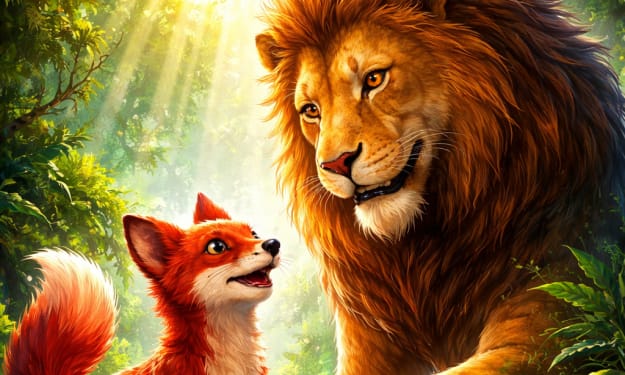
In a deep, dark, and intimidating jungle, there lived a little red animal named Rafi. The jungle was filled with fear and danger, where every creature had its own territory, and survival was a constant struggle. Rafi, being a small and vibrant animal, was different from the others. He often wondered why he had to live in such a scary place, where everything seemed out of his control. The other animals had their own spaces, and Rafi felt isolated. He often wished for a change but didn’t know how to find it. Rafi lived his days trying to keep his distance from the other creatures. He was wary of them and didn’t know how to make friends. One day, Rafi decided to change his life. He didn’t want to keep hiding or living in fear. He thought that perhaps if he ventured deeper into the jungle, he could learn something new and make his life more meaningful. He heard whispers among the other animals about a powerful lion named Shere Khan who ruled the jungle. He was feared by all, but also respected. Rafi thought to himself that if he could understand Shere Khan, he might be able to change his life. He might learn something valuable from the great lion. So, one evening, he gathered all his courage and set out to find the mighty Shere Khan. As night fell and the jungle grew quiet, Rafi moved silently through the underbrush, determined to meet the lion. After walking for some time, Rafi finally saw Shere Khan in the distance. The lion’s presence was commanding, his golden mane shining in the moonlight. Rafi’s heart pounded in his chest as he watched the lion move through the jungle, his powerful body cutting through the trees. Despite his fear, Rafi followed him. He didn’t know why, but he felt an urge to learn more about the lion, to see what made him so powerful. Rafi continued to watch as Shere Khan walked deeper into the jungle. To Rafi’s surprise, the lion wasn’t hunting or chasing other animals. Instead, Shere Khan seemed to be walking aimlessly, lost in thought. Rafi couldn’t understand it. The great lion, who was feared by all, was not acting like the predator everyone had made him out to be. Suddenly, Shere Khan turned around and spotted Rafi. His sharp eyes glared at the little red animal. Rafi froze, his heart racing. He knew this could be the end of him. But instead of attacking, Shere Khan simply stared at him for a moment. Rafi, trying to control his fear, spoke up, "Shere Khan, I don’t want to fight. I just want to understand you. I want to learn how you survive in this jungle and why you seem so different from the other animals." At first, Shere Khan was silent. Then, with a low growl, he responded, "You are bold, little one. You dare to speak to me? What could you possibly learn from a lion like me? The jungle is not a place for weak creatures." Rafi, trembling but determined, replied, "I want to understand. I don’t want to be afraid anymore. I want to know how you manage in a jungle where danger lurks at every turn. Please, teach me." Shere Khan studied Rafi for a moment, his expression softening slightly. "You are not like the others. I can see that. If you truly want to understand, you must know this: the jungle is not just about power and strength. It is about survival, understanding, and sometimes, even friendship. You cannot conquer it alone. You need allies, and you need to learn how to give and take." Rafi, amazed by the lion's words, felt a shift within himself. He had always thought that survival was about being stronger than the others, about being the best hunter. But Shere Khan was telling him something entirely different. It wasn’t just about strength—it was about connection, understanding, and trust. "I want to learn," Rafi said earnestly. "I want to know how to be strong in my own way." Shere Khan nodded, and with that, the two of them began to walk together through the jungle. Over the next few weeks, Rafi learned many things from the lion. He learned that strength wasn't just about being physically powerful. It was also about knowing when to act and when to wait, about knowing when to help others and when to trust them. Rafi also learned the importance of friendship and how allies could help each other in times of need. Together, Rafi and Shere Khan became an unlikely pair, with Rafi offering the lion a fresh perspective on the jungle and Shere Khan teaching Rafi how to navigate the complexities of jungle life. Over time, they formed a bond built on mutual respect and understanding. They learned that in a jungle filled with dangers, it wasn’t enough to be strong alone. It was far more important to have allies, to have trust, and to share in the experience of survival. And so, Rafi and Shere Khan remained friends, each stronger for having the other by their side. Through their friendship, Rafi learned that the true strength in the jungle came not from brute force, but from the bonds one built with others, and from the wisdom one gained along the way.
By Abbas Story's 8 days ago in Fiction



Comments
There are no comments for this story
Be the first to respond and start the conversation.