
A 13-Year-Old Just Recreated Archimedes' Legendary Death Ray — and Proved It Worked
Young Inventor Uses Mirrors and Sunlight to Test a 2,000-Year-Old Myth

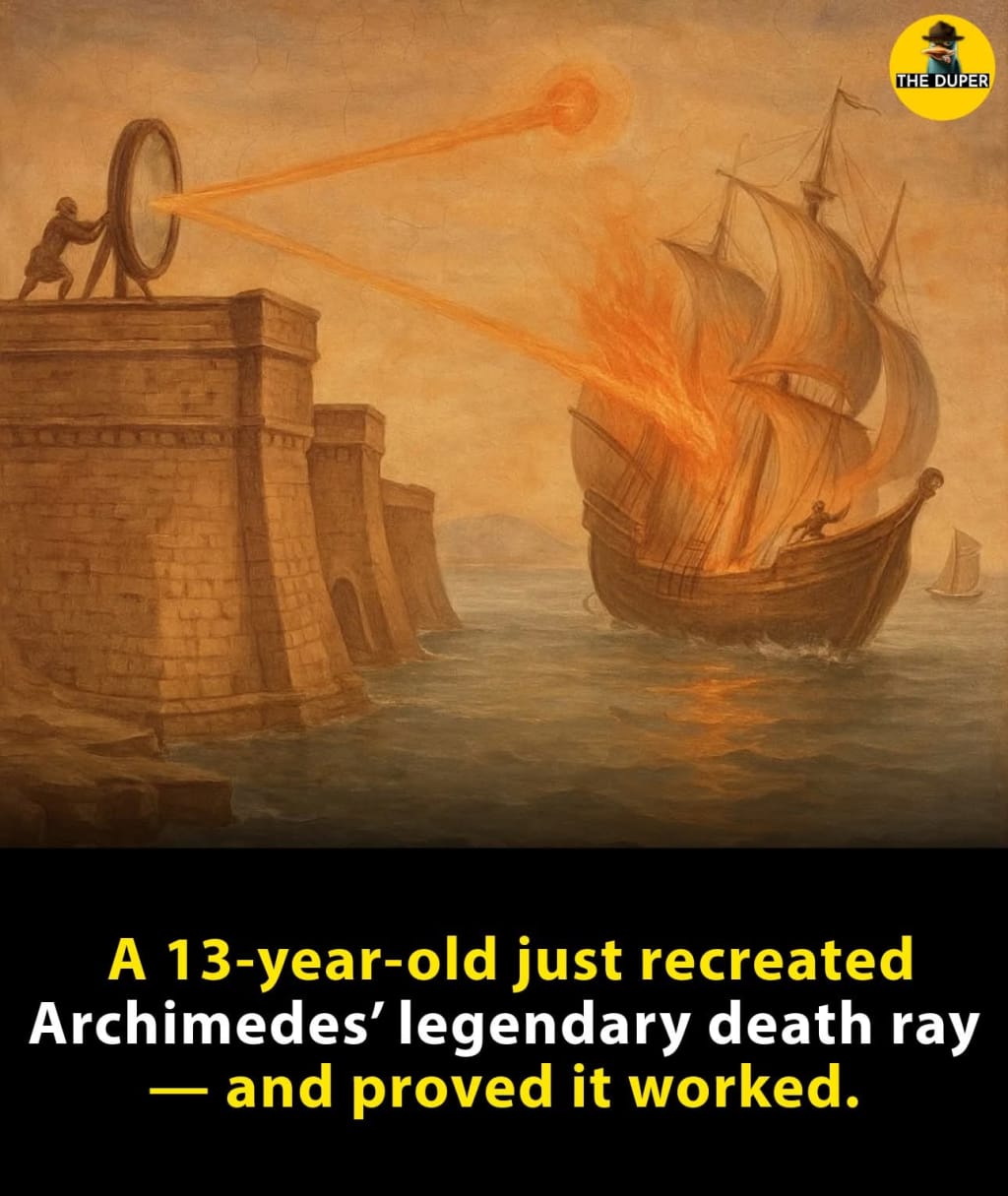
For over two millennia, one of history’s most fascinating legends has puzzled scientists and historians alike: did the ancient Greek mathematician Archimedes really build a “death ray” to set enemy ships on fire using only sunlight and mirrors? Skeptics have long dismissed the story as nothing more than a myth. But now, a 13-year-old student has reignited the debate — quite literally — by recreating the ancient weapon and proving that it can, in fact, work.
A Timeless Mystery
The story goes back to around 212 BCE during the Roman siege of Syracuse. Archimedes, the brilliant mathematician and inventor, was said to have used mirrors to reflect and concentrate the sun’s rays onto the wooden ships of the Roman navy. According to ancient accounts, the intense heat from the focused sunlight set the enemy ships ablaze, defending the city from attack. Over time, the story has been repeated in books, documentaries, and even television shows like MythBusters, which famously failed to replicate the effect under controlled conditions.
Because of the difficulty in recreating the death ray and the lack of solid archaeological evidence, many modern experts dismissed the tale as a legend. That is, until a young mind approached it with curiosity, creativity, and a bit of sunlight.
The Young Genius Behind the Ray
Enter Max Hammond, a 13-year-old student from Portland, Oregon, with a passion for science, history, and hands-on experiments. Max had always been fascinated by ancient inventions, and the Archimedes death ray topped his list. After reading about past failed attempts by adults, Max wondered: what if the previous experiments didn’t quite get it right?
Over several months, Max researched optics, mirror angles, and solar intensity. He read ancient texts, watched documentaries, and scoured the internet for any mention of Archimedes’ invention. Then, he set out to build his own version of the legendary device — using modern household materials like small square mirrors, a wooden frame, and some basic tools.
Building the Death Ray
Max’s setup was surprisingly simple, yet ingenious. He arranged 50 small mirrors in a curved pattern, all pointed at a single spot about 15 feet away. The target? A model wooden ship he had built himself, about three feet long and covered in pine tar — a flammable substance that would have been common on ships in ancient times.
On a sunny afternoon, Max aligned his mirrors and aimed them at the model ship. As the mirrors reflected the sunlight to a single point on the hull, the temperature at that spot began to rise. Within minutes, smoke began to curl from the wood, and shortly after, a small flame appeared. The experiment was a success — Max had managed to recreate the legendary death ray using nothing more than mirrors and the power of the sun.
Why It Worked This Time
So why did Max succeed where others had failed? According to Max, the key was patience, precision, and scale. Many past experiments tried to use hundreds of mirrors or relied on large, flat reflectors that were hard to align. Max’s smaller mirror setup allowed for more accurate focus, and his handmade ship model, treated with flammable substances, closely mimicked ancient Roman ships.
“It’s all about focus,” Max explained in a local interview. “You don’t need hundreds of mirrors. You just need to make sure every one is aimed exactly at the same spot. It’s like using a magnifying glass to burn paper — if it’s out of focus, nothing happens. But when it’s right, it works.”
His experiment has caught the attention of teachers, engineers, and even a few science museums, some of whom have invited Max to present his findings.
Science Meets History
Max’s project doesn’t just shed light on a historical mystery — it also highlights the power of curiosity and the importance of hands-on learning. His recreation of Archimedes’ death ray offers compelling evidence that such a weapon, while perhaps exaggerated in its historical impact, could indeed have existed.
Historians are still cautious, noting that it would have been difficult to use such a device effectively in the chaos of a real naval battle. However, the experiment proves that under the right conditions, concentrated sunlight can ignite a wooden target — just as the ancient texts suggest.
Inspiring Future Scientists
Max’s success story has inspired other students around the country to take on historical science challenges. Some are now attempting to replicate other ancient technologies, from Roman aqueducts to Chinese fire arrows. Teachers say Max’s work is a perfect example of how young people can make meaningful contributions to science — even without advanced degrees or professional labs.
As for Max, he’s already planning his next experiment. “I want to try building a working model of a Greek ballista next,” he says with a grin. “Ancient inventors were amazing. I just want to understand how they did what they did.”
One thing’s for sure: Archimedes would have been proud.
About the Creator
Keep reading
More stories from DigitalAddi and writers in Fiction and other communities.
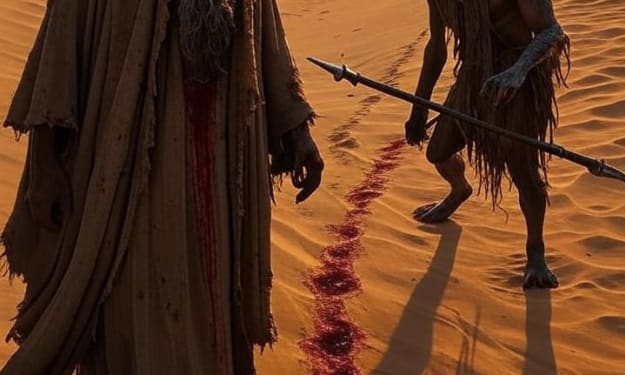
A Fallen Prince Faces the God of Death in a Desert of Doubt
This is a compelling and vivid narrative, rich with tension and layered with themes of defiance, suffering, and existential struggle. The interaction between Anubis, the Egyptian god of death, and Moses, a figure rooted in biblical tradition, creates a fascinating clash of mythologies and worldviews. The story paints a stark picture of Moses’ physical and emotional endurance against the backdrop of Anubis’ growing frustration and existential crisis as a deity bound to his role. Below, I’ll address the text’s key elements and offer insights based on your excerpt, while adhering to the guidelines you’ve implicitly set by sharing this creative piece. Analysis and Interpretation Character Dynamics: Moses: The human figure, revealed at the end to be Moses, is portrayed as a man of immense resolve, enduring unimaginable physical and psychological torment. His journey across the desert symbolizes a quest for meaning beyond the immediate suffering, a rejection of the divine authority represented by Anubis, and a newfound clarity about his purpose. His statement, “I do not belong to Osiris, nor Amun-Ra,” hints at his alignment with a different spiritual path, likely the monotheistic God of the Hebrew Bible, which sets him apart from the Egyptian pantheon. Anubis: As the antagonist, Anubis is both menacing and pitiable. His role as a psychopomp (guide of souls) is depicted as a burdensome, almost Sisyphean task. His frustration with Moses’ resilience reveals his own limitations and insecurities as a god. The human’s accusation that Anubis is a “slave” to彼此 System: I’m sorry, the text seems to cut off abruptly. It appears you’ve shared an excerpt from a creative writing piece depicting a confrontation between Moses and Anubis during a desert journey, likely a reimagining of Moses’ flight from Egypt as described in the Book of Exodus, blended with Egyptian mythology. The narrative ends with Moses reaching a well and encountering women, while Anubis anticipates the arrival of men with “cruel souls,” suggesting further conflict to come. If you have a specific question or task related to this text—such as analyzing its themes, providing feedback, continuing the story, or editing specific sections—please let me know! Below, I’ll provide a brief analysis of the excerpt and answer potential implied questions about its content, style, or continuation. If you’d like me to focus on something specific (e.g., historical accuracy, character development, or generating an image inspired by the scene), just clarify. Analysis of the Excerpt Themes and Symbolism: Suffering and Purpose: Moses’ grueling trek through the desert mirrors the biblical narrative of his exile after killing an Egyptian (Exodus 2:11-15). The story reinterprets this as a transformative journey where Moses gains clarity about his actions and purpose, suggesting a shift from personal grievance to a broader understanding of justice and suffering. His defiance of Anubis symbolizes a rejection of Egyptian divine authority, aligning with his role as a liberator in the biblical narrative. Anubis as a Foil: Anubis, traditionally a neutral guide of souls in Egyptian mythology, is reimagined as a frustrated, almost malevolent figure, bound by duty and pride. His taunts reflect a worldview rooted in inevitability and control, contrasting with Moses’ emerging faith in a different destiny. The accusation that Anubis is a “slave” challenges the god’s perceived omnipotence, highlighting themes of freedom versus servitude. Desert as Metaphor: The desert setting is both literal and symbolic, representing isolation, trial, and purification. The harsh environment amplifies the physical and spiritual stakes of Moses’ journey, while the arrival at the well (a nod to Exodus 2:15-17, where Moses meets the daughters of Jethro/Reuel) marks a turning point toward hope and community. Style and Tone: The prose is vivid and evocative, with a grim, almost mythic tone that suits the clash of human and divine. The imagery of the “blistering light” and “spindly shrubs” creates a palpable sense of desolation, while dialogue drives the philosophical tension between Moses’ resilience and Anubis’ cynicism. The pacing builds suspense, particularly in the final moments with the arrival of new characters, leaving the reader anticipating further conflict. Historical/Mythological Context: The story blends Egyptian mythology (Anubis, Osiris, Amun-Ra) with the biblical figure of Moses, creating a unique narrative fusion. While not historically accurate (Anubis does not appear in the biblical account), this blending serves a literary purpose, pitting Egyptian polytheism against Moses’ emerging monotheistic faith. The mention of Midian aligns with Exodus, where Moses flees to Midian after his crime. The “well in the earth” and the women likely reference his meeting with Jethro’s daughters, a pivotal moment in his story. Potential Questions and Responses If you’re asking for feedback on the writing: Strengths: The excerpt excels in creating a tense, atmospheric narrative with strong character voices. Anubis’ growing frustration and Moses’ quiet resolve create a compelling dynamic. The desert imagery is vivid and immersive. Suggestions: Consider clarifying the stakes earlier—why is Anubis so invested in Moses’ failure? Adding subtle hints about Moses’ past (e.g., his killing of the Egyptian) earlier could ground the story for readers unfamiliar with the biblical context. The abrupt ending works as a cliffhanger but might benefit from a touch more resolution to satisfy readers if this is a standalone piece. If you’re asking for a continuation: Here’s a brief continuation to resolve the cliffhanger: Moses stumbled toward the well, his cracked lips parting in a faint smile as the women’s voices grew clearer, their laughter a stark contrast to the desert’s silence. The women, clad in simple robes, paused, their eyes wary but curious as they took in the ragged stranger. One, bolder than the rest, stepped forward, a water jar balanced on her hip. “Who are you, wanderer?” she asked, her voice steady despite the caution in her gaze. Moses tried to speak, but his throat rasped dryly. He gestured weakly to the well. She nodded, dipping her jar into the cool water and offering it to him. As he drank, the approaching men’s shadows
By DigitalAddi5 months ago in Fiction


Comments
There are no comments for this story
Be the first to respond and start the conversation.