
341 — Terraforming Mars: Part 11
For SciFriday, December 6, Day 341

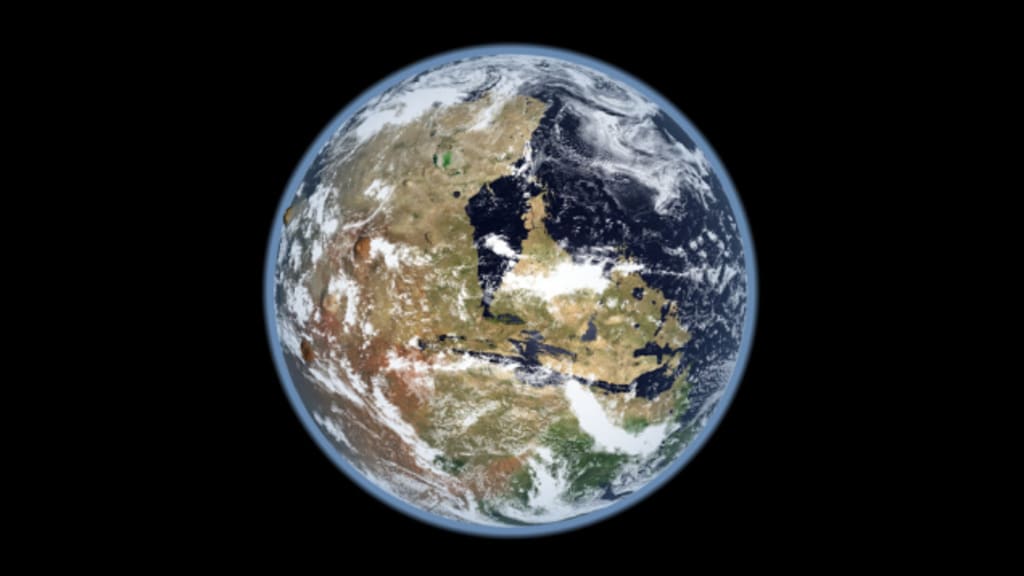
In Dr. Renée Niemann’s present, Mars “as is” was a quasi-water world with chilly, but not unpleasant 50º-72º F temperatures along its peri-equatorial bands of latitude. A very respectably sized moon graced the view above its 84% Oxygen/15% Nitrogen skies. Moon Ancile, during Phases I and II, wobbled the new center of gravity between it and its planet enough to ratchet Mars’ orbit in closer to the sun, adding more warmth, as well as rounding its orbit to make it less elliptical. The Martian year was still just shy twice that of Earth’s, but the perihelion-aphelion variation narrowed to almost negligible.
What was left of Mars’ two former moons was either debris at the impact sites, Asaph Hall North and Asaph Hall South, named after their original discoverer; or sitting as souvenir paperweights on many colonists’ desks. The beautiful and temporary equatorial ring that Diemos and Phobos created had long been cannibalized by Ancile.
Renée would be greeted by a Mars with sixty years of rooting and expansion of its vegetation, transplanted from Earth, and now described by landscapers as mature.
The sluggish ambulatory native species, the green Ares arboreta, referred to as “Chantū” in the Sonotomes, fit right in. They seemed very happy among the conifers of Scotch pines, Douglas firs, aspens, spruces, the Alpine heathers and grasses undergrowth, and the moss lichens. The botanists even determined that since the Chantū seemed to “visit” one plant or tree after another, it was actually participating in the pollination process. The Chantū even got along with the imported bees and butterflies that had escaped the large hydration dome after their cautious interplanetary introduction. Even though terrain irregularities had been successfully pulverized in Phase II to deposit a fertile topsoil, Mars was still plenty red, but no more than Alabama mud.
The day of the first genuine, spontaneous, treble rainstorm, signifying the end of Phase II, became celebrated as New Mars Day, for it had heralded the closure of a planetary ecosystem, barely self-sustaining, but on its own.
Mars, the errant child of the Sol family, was now ready to rejoin his siblings. And Earth saw green from red, as capitalism's bold investment seemed about to pay off.
About the Creator
Gerard DiLeo
Retired, not tired. Hippocampus, behave!
Make me rich! https://www.amazon.com/Gerard-DiLeo/e/B00JE6LL2W/
My substrack at https://substack.com/@drdileo
Keep reading
More stories from Gerard DiLeo and writers in Fiction and other communities.
Bomb Scare
It was 2027, and the world never thought it would happen. A missle hit the United States, but it wasn't where they had anticipated. A little town in the northeast was hit by a missile strike, they didn't know why, and they didn't know exactly where it hit, but they did know it was a coastal community, somewhere between Maine and Delaware.
By Gregory Payton4 days ago in Fiction
A "Wolf", a Girl and Her Grandmother
The Observer's eyes had no whites; they were simply two glowing red points in the dark. His face, which a human might describe as unmistakably wolf-like, was covered in luxuriant red fur. An elegant, black-tipped nose — moist with his breath — and a long lipless mouth with a double row of white teeth completed his visage.
By Brian Loo Soon Huaabout 5 hours ago in Fiction
The BAFTA Awards
By now, in a stunning departure from recent years, most of the world is aware of what happened at the BAFTA film awards. Social Media Headlines will tell you the bare bones: that John Davidson, a Tourette's Syndrome advocate, shouted a racial slur at two Actors of Colour, Michael B Jordan and Delroy Lindo.
By Natasja Rose6 days ago in Psyche



Comments (3)
Follow the money! Great stuff, Gerard!
What?? I love the story and it seems like you have reversed what’s happening on earth to make it that they’ve come here and greened us up like Mr. Elon and Buddy billionaires want to do to Mars! Is this a series, where I missed it devious ones? Great work and I have to ask - Have you ever read Galapagos by Kurt Vonnegut- it could be right up your alley. I’m in the middle of that satire.
You have created quite the story with a rich background and endless possibilities.