
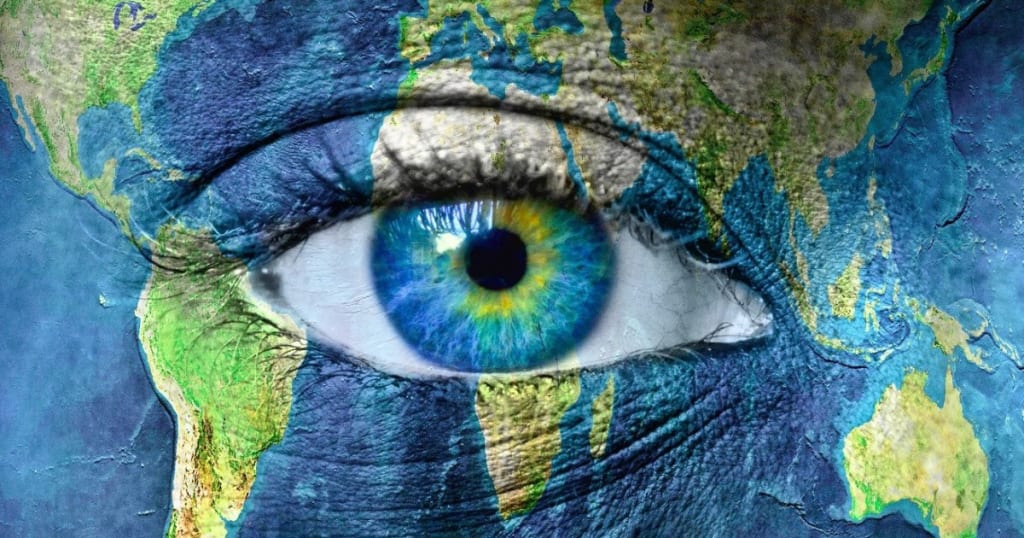
In 2041, Earth’s temperature has risen three degrees Celsius in the last twenty years. In defiance of decades of pleading for change from scientists, conservationists, and activists, the human population did not heed the warnings of what climate change could bring upon the earth if they did not steer away from fossil fuel consumption and deforestation. The continuous rise in temperature and deforestation of earth’s lands churned out higher CO2 emissions, which lead to a catastrophic chain of events bringing about the end of modern civilization.
The melting of the ice caps led to a rise in sea level, and since the earth’s poles were no longer protected in a sun-reflecting sheet of white, the waters and land trapped the sun’s energy, causing heat waves all over the world. The ocean continued to absorb greenhouse gases, trapping in the heat and causing extreme weather events and the loss of coastal protection, as underwater species dependent upon a balanced ecosystem started to die off. The costal countries we once knew and the entirety of the Caribbean and Southeast Asia were wiped out by tsunamis and hurricanes. Most of the world's coastal cities were under water, forcing their populations inland.
On land, the rise in temperature led to forest fires and extreme droughts, and created deserts to replace most of our farmlands. By 2035, the earth has been plagued by despair - luscious forests once filled with vivacious wildlife have been scarred by deforestation, leaving behind a barren wasteland. Africa was the first continent to go. Rain periods started later and ended sooner, which rapidly changed and destroyed the continents’ dependency upon and relationship with water. Flooding in North and East Africa destroyed homes and introduced new diseases born from contaminated flood water, while Sub-Saharan Africa was plagued by droughts, slowly eradicating any sustainable food source. The rapid decline in precipitation led to dried-up rivers and receding bodies of water, and access to clean water became non-existent. New diseases tortured humans and livestock alike, and as the last of the crops began to die off, so did the last of Africa’s inhabitants.
Intense storms ravaged the southwest United States, reducing global yields of major crops. Though the destruction of the earth’s forests was one of the catalysts that caused this rise in temperature, the humans, desperate to replace the fertile soil they had destroyed, continued the trend in an anguished attempt to feed their ever-growing population. As crop yields lessened and became less nourishing as their dry, mineral-depleted soil produced less nutrients, populations turned to the oceans for their food source.
Decades of overfishing had already depleted many species of fish, and nearly 80 percent of all living creatures in the ocean had perished. By the time the earth’s temperature increased two degrees Celsius, the vibrant and picturesque rainbow of colors offered by its oceans’ coral reefs turned to a dull, bleached boneyard, ruining the ecosystems around it. As the food, shelter, and spawning grounds for the majority of marine life disappeared, the fishing industry subsequently collapsed.
With all of earth’s resources depleting, allied countries turned on each other to reserve their food stores and resources for their own citizens, turning away anyone who dared to try and seek refuge in still-thriving countries. As humans became desperate for their own survival, nations quickly turned to violence and global warfare followed.
Fort Pitt, which had previously been known as Pittsburgh, had become one of the few safe havens left in the United States. Due to the city’s efforts to convert to clean-energy by the year 2030, many residents adopted solar energy and practiced a reduction in water consumption in the earlier years of global warming. While it wasn’t enough to curb the growing effects of climate change, it gave the city a fighting chance as the world withered around it. After Canada permanently closed its borders and civil war broke out in the United States, Pittsburgh had no choice but to barricade its bridges. Buildings were torn down to make room for gardens, and the recycled steel formed an impenetrable wall around the city and the confluence of its three rivers. For a while, its residents were able to live without worry of food scarcity and malnutrition. But as those less fortunate made the trek to seek refuge, the once welcoming city was forced to turn them away, and found itself under constant threat of attack.
Facing a shortage in rations that was quickly becoming unsustainable, Fort Pitt assembled a task force to go beyond the safety of the city’s walls and scavenge for supplies. As the cities' residence became plagued with newly introduced diseases from the rising contamination in food and water sources, its citizens became weak. What started as a squadron with hundreds of volunteers had dwindled down to only four members.
***
“Is it going to be much longer?” Julie asked, wiping the perspiration from her forehead onto her drenched sleeve.
“We're almost there, just keep moving,” Alex said, trying to catch her breath through her sweat-soaked cloth mask.
“I don’t know why you even bother wearing that thing anymore,” Rico said, rolling his eyes.
“I don’t particularly enjoy dining on insects as I’m trying to breathe, but by all means inhale those mosquitoes.”
Rico chuckled, exposing his rotting, yellowed teeth. “Hey, it’s protein!”
“...Yeah, and malaria, Ebola, and whatever else these--” Julie was quickly cut off.
“Enough already!” Justin yelled, “let’s just keep going.” The heat and hunger brought about a tension that even the closest companions couldn’t defeat.
“OUCH!” Alex reactively slapped her shoulder at the feeling of a bite, wiping the red and brown guts of a mosquito down her arm. She was used to this, as the mosquito population had grown rapidly over the last decade along with the increasing temperatures, introducing the world to diseases that only third world countries previously knew.
As she rubbed her shoulder to relieve the itch, Alex glanced down at the faded elephant tattoo she got in 2018, noticing the swelling red mark in the middle of its forehead. “Don’t worry Elle, I’ll keep you safe”, she whispered to her shoulder as she often did, and gave it a gentle kiss. “You’re the only one left of your kind.”
“So much for that face mask,” Rico quipped.
“Over there, that has to be it!” Alex’s anger was broken by Justin’s sudden enthusiasm, “up ahead, that’s the old Westinghouse building.” The remote Blairsville location had been one of the last sources of clean nuclear energy powering select locations in the United States. In 2037, a group of foreign rebels seized the building and used it as their base for launching attacks on neighboring communities.
“Is it safe to go in there?” Julie asked hesitantly. “I mean, this place just collapsed like a month ago. How do we know there’s no radiation that’s going to kill us?”
“You’re afraid of radiation?!” Rico laughed hysterically. “Look around us, will you?”
Justin snapped, “ENOUGH! Let’s just get this over with.” The group marched on in silence. As they approached the chaotic mass of rubble and rust, the sudden smell of rotting flesh stung their senses. A wall of bodies surrounded the collapsed structure, accumulated over years of trying to take back control of the building, but they were no match for bullets and bombs.
“Oh God! This is disgusting,” Rico cried, “I think I’m going to throw up.” Julie turned to cover her eyes and buried her face in her shirt. Alex didn’t react. She had become immune to any emotional triggers that rotting flesh had once provoked. As an inaugural member of the task force, Alex was used to stumbling upon rotting mammals. After the melting permafrost released anthrax, microbes, and other viruses into a large portion of the world’s water and food supply, rotting carcasses of deer, racoons, skunk, and other forest wildlife were plentiful.
Those unknowing communities who hunted and ate the infected wildlife just became another group of carcasses to be found. Sometimes, they would find the remains of weakened communities, murdered by aggressive groups who were desperate for supplies. It’s hard to say who was less fortunate. Alex thought of her own weakening community, wondering when another group of scavengers might discover her own dead body.
“Hey, you coming or what?,” Alex’s train of thought was interrupted by Justin’s question.
“I think I’ll keep watch outside and take a look around here.” Alex pulled back her thin strands of brown and gray from her face and neck and tucked them loosely in a bun on her head. Despite it being October in western Pennsylvania, the temperature was a scorching 90 degrees. She closed her eyes and remembered what this time of year would have been like thirty years ago - brisk fall air against her cool skin, the smell of burning pumpkin on Halloween, sipping a hot apple cider freshly made from the sweet Honey Crisp apples at Soergel Orchard. Now, she couldn’t even recall the last time she saw an orchard, at least not without barbed-wire fences surrounding the perimeter and armed guards at every tree.
As the rest of her team scavenged through the rubble and decay attempting to find anything of value, Alex apathetically surveyed her surroundings. Back in the age of stability, Westinghouse was one of her customers, and she had been here on a campus visit. Out of all of the change the world had seen, the adjacent area remained relatively uninterrupted. Dead brown grass and a few barren trees bordered the perimeter, not much different from before. The chain link fence surrounding the parking lot was still intact, although reinforced by layers of concrete erected by the foreign rebels, and despite cracks in the asphalt, you could still make out the blue paint of the numbered parking spots. It was refreshing to see something that still reminded her of a world before it unraveled.
She slowly walked the grounds, scanning the distance for any signs of wildlife. Out of the corner of her eye, she noticed the intense sun glistening off of an object in the myriad decaying bodies. In an age where gold and silver no longer held value, she usually ignored the junk society once desired. Perhaps it was boredom from waiting for her team, but curiosity got the best of her. She took a deep breath and approached the pile. She reached down and pulled a necklace from the chest of a decomposing corpse. She inspected the locket, heart shaped and tarnished, and flaked away the rust to pry it open. To her surprise, there were no pictures on the inside, rather a broken clock, frozen in time at 8:41, set atop a background of the map of the world. It must be old, she thought to herself, recognizing that this map still showed unflooded coastlines.
Alex snapped the locket shut and looked down at the body she removed it from. She found herself thinking about the time, and wondering if it was AM or PM - if it had stopped years ago, or if it represented the very time of death of its previous owner. As she pondered, she rubbed the locket between her fingers, and felt the indentation of an engraving. She brushed a piece of flesh from the surface to reveal the etching on the back.
Alex laughed facetiously as she read the words out loud to herself, “Save the Earth.”
She shook her head, and with passivity in her voice she sighed. “Too late.”
She threw down the locket and walked back towards the entrance to wait for the others. Moments later, the rest of her team emerged, empty-handed with defeat worn on their faces. Justin and Rico walked ahead without a word, and Julie turned to wait for Alex.
“I’m guessing it was a bust?” Alex asked rhetorically as she stood, brushing the dust from her shorts.
Julie sullenly nodded her head. “You? Find anything interesting?”
Alex drew in a long breath and sighed, “just wasted time."
About the Creator
Alexandra MacKenzie
Pittsburgh based author with a passion for creative writing.
Keep reading
More stories from writers in Fiction and other communities.
Free Loveseat
Every other night, I notice the variation of kipple that loiters—the many monuments littering the city—of every single different kind of leather chair, plush recliner, and loveseat, and Art Deco sofa, many of which end up abandoned, deteriorating the crumbling, and most definitely paper-thin, sidewalks of the street. They rest discarded, like departed souls, or perhaps, the poor souls of Black folk, neglected by the bluest of eyes. Of all of the rubbish, chairs are my fancy. There’s a lot of character in the shape of a chair; the subtle curves especially remind me of the night women who stand on the curb.
By Thomas Bryant5 days ago in Fiction



Comments
There are no comments for this story
Be the first to respond and start the conversation.