
2.6 Million Golden Eggs Found Near Underwater Volcano
Mysterious Discovery at the Ocean Floor Sparks Fascination and Scientific Curiosity

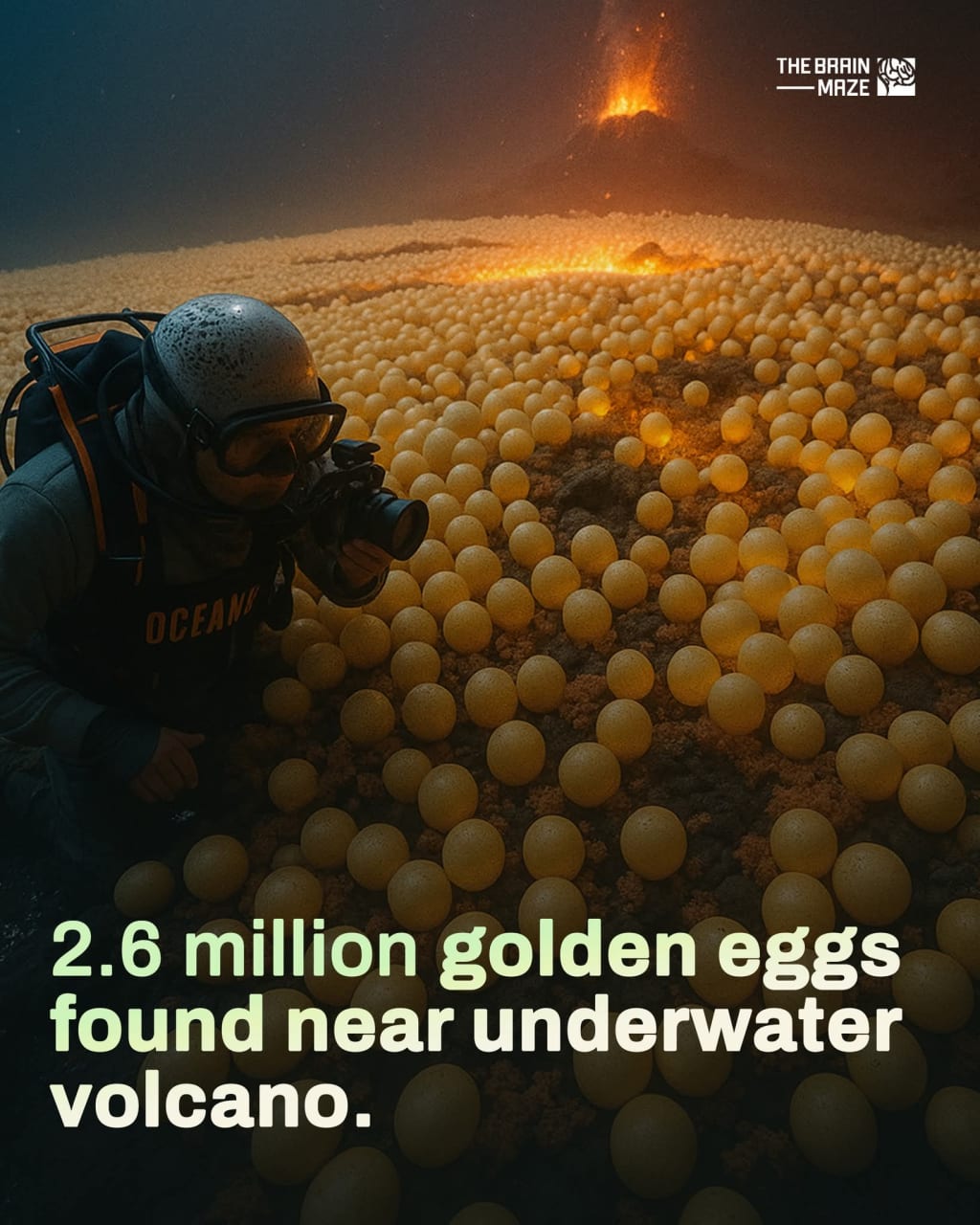
In a stunning discovery that has left scientists amazed and the public intrigued, researchers have found an estimated 2.6 million golden eggs clustered near an underwater volcano. The eggs were discovered during a deep-sea expedition in the Pacific Ocean, near a hydrothermal vent system where extreme heat and unique marine life thrive in darkness and high pressure. The find is being hailed as one of the most unusual biological mysteries in recent history.
At first glance, the eggs appeared like shimmering beads scattered across the ocean floor. Their golden hue reflected the lights of the remotely operated vehicle used by the marine research team. These egg-like structures were found in and around cracks in the volcanic seabed, nestled near mineral-rich vents that spew superheated water and gases into the deep sea.
Despite their beauty and strangeness, the identity of these golden eggs remains unknown. Scientists believe they are biological in origin, most likely laid by a yet-to-be-identified deep-sea creature. They are not made of metal or gold, but have a soft gelatinous shell similar to that of fish or invertebrate eggs. The golden color is believed to come from pigments in the outer membrane, possibly serving as camouflage or protection in the unique lighting conditions of the ocean depths.
The discovery was made as part of a long-term project aimed at studying hydrothermal vent ecosystems. These ecosystems are known to support extraordinary life forms that exist independently of sunlight, relying instead on chemical energy. Tube worms, giant clams, blind shrimp, and other alien-like organisms thrive here, many of which are found nowhere else on Earth.
What makes this find especially fascinating is the sheer number of eggs. To discover millions of them in one concentrated area suggests that a mass spawning event may have taken place. This kind of large-scale reproductive behavior has rarely been documented in such extreme underwater environments. It raises questions about what species might be responsible and how they coordinate such activity in an environment with no natural light and few signals.
The presence of the eggs near a volcanic vent also suggests a possible link between volcanic activity and marine reproduction. Some scientists believe that the heat and mineral flow from these vents may create ideal conditions for incubation. The warm, nutrient-rich water might act like a natural incubator, speeding up development and increasing the chance of survival for hatchlings.
However, the mystery deepens because no adult specimens of the creature that laid the eggs have yet been found. Despite scanning the surrounding area thoroughly, the research team found no sign of any large marine animal that could be responsible for laying so many eggs. This has led to speculation that the parent species might be highly elusive, extremely deep-dwelling, or possibly even nocturnal and active only at certain times of the year.
Researchers have already collected samples of the golden eggs for laboratory analysis. They plan to study the genetic material within the embryos to determine what kind of creature they belong to. This could lead to the identification of a new species or even a new genus of deep-sea life. Such discoveries could offer insights into how life survives and evolves under extreme conditions, far from the reach of sunlight and surface-based ecosystems.
Beyond scientific circles, the find has captured the imagination of the public. Images and videos of the golden eggs have gone viral, sparking comparisons to science fiction movies and mythical treasures. Some have jokingly called it the “Atlantis nursery,” while others wonder if the eggs could hold secrets from Earth’s distant evolutionary past.
While the golden eggs are not made of real gold, their ecological value could be far greater. Understanding the life cycle of deep-sea organisms can provide vital knowledge about biodiversity, resilience, and the health of our planet’s oceans. The ocean floor, especially around underwater volcanoes, remains one of the least explored environments on Earth. Each discovery in these dark, hidden worlds is like opening a new chapter in the book of life.
In the coming months, scientists will continue their analysis using advanced imaging and genetic sequencing techniques. The hope is not only to identify the creature that laid the eggs but to understand how it fits into the complex web of deep-sea life. The study may also help predict how these unique ecosystems will respond to climate change and human activity, including deep-sea mining and drilling.
For now, the mystery remains unsolved. But what is clear is that our oceans still hold wonders we can hardly imagine. The 2.6 million golden eggs found near the underwater volcano are a glowing reminder that there is still so much to explore, learn, and protect beneath the surface of the sea. From unknown species to strange behaviors, the deep ocean continues to surprise us — proving that some of Earth’s greatest secrets are hidden in the darkest corners of our planet.
About the Creator
Keep reading
More stories from DigitalAddi and writers in Fiction and other communities.
A 13-Year-Old Just Recreated Archimedes' Legendary Death Ray — and Proved It Worked
For over two millennia, one of history’s most fascinating legends has puzzled scientists and historians alike: did the ancient Greek mathematician Archimedes really build a “death ray” to set enemy ships on fire using only sunlight and mirrors? Skeptics have long dismissed the story as nothing more than a myth. But now, a 13-year-old student has reignited the debate — quite literally — by recreating the ancient weapon and proving that it can, in fact, work.
By DigitalAddi7 months ago in Fiction


Comments
There are no comments for this story
Be the first to respond and start the conversation.