
13 Minutes Late
A routine train ride turns into a deadly countdown.
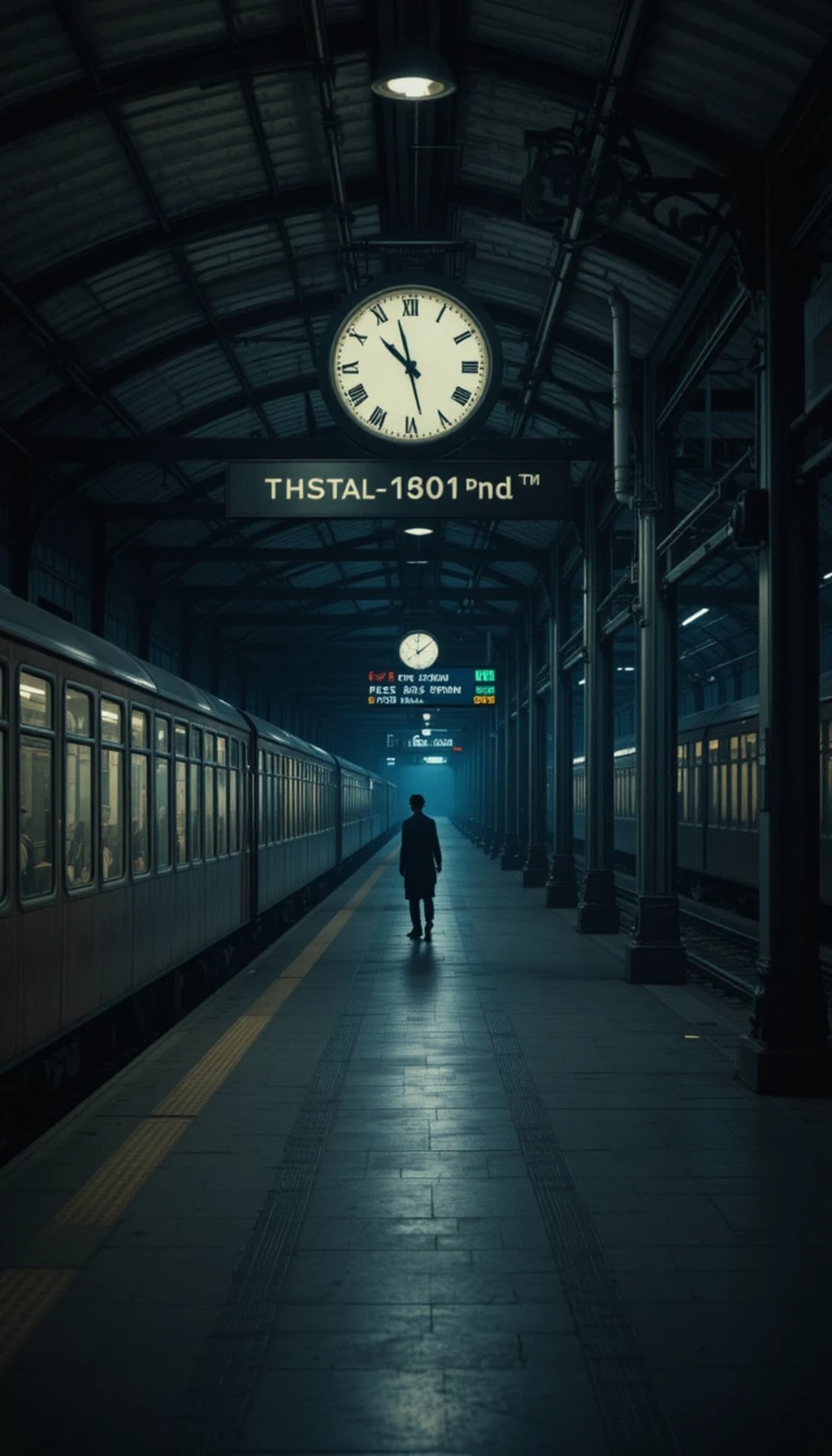
Amira took the 11:00 PM train every night.
Always the same seat — third car, left window. The familiar hum of the train was her nightly lullaby after long shifts at the hospital. She liked the predictability of it, the quiet rhythm between stations, the soft reflection of tunnel lights gliding across her face.
Routine was her comfort. Routine made her feel safe.
But tonight, that comfort was cracked open.
“Attention passengers,” the overhead voice buzzed. “The 11:00 PM train will be delayed by approximately thirteen minutes. We apologize for the inconvenience.”
Thirteen minutes. A small delay — but it unsettled her.
Amira glanced around the near-empty platform. The vending machines hummed, the fluorescent lights flickered. A soft wind rolled through the tunnel, carrying the scent of metal and rain.
Then she noticed him.
A man in a long black coat stood near the vending machine. His posture was rigid, controlled. He wasn’t scrolling through his phone like everyone else — he was pacing. Over and over, short measured steps, like someone trying to keep calm.
He held a small silver briefcase. Not a backpack or a duffel — a briefcase, polished and out of place in a subway station at midnight. Every thirty seconds, he glanced at his watch. Not the large station clock. His own.
Something about that detail caught her attention. He wasn’t worried about the train being late — he was worried about being late for something else.
When the train finally arrived, screeching into the station, only four people boarded.
By the second stop, two had gotten off. The carriage grew quiet — just Amira and the man.
He chose the seat directly across from her, setting the metal briefcase carefully between them. He gave a polite, tense smile. “Long night?”
“Always,” Amira said, forcing a small grin. She tucked her hair behind her ear and looked out the window, hoping the conversation would end there.
The tunnel lights began to blur. The train rattled, echoing in the silence. Then — the lights flickered once, twice — and went out completely for two full seconds.
When they flickered back on, Amira blinked. The seat opposite her was empty.
The man was still there — but his briefcase wasn’t.
He jumped up instantly, panic in his voice. “Did you see it? It was right here!”
Amira looked around, confused. “No one else is here. It can’t just disappear.”
He ran his hand through his hair, trembling. “You don’t understand. It’s not money. It’s worse.”
She frowned. “What’s in it?”
Before he could answer, his phone buzzed. A message appeared on the screen.
You’re 13 minutes late. It’s already armed.
The color drained from his face.
“Armed?” she repeated, her voice barely above a whisper.
He met her eyes — the kind of look that carries both fear and guilt. “If it’s not defused in time, the entire tunnel—”
Before he could finish, the train screeched violently to a stop. Sparks flashed against the tunnel walls. The lights flickered again, then went black.
The driver’s voice crackled over the speakers: “Attention passengers, we’re experiencing technical—” and then cut out.
Silence.
Then — tick… tick… tick…
Amira’s heart dropped. “Do you hear that?”
The man knelt down, pressing his ear to the floor. “It’s here. Somewhere under the seat.”
Her pulse pounded in her ears. “You planted a bomb?”
“No!” he shouted, his voice raw. “I was supposed to deliver it safely. Someone switched the case. I swear.”
He tore at the floor panels, searching frantically. Amira hesitated for a moment — then joined him, her trembling fingers helping lift the seat.
There it was.
A small black box, blinking red.
The digital timer glowed: 00:02:17.
Her breath caught. “Two minutes?”
He swallowed hard, his hands shaking as he pulled a tool from his coat. “I can stop it. Maybe.”
“Maybe?” she snapped. “That’s not exactly comforting!”
He didn’t answer. Sweat trickled down his temple as he opened the panel, revealing a tangle of colored wires. Blue, green, red.
He whispered to himself, “They changed the sequence…”
Amira stared at the timer — 1:41.
Her voice trembled. “Blue or green?”
He froze, eyes flicking between them. “I don’t know.”
The air grew heavier. The ticking echoed like a heartbeat.
Finally, he looked at her — a desperate, human look. “Do you trust me?”
She met his eyes. “No,” she said, “but I don’t have a choice.”
He took a deep breath, exhaled slowly, and snipped the blue wire.
The ticking stopped.
The timer froze at 00:00:06.
Amira’s legs gave out. She sat down hard on the floor, shaking. For a moment, all she could hear was her own ragged breathing.
Then, the train jolted forward again. The lights returned. The hum of the tracks filled the air, as if nothing had happened.
The man stood, pocketing his tool. His hands were still trembling. “It’s over,” he said quietly.
But Amira wasn’t convinced. “Who sent that message?” she asked.
He hesitated. “Someone I used to work for. Someone who doesn’t forgive failure.”
Before she could ask more, the loudspeaker crackled again: “Next stop — Downtown Central.”
When the doors opened, police officers flooded in, shouting orders. Someone must have reported the stop.
“Everyone stay calm! Hands visible!”
Amira raised her hands immediately. The man did too.
But when she blinked, he was gone. Vanished — as if he’d melted into the chaos.
All that remained was the metal briefcase, sitting neatly on her seat. The same one from before.
She approached it cautiously, her hands trembling. The police shouted for her to step back, but she couldn’t help herself. She flipped it open.
Empty. Except for a single folded note.
She unfolded it slowly.
Thank you for being 13 minutes late.
The words hit her harder than any explosion.
She stared out at the tunnel, the lights reflecting off the tracks. Thirteen minutes — the delay that saved her life, and perhaps hundreds more.
That night, as she gave her statement, she replayed every moment — the pacing man, the flickering lights, the ticking bomb, the impossible timing. None of it made sense, and yet it did.
Someone had planned for her to be there.
Someone had delayed that train.
And whoever that man was — terrorist, spy, or something else — he’d vanished, leaving only that cryptic note behind.
When Amira finally left the station, dawn was breaking over the city. The sky was pale gold, the streets quiet.
She looked back one last time at the station clock — 6:13 AM.
For the first time, she realized: some delays aren’t accidents. Some are destiny.
“Thank you for being 13 minutes late.”
About the Creator
Keep reading
More stories from MUHAMMAD SAIF and writers in Fiction and other communities.
So You Decided To Become a Nurse Practitioner:
So you decided to become an "Advanced Practice" nurse. Congratulations!... is what I would say if this was a good idea. Grad school? In this economy? What were you thinking? Likely it was something along the lines of either 1) “I've seen these other chucklefucks do it— Why can't I?” or even 2) “I've got a nice career, I should shake it up. I miss feeling like I have no clue what I'm doing.”
By Sandor Szabo5 days ago in Fiction
The Ritual
Every night at nine, Mara set the second place. She did it even when she ate standing at the counter, even when the sink was full and the radio was still murmuring to itself. She took the blue plate from the cupboard—the one with the chipped rim—and set it across from her. She folded the napkin into a neat rectangle. She put the fork on the left, the knife on the right, blade facing in, as if someone had taught her manners she was determined not to forget.
By Nina Pierce8 days ago in Fiction



Comments
There are no comments for this story
Be the first to respond and start the conversation.