

“I’m done. I can’t do this anymore,” Heather said as she got up off the floor and tried not to step on the piles of papers and photos.
I looked up from the photos I was sorting. “What’s wrong?”
“It’s, it’s…I just can’t,” she answered.
“Can’t what? Help me organize Dad’s old photos?” I asked. “Sort his papers?”
“Sorry, Sis…” Heather bent over and kissed the top of my head.
“I suppose you’re leaving in the morning?”
“Yeah, I’ve been gone too long. Timmy keeps asking when I’m coming home. He and the dogs are giving Paul fits.” She picked up an empty wine bottle and her glass, leaving mine and the bottle that we hadn’t finished. “Don’t stay up too late.”
“Night…” I replied.
—————————
“Don’t forget the pastel,” I said.
“I’ll take one last walk-through and get it,” Heather said.
She had been at the auction when Dad bought the pastel drawing. He had hoped it was authentic. Although Heather and I were skeptical, she had always coveted it. Now it was hers. Besides the family knickknacks, it was her only inheritance. Dad had followed the principle of living his dreams and not worrying about dying broke. He had never believed in investing in stocks. “Invest in experiences—they feed your soul,” he had always told us.
Since I was the writer in the family, I got the Native American rug that was a significant aspect of the book Dad had written. He had bought it on his bucket-list cross-country trip. Neither was worth much.
“All’s empty up there except the mattress and boxes of his old clothes,” she said. She frowned at the eight floor-to-ceiling bookshelves. “What are you going to do with all his books?”
I shrugged. “Keep some, sell them, give them away? What do you want to do with them?”
“I don’t care,” she said. “They aren’t worth anything. Not worth schlepping home and trying to sell.”
“Okay.” Heather knew art and antiques better than I did. “I’ll have the auction company put them in the sale, or I’ll take them to the thrift store.”
“Give them to the thrift store,” she said. “They might make a few dollars apiece on them. Dad would like that.”
“Sure.” I nodded to the stack of little black notebooks bound in string. “I’m keeping his Moleskines though.”
“I don’t want them; they’re all yours. Same with the photos. They’re all just worthless paper, nothing of historical importance. Put them in the burn bin for all I care.”
“I can’t do that! They were a part of Dad. When I worked for him in my teens, once in a while he’d stop work for no apparent reason, pull out his notebook, and read me a recent musing.”
“They’re just stupid notes, not any great philosophies.”
“Well, I want to read them; hear his voice again. Who knows, maybe there’s a story in them waiting to be written.”
“Whatever.” Heather walked to the door. “Well, I guess…”
“Yeah…” I followed her out to her car. “Call me when you get home? Let me know you made it safe?”
“Sure.”
“Love you, Sis!” I gave her a big hug. Although we talked almost weekly, our lives were on different schedules. Because we lived halfway across the country from each other it had been six years since we’d seen each other. Now with both of our parents gone and no other family to bring us together, I didn’t know when we’d see each other next.
“Love you too, Sissy!”
—————————
“Now’s as good a time as any,” I said to myself. Heather might not have been interested in the Moleskines, but I certainly was. I pushed aside lunch and placed the bundled stack of notebooks on the table.
I’d grown up watching Dad jot something in them at auctions, while in his workshop or on the phone, and even on the sidelines when Heather and I were playing soccer. They had always been sacred though—no one, not even Mom, had been allowed to open them. Reading them was forbidden. For all I knew, Heather was probably right that they were full of the worthless scribbles of to-do and grocery lists and corny jokes.
Tears welled up in my eyes the more I thought about the notebooks. Not having Dad’s express permission to read them brought conflicting feelings: Who’s it going to hurt by my reading them? They’re his private thoughts. He’s gone. If he wanted you to read them, he would have said something. Yeah, but…
“Dad, I hope you don’t mind. You didn’t give instructions one way or the other, but you didn’t even leave a will.” I almost felt like I was with Huck Finn and Tom Sawyer digging for pirate treasure. With as much ceremony and respect as possible, I tried in a dignified manner to untie them, but the old string didn’t budge. Cutting it seemed cruel. I wondered if untying them would cause what they represented to unravel and cause everything in them to disappear as if written with magical ink.
I gave a stronger tug on the end of the bow. The string broke at the knot, releasing the rest of the knot. The stack of notebooks leaned a little as if giving a sigh of relief from being bound for years.
“There, now let’s see…” Sure enough, they were full of diary-type happenings of the day, sprinkled with names, phone numbers, and assorted work notes and figures. The jokes changed to match the politics of the time. There were weather observations and simple sketches of where he had gone on vacation. And as I had hoped, there were musings about life—his, our family’s, my sister’s and mine, his dreams, and his sorrows. That’s what I wanted. Despite being so friendly, he had always been very private. Now I might be able to get to know my father better. “Thank you, Dad.”
Carefully, I riffled each notebook's pages looking for anything that demanded attention before I tucked into my suitcase these treasures to be savored later. No will or secret bank statements flitted out. The one at the bottom of the pile was the newest without much writing, so I read its first page. It was dated a few years before his health took a turn for the worse.
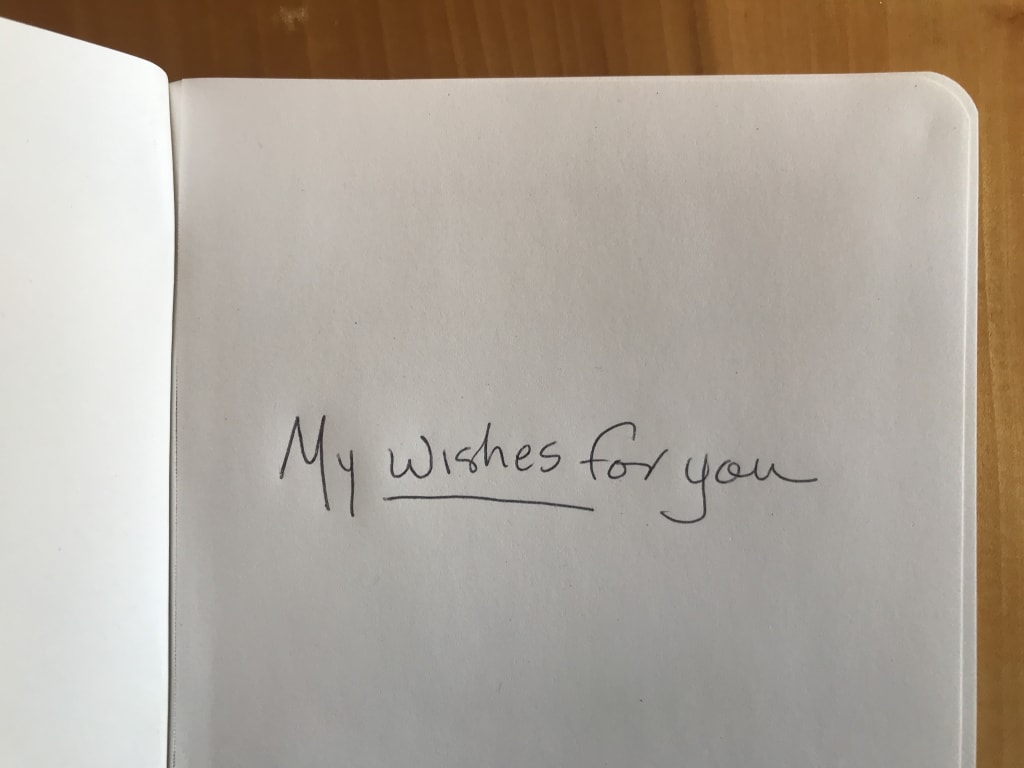
“My Wishes for You,” he had written.
Pam and Heather, if you are reading this then I am dead.
I love you, have always loved you, and hope that I have been as good of a friend to you as I think I was a father.
“Aww. You were, Dad.”
On the next page he had written:
Take care of each other.
Be kind to each other.
Sell the car; it’s worthless.
“Yup. Gave it to the handyman.”
Give the motorcycle to Timmy.
“Sorry Dad, we gave the Beemer to Ziggy. Timmy isn’t old enough for a classic touring motorcycle.”
Dad had spent so much time swapping tales with Ziggy at his garage, who had always admired it, so we gave it to Ziggy.
The pastel is authentic and worth at least twenty thousand. I put the papers that prove it behind the backing paper.
“Well, Heather will be happy.”
And may all your wishes be granted.
I turned the page.
I know you sometimes laughed or rolled your eyes at what your dear old dad considered his bits of wisdom, so I’m going to try to put them all in one place for you, where you can easily refer to them when you need advice even though I’m not around.
There was nothing else on that page.
Next was a list of books:
The Prophet Kahlil Gilbran
Siddhartha Herman Hesse
The Alchemist Paulo Coelho
Bury My Heart at Wounded Knee Dee Brown
The Little Prince Antoine de Sainte-Exupery
Zen and the Art of Motorcycle Maintenance Ken Pirsig
Fate is the Hunter Earnest Gann
A Sand County Almanac Aldo Leopold
Where the Wild Things Are Maurice Sendak
Hope for the Flowers Trina Paulus
The Phantom Tollbooth Norton Juster
The Little Engine that Could Watty Piper
Charlotte’s Webb E. B. White
Monkey Wrench Gang Edward Abbey
We Took to the Woods Louise Dickinson Rich
The Hobbit J. R. R. Tolkien
Hidden Figures Margot Shetterly
The Journal of George Fox
his book, The Weaving of Harold Jenkins
and my book, Art of Winter.
The rest of the little black book was blank.
Twenty titles. With a few exceptions, I had read most of them at some point in my life. They weren’t in any order, but together they were about following dreams, taking risks, standing up for what is right, and believing in oneself. That was definitely how he lived and had raised us.
“Well, if these are on the shelves, I guess I’m taking them with me.” There were about twenty-five hundred books to search. “No time better than the present.”
Some of the books on the list were old with beautiful dust jackets. Most showed hardly any signs of wear. I opened the third one to read the copyright—it was a first edition. So was the next, and the next. “Surely these are worth something.”
I watched something slip out of the book and flutter to the floor. President Grant stared up at me. I bent over and picked up the fifty dollar bill, then flipped the book’s pages and found more. Searching the first four books, I found more money, lots more between the pages with each bill marking underlined passages. I was stupefied as I went through the list. Each book had a thousand dollars in it. One book was missing though—oh, well.
“Dad, why didn’t you tell us? We almost gave away thousands of dollars!” He knew how much I loved puzzles and books, and how meticulously I had cleaned out Mom’s house. He must have hoped I’d be as careful sorting his stuff. Well, Heather had her inheritance and now I had mine.
My phone rang as I was still shaking my head in amazement. “Hey there. Perfect timing.”
“Hi. Traffic was hell, but I’m home,” Heather said. I heard her dogs barking in the background.
“Good. You’ll never guess what I found.” I said. “You know those notebooks? You were right—not much in them. Except one.”
“Oh?” she asked.
“Did you take any books?” I asked.
“Only a couple about the civil war for Timmy. And a few art books for myself. Why?”
“He wrote a list of books. I can find all but one.”
“Hold on a minute, would you?” she asked. There was more barking and I could hear Paul talking with her. “Hey, I gotta go. Paul’s car won’t start, so I gotta take Timmy to soccer practice.”
“Okay, Dad also wrote that the pastel is real. Call me back later. ”
“Okay. Gotta go. Love you, Sissy.”
“Love you too, Sis,” I said to the click and knew she hadn’t realized what I had just told her.
I stared at nineteen of Dad’s favorite books on the table, each with their thousand dollars. My thoughts of what to do with the money were interrupted by the ringing of the doorbell. Someone was insistently knocking by the time I got to the door.
“Umm, uhh, hi Miss Pam. I’m really sorry about your dad,” Ziggy stammered in his thick Polish accent. “Thank you for the motorcycle. She’s a wonderful lady.”
“You’re welcome, Ziggy. Dad would be happy knowing she’s treasured,” I said. “Do you want to come in?”
“No, I just come to give you this.” He handed me a book he’d been clutching. “I found it in the saddlebag. I think it’s yours.”
It was Zen and the Art of Motorcycle Maintenance—the missing book with another thousand dollars. I took out the first two fifties I found, and handed them to him.
“Thank you, Ziggy,” I said. “This is for you.”
About the Creator
Julie Covert
Julie is a published author, photographer, editor, (retired) therapist, and teacher. Her passion for nature is seen in her photography and and expressed in her writing. She lives off-the-grid in the Upper Peninsula of MI with her husband.
Keep reading
More stories from writers in Families and other communities.
Wise~Guys
— Look Behind what's in Front of You ~ Make Good Choices — Hey, So how you Doin'..! Made~Men — Mobster Movies romanticise a distinctive, elegant appearance, impeccable attire style, along with the 'Families' expressive lingo. Making their 'Bones' gave them Panache — with vintage fedoras, tailored pin-striped suits, mirror-polished wing-tip shoes adorned with tassels; with their 'Gun Moll' gorgeous dates on their arms.
By Jay Kantor25 days ago in Families



Comments
There are no comments for this story
Be the first to respond and start the conversation.