
Why don't older kids engage in reading book
The decline of Reading Among Older Kids: Exploring the Reasons



I was lucky as a parent in many ways, but I always felt especially grateful that my kids were readers. They were so into reading, in fact, that we had to replace a few of our Harry Potter books because they’d been so heavily used and abused (one child loved to read them while eating; a couple of the volumes became pretty gross).
Our kids’ voracious appetite for books was great! On a practical level, books were a cheap way to keep them occupied (libraries are wonderful—ours literally saved us thousands of dollars and provided many hours of entertainment). More importantly, reading turbocharged our kids’ imaginations, gave them large vocabularies, improved their performance as students, and made them more knowledgeable about the world.
That’s why, when they hit middle school, it was so disappointing to see my kids reading less and less. By the time they got to high school, though they did plenty of reading for homework, they’d essentially stopped reading for fun.
It turns out that my kids’ experience was not all that unusual. The enjoyment that young people get from reading—and the amount of time they spend doing it—plummets around middle school. According to a survey by Scholastic:
There is a significant drop in reading enjoyment as kids age (70% among 6–8-year-olds vs. 46% among 12–17-year-olds).
Nearly half of 6–8-year-olds (46%) say they are frequent readers (reading books five or more days a week); this level declines to 32% of 9–11-year-olds, 21% of 12–14-year-olds, and 15% of 15–17-year-olds.
Half of school-aged children (50%) believe reading books for fun is highly important; however, as children get older, they place less importance on reading for fun (64% children ages 6–8 vs. 43% children ages 12–17).
The vast majority of parents (83%) believe it’s important that their child read books for fun; however, as children get older, parents are less likely to say reading is important (89% of parents of children ages 6–8 vs. 67% of parents of children 15–17).
This trend has gotten worse in recent years. The National Assessment of Educational Progress has asked kids about their reading habits since 1984. The survey has found that kids read less these days, especially as they get older. The number of 9-year-olds who say they read for fun “almost every day” has declined by about 20% in that time, but the percentage of 13-year-olds who say the same has gone down by half.
What’s going on? Why do kids lose their love for reading as they get older?
Theory 1: It’s schools’ fault!
The Atlantic recently published an article that centers its narrative on elite, unrepresentative institutions, framing its argument as a Columbia professor’s lament that his students “had never been required to read an entire book.” It’s intended to spark panic about The Kids These Days, arguing that schools don’t make students read books anymore. And its vibe is one of inexorable cultural decline.
In short, it’s a quintessential Atlantic piece.
None of this is to say that the article is wrong, although one high school teacher that The Atlantic interviewed for the piece claims that the author ignored her nuanced points to present a more simplistic narrative. In my over-two-decade experience as a high school (history) teacher, I’ve seen a decline in the number of pages assigned to students in many classes, including my own. Though I don’t have data to back it up, I’d bet that students leave our school having read fewer books than they did 20 years ago (although we are very far from having students graduate without ever having read a book for school, which is what the Atlantic piece says is happening around the country).
There may be a couple of reasons for this. First, it may be that schools have simply lowered their expectations for students. As kids (and, often, their parents) have pushed back against being challenged in school, some teachers have obliged, deciding that giving students less work and inflated grades is easier than fighting the tide.
Then again, maybe we’re challenging students too much! I have heard many high school students talk about English class as a reason why they don’t read as much as they used to. Their reading time is taken up by painstaking analysis of difficult texts. Though this is captivating and satisfying for a lot of kids, some lament that they don’t get the chance to simply enjoy a story the way they did when they were younger.
Second, schools have changed their curricula to focus on skills like critical reading. In order to meet standards and make sure their students pass state tests, teachers, even in lower grades, are more likely to focus on analyzing small passages rather than reading whole books. This means that schools are spending less time letting kids do the parts of reading that are fun (getting lost in stories, getting attached to characters) and more time teaching them to annotate passages or identify metaphors.
Critics argue that these curricular changes have meant that kids never learn to read longer works, nor does school teach them that reading is anything other than drudgery.
Theory 2: It’s parents’ fault!
The problem with blaming the schools is that school isn’t—and maybe shouldn’t be—the place where kids learn to love reading. Shouldn’t that start at home?
Kids aren’t the only ones who are reading less. Fewer than half of American adults read even one book for pleasure each year. Less than 40% read any fiction or literature.
We all know that kids imitate the behavior they see from the adults in their lives. If kids see their parents messing around on their phones or watching TV instead of reading, they probably won’t choose to read, either. Maybe kids are just mirroring the larger changes in society.
Age-related reading apathy may be due to parents not giving them time. Many kids are shuttled from school to violin to basketball to tutoring—and then, after they get home, they have to eat a quick dinner and do a bunch of homework. When are they supposed to read a book?
As John Warner writes,
Some… have suggested that we are looking at a case of arrested development where college students are still naming a young adult series as a favorite, but I’m wondering if they’re not just expressing that middle school was the last time they were allowed to read out of a sense of personal interest or fun.
Overscheduled kids are not going to have the energy to pick up a novel and read for fun. They’re going to choose an activity that requires much less of them, something like social media or video games. Which brings us to…
Theory 3: It’s technology’s fault!
I won’t belabor this one, because screens are the most obvious villain, and for good reason. It‘s probably not a coincidence that most kids get a smartphone by the time they’re 11, which is right around the time that they stop reading for fun.
And can we blame them? Screens are way more enjoyable than books. They keep us stimulated, give us an opportunity for instant gratification, and never let us get bored. Reading a book, by contrast, requires effort and forces us to use our imaginations. Since we raise kids with technology—not only do almost all middle-schoolers get a smartphone, but a vast majority of younger kids spend a lot of time each day on a tablet—they learn to cherish the instantaneous pleasures of the internet more than the slow burn of literature.
Just think of the message that adults send to kids when we try to discourage them from spending their time on screens and encourage them to read because it’s beneficial for them. As any 10-year-old knows, adults try to discourage them from eating candy and encourage them to eat their broccoli. That’s because broccoli tastes worse than candy. Kids know what’s up.
Theory 4: It’s publishers’ fault!
When my kids hit their tween years, they found themselves in a conundrum. They felt too old for “kid books”—Harry Potter, Percy Jackson, and the other stuff they’d devoured in grade school—but didn’t like a lot of the “teen” literature that was marketed to their age group.
Once they graduated from the kids’ area of the library to the “teen zone,” my kids found that the books there fit one of several molds. Some amped up the violence and intensity in an attempt to emulate the success of books like The Hunger Games. Others turned up the romance, promising steamy love scenes that my tween kids weren’t very excited about (at least when checking books out with their dad). A third category felt like the old after-school specials of my childhood, wrapping a story around a Very Important Social Issue. The problem was that a lot of these books weren’t very good as stories.
Once they reached middle school, my kids wanted exciting, engaging stories aimed at people their age, and they just couldn’t find them anymore.
As Dan Kois explains, the publishing sector, like the movie industry, adopts a risk-averse attitude to its production. If a graphic book about zombies sells well, you’re certain to see a million graphic novels about zombies next year. There appears to be less place for distinctive novels that may attract a young reader. As Kois says,
It’s terrific that the kids who enjoy these novels—or Spider-Man comics, or manga, or, for that matter, off-putting kid-lit “histories” about disasters that occurred in my lifetime—are reading anything. For sure! Yet I can’t help but be anxious that the types of books that altered my life between years 8 and 12 are disappearing by the wayside. Is there a place for the intelligent, serious, lovely young person's book in 2024? Can you publish Bridge to Terabithia in the age of Captain Underpants?
Personally, I believe there’s substance to all of these hypotheses. But I also know that the reduction in adolescent reading doesn’t have to be permanent.
Both of my kids are young adults now, and it turns out that both of them—even the one that is still in college—have regained a love of reading. After they graduated high school, both of them went back to consuming literature. Maybe it’s because they now have a bit more spare time. Maybe it’s because they’re no longer in English class and can now choose the literature they read. Maybe it’s because they’ve built more mature connections with their technology.
As much as we bemoan the fact that youngsters read less when they approach their teen years, the drop doesn’t have to be permanent. Maybe the best we can do is to cement a strong relationship to reading in younger youngsters. They may leave reading for a spell in their teens, but if they’re fortunate, they’ll find their way back later in life.
Thanks for reading! If you’d like to get an email anytime I write an article, click here. I also publish Looking Through the Past, a newsletter featuring historical items and photos—check it out! You may “buy me a cup of coffee” here.
About the Creator
jaklin genie
I am a writer and content creator specializing in book reviews, health, and cooking. I share valuable insights from books I read and offer practical content on health and recipes, aiming to enrich daily lives with useful information.
Keep reading
More stories from jaklin genie and writers in Families and other communities.
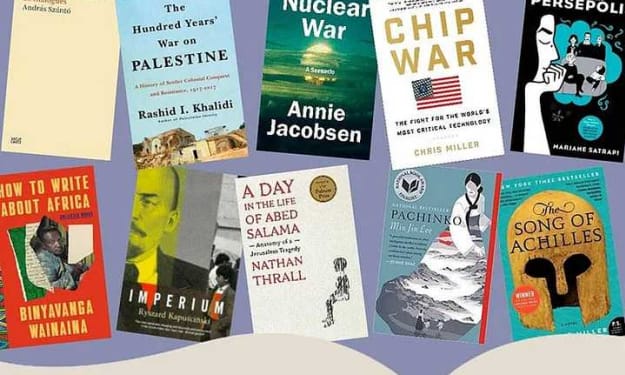
My 2024 Book list: Challenging Book for Challenging Time
I read 44 books in 2024, extensively sampled throughout history, technology, society, and current events. That’s reflected in the first and end portions of my post, which spotlight my favorite nonfiction and fiction novels.
By jaklin genieabout a year ago in Education
Wise~Guys
— Look Behind what's in Front of You ~ Make Good Choices — Hey, So how you Doin'..! Made~Men — Mobster Movies romanticise a distinctive, elegant appearance, impeccable attire style, along with the 'Families' expressive lingo. Making their 'Bones' gave them Panache — with vintage fedoras, tailored pin-striped suits, mirror-polished wing-tip shoes adorned with tassels; with their 'Gun Moll' gorgeous dates on their arms.
By Jay Kantor24 days ago in Families



Comments
There are no comments for this story
Be the first to respond and start the conversation.