
Why China’s Population is shrinking
Main causes of China's reduction in population
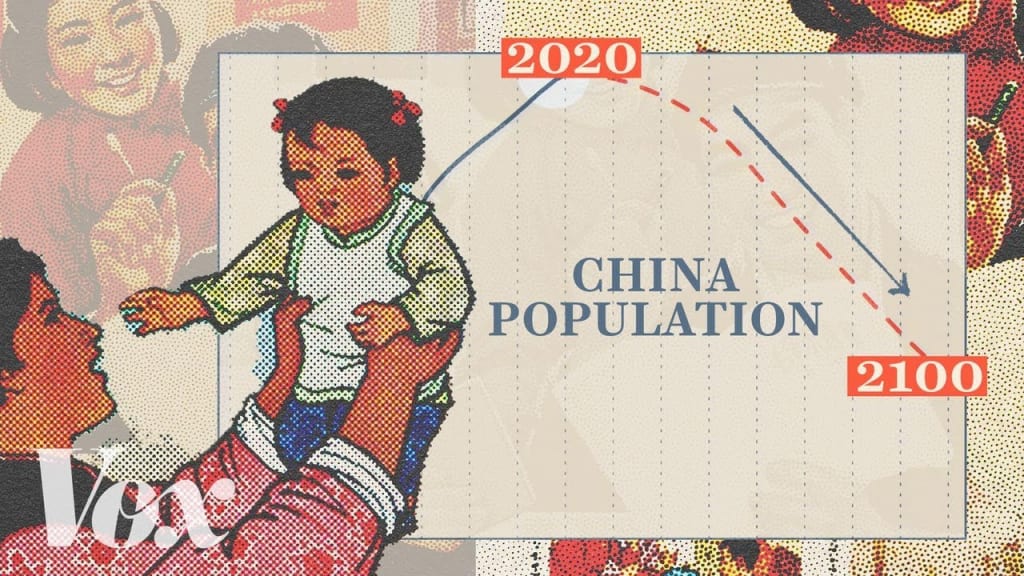
Over the past 60 years, China's birth and mortality rates have witnessed strong birth rates. But in 2022, China's population fell for the first time in six decades as a result of more deaths than births. Consider this to see why this is such a significant deal: Because of its enormous population, China is the world's industrial superpower. Manufacturing accounts for around 30% of the nation's economic output. Here is a chart of China's population during the previous 60 years. Its population of 1.4 billion people is still roughly as large as it has ever been, despite losing over a million individuals in 2022. However, it's anticipated that by the end of the century, that will almost halve. China's growth and policies over time have contributed to the reduction of its population.
It is presently trying to change its trajectory in order to maintain its population. Unfortunately, it could already be too late. Under Mao, China went through one of its worst famines ever in the 1950s. Deaths totaled 30 million. The birth and death rates chart shows a significant increase in mortality if we look at that. The population shrank at the same time that the birth rate fell. But there was a baby boom just after, as is typical with wars, famines, and other severe catastrophes.
In addition to international medical advancements that reduced newborn death rates The typical Chinese family now had six kids. The administration considered the skyrocketing birth rate to be a serious issue. The Chinese government recognized that the population was expanding too quickly and that action needed to be taken. The administration unveiled a policy... It was referred to as "Later, Longer, Fewer". fewer births, later marriages, and birth intervals that are longer. As a consequence, China's birth rate began to decline, but the country's officials felt it wasn't low enough. The severe one-child policy, which restricted most families to one child, was also put into effect in 1980. Extremely severe tactics were also used to support the policy.
There were sterilization drives, IUD insertions, and forced abortions. These programs were at their worst during the one-child policy, when China sterilized 20 million men and women and instigated approximately 15 million abortions in a single year, despite the fact that they started during the Later, Longer, Fewer era. But China had succeeded in its objective. Population expansion was being managed. However, China would soon find that these stringent regulations were maybe a bit too effective.
Every couple has to have, on average, 2.1 children for any population to maintain its size throughout time. The replacement rate is what we refer to as. The notion is that 0.1 makes up for children that pass away before they reach adulthood and that one child replaces one parent. But for more than three decades, China has had a fertility rate far below 2. To mention that, China ultimately abandoned the one-child policy in 2016. And in 2021, after a brief experiment with a three-child limit, they eventually allowed families to have as many children as they wished. It hasn't, though. The particular family structure that the one-child policy creates is a significant factor. We're looking at a family structure known as a 4-2-1, in which a pair has 4 parents above them and 1 kid below.
Most nations have a variety of family patterns, some with three children and others without any. Millions of only children, however, are under growing pressure to care for their aging parents and elderly grandparents as a result of China's 4-2-1 model. And this can make raising numerous children more difficult, especially now that living expenses are increasing. According to a recent poll, more than 50% of young individuals don't desire more than one kid due to financial and employment demands. Cash subsidies for more births, lengthier paternity absences, kindergarten subsidies, and other forms of financial support have all been observed.The truth is that very few of them have succeeded since having a kid is extremely expensive and requires a lifetime commitment. It is therefore quite difficult to assign a monetary value to this.
However, the demographic issue in China is not simply about newborns. In addition, the harmony between young and old is important. If we examine population pyramids that display age distribution. We see that nations with high population expansion, like Kenya, resemble this: broad at the bottom, signifying a large influx of new youth, and thin at the top. Philippines-like nations with slower growth are still triangular. But there is less of a distinction between the top and bottom. Now look at China; you'll see that it has a narrow bottom and fewer infants. And the hefty top: a greater proportion of senior citizens. This is a positive result of our rising standards of life and better health, but when paired with persistently low fertility, it only results in persistent population aging. This is how the pyramid is predicted to appear in 2050.
And it will further reduce China's population, reduce its workforce, and place the entire nation in an exceptionally challenging situation. China developed and became a hub for inexpensive manufacturing and exports in the 1980s. A decade later, it was climbing the economic ladder quickly and was one of the largest and fastest-growing countries by GDP. However, that economic modernization not only resulted in additional declines in birthrates but also did not result in a more prosperous economy for everybody. China has a far lower level of life than these high-income nations when we compare GDP per capita, which is our best measure of living standards.
Despite almost overnight economic growth, China is still a middle-income nation. numerous, particularly in rural regions haven't reaped the benefits of China's economic rise too much. Moreover, China has not yet created the safety nets required to care for its elderly population. in order to create the social infrastructure. like the social programs for retirement and health care. It requires time. That's getting, too. actually more difficult in light of the declining economy. Furthermore, a weaker economy will ultimately change China's status as a global manufacturing giant.
The internal resource restrictions would also limit Chinese ambition and its global reach, which has implications for both China and the rest of the globe. In certain respects, China is not unique. Numerous nations in Asia and Europe are also seeing population reductions. China stands out because of how quickly things have changed there. It was just forty. Years ago, China began using its enormous population to boost its economy while also attempting to slow population growth. China's population growth has now been declared to be finished. China may need to reevaluate its destiny for its domestic population as well as its future as a global giant.
About the Creator
Pelumi Emmanuel
freelancer, a degree holder,
Counselor, public speaker and sports enthusiast....
Keep reading
More stories from Pelumi Emmanuel and writers in Families and other communities.
How researchers hack bacteria to dye blue jeans
The vast majority of us can't envision looking through our storage room and not seeing a couple of these, blue Jeans. you have the thin trendy person kind, boot cuts, father pants, no judgment. One thing that pretty much our pants share for all intents and purposes is all that blue part, the indigo color. Tragically, the color we use today is really grimy. What's more, since we make a great deal, and I mean, truly a ton of pants, that one cycle has an effect, yet certain individuals are reevaluating the manner in which we make the indigo color. So later on, our pants may very well be a little more clean. I'd wear this. I believe I'm wearing this at the present time. Truth be told. Pants are notable, just so everyone has them in their wardrobe. In this way, I feel for that reason they're an extraordinary contextual analysis. The fact that billions of matches make reliably, it assessed of pants are made, and to give them that notorious blue shade, north of 70,000 tons of indigo are delivered too, and that indigo is really key to that exemplary blurred look. That makes pants so incredible in light of the fact that like as you wear pants, this falls off, and you get this like lovely blurring. Thus, that is the reason you can utilize indigo.
By Pelumi Emmanuel3 years ago in Futurism
Wise~Guys
— Look Behind what's in Front of You ~ Make Good Choices — Hey, So how you Doin'..! Made~Men — Mobster Movies romanticise a distinctive, elegant appearance, impeccable attire style, along with the 'Families' expressive lingo. Making their 'Bones' gave them Panache — with vintage fedoras, tailored pin-striped suits, mirror-polished wing-tip shoes adorned with tassels; with their 'Gun Moll' gorgeous dates on their arms.
By Jay Kantor22 days ago in Families




Comments
There are no comments for this story
Be the first to respond and start the conversation.