
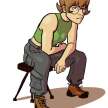

“Find her.”
These were the last words my grandfather said.
Then he fell face forward into his food.
“Dave,” my mother finally said. “Your father’s dead.”
“Yes.”
Dad just kept looking at his dad’s face plant. My brother and I wiped gravy splatter from our cheeks. No one knew what to do. I mean, would you?
Then suddenly Mum went into super high efficiency mode. She grabbed up a cushion from the sofa. She put it on the table and extricated Gramps’ head from his now empty bowl and placed it on the cushion. Then she started delegating.
“Stephanie, call Dr. Singh. Here.”
She handed me her phone with the doctor’s number already mid-dial.
“Matt, get your dad a glass of scotch.”
“Dave,” she took my dad’s hand and put it on his dad’s shoulder.
She’d kept his face turned away from dad when she’d placed it on the cushion so he didn’t have to look at Gramps’ slack food spattered face but, when she draped a napkin over him too, Dad looked like he might faint so she whisked it away again. Matt handed him a stiff drink, he got it together and we sat there in silence, Dad patting his dad’s arm now and then, the rest of us just looking at the two of them.
When Dr. Singh arrived he looked grave and serious and respectful then surprised us all by declaring, “Mr. Shaw is not dead.”
And that’s how my grandfather came to be lying in an intensive care unit in a coma.
“We shouldn’t have called the doctor,” Mum said, guilt being her default mode.
“You have to,” Dad said. “We shouldn’t have let them put him here.”
He gestured to the whole ICU set up.
“You have to,” I said. “We should see if he made a Living Will.”
“We should find her,” my brother said.
All three of our heads turned toward Matt.
“Find who?”
“The old woman who lives in the shoes,” he said.
Then he pulled a little black book out of his jacket pocket.
“That’s not…you didn’t…Matt, were you snooping around your grandfather’s room?”
So, here’s the thing. Old people have their schticks, right? Stories they keep telling, moments in time they repeat and repeat as if you’ve never heard them before. All my childhood I can remember my Gran and Gramps—it looked like flirting—saying two things to each other. If he was annoyed with Gran, Gramps would pat his pocket and say, “Careful or I’ll look up the names in my little black book.” To which Gran’s reply, again and again, was, “Do that and I’ll use my mad money.”
She’d bat her eyelashes and he’d give what she referred to as his “sly grin.”
Then she’d proceed to explain, for the two thousand three hundred and sixty-fourth time, what was meant by Little Black Book and Mad Money.
Yackety yack. I tuned them out. A little black book with the names and numbers of available females was not a good look for my then octogenarian Grandfather. Gran’s Mad Money locket was of some interest, at first. She’d take me into her room, open her ancient jewellery box, and pull out a gold chain with what looked like an enormous locket.
“This,” she said. “Is what a young woman would wear on a date. If a young man got frisky you could get out of the car and have enough tucked inside for a taxi.”
Since they’d had only my dad and there was no daughter for her to pass this onto, clearly I was supposed to lust after this locket. And maybe at the ages of five, six, or seven, I actually did. But by the time I was a tween this clunky heart-shaped thing held no interest.
“If a young man got frisky with me, I’d deck him,” I’d say, or “You’d need way more than that thing would hold for a taxi these days”, or “I’m more likely to date girls, do we need Mad Money for them too?”
Gran stopped showing me her locket.
But she never stopped teasing Gramps with it, so it wasn’t all that weird that when Matt produced the Little Black Book, my mind immediately flashed onto the locket.
“Look,” he said, riffling through the pages of this small worn book.
“Empty,” Mum said.
“Of course it was empty,” Dad said. “He was devoted to Mum.”
“Then who’s this?”
Matt’s riffling ended at the last few pages. He plucked out a tiny black and white photograph and held it out for us. It was of a woman, blonde, with a huge smile, holding her hands clasped behind her head like a pinup girl from the old days.
And on the back it said, “From the old woman who lives in the shoes” in a very swirly clearly female hand. And there was a little x and a little o. That’s all.
“Not Mum,” Dad said.
“Definitely not Gran,” Matt and I said together, then, “She’s a babe,” Matt said.
“Well, I’ll be,” said Mum. “Must be England. Wartime.”
“Must be,” Dad said.
“I think he wants us to look for her,” said Matt and at that moment, I swear, we all four heard a sound from Gramps. We rushed to the bed but there was no change in him at all. Had we imagined it?
Matt immediately got to work. There were several pubs in England with the word “shoe” but only one with “shoes.”
“The Elephant and Shoes,” Matt said, holding his phone towards us.
Back home, Matt kept digging. Not one of us believed this woman, whoever she was, would still be alive and yet…why not? Gramps was.
Well, Sort of.
I went into his room, he’d moved in with us just a few weeks before, and there was Gran’s jewellery box on top of his dresser. I could hear Matt making a phone call. I could hear the anticipation in my parents’ voices in the kitchen, but I was drawn like a magnet to the ancient box. I opened it. It now held some of my Gramps’ cufflinks and tie pins, but all of Gran’s stuff was still there too. Including the locket.
“Do they have a phone number?” I heard my mother say.
I lifted out the locket and saw that inside was a tiny key. The kind that might open a diary, it was that small. Immediately, my eyes went to the little lock in the lower quarter of the jewellery box. I’d always thought the key to it was lost. Gran always said it was empty, anyway, when I’d wanted to see inside. Sure enough, the key fit.
I slid out the slender drawer, expecting to see an old necklace or something, but no. There was no jewellery. There was money. Old money made of paper instead of plastic. There were fifteen one thousand dollar bills, which you can’t even get anymore, and ten five hundred dollar bills. Twenty thousand dollars total. I walked back into the kitchen where the rest of them were clearly excited.
“Steph, we think we’ve found her,” Mum said.
“We’re going to call right now,” Matt said.
“Let’s not call,” I said. “Let’s visit.”
I could see my accountant mother quickly adding up the cost of four trans-Atlantic flights and hotel rooms in her head including meals, trains and taxies.
“My treat,” I said, waving the stack of pink and brown bills. “Mad Money.”
And that’s how the four of us came to be sitting in the tiny senior’s flat, in Ely, Cambridgeshire, England, of one ninety-six year old Anne Pigott. She held the photograph in her hand and stared at it. What did she make of these four jet-lagged Canadians who’d just burst in on her peaceful village life?
“You were a babe,” Matt said.
She smiled, then, and despite the wrinkles and completely white hair it was The Babe again.
“Wasn’t I?” she said. “The bee’s knees. The cat’s pajamas.”
I loved her accent. “Pajawmuhs.”
“I think we need tea.”
That gave us all something to do, at least. There were biscuits to pull out of a cupboard. There was a kettle, a tea pot, matching delicate cups and saucers. And all this had to be arranged on a tray and carried back into the sitting area which was all of ten feet from the kitchenette. When we settled again, Matt just burst out with what we were all thinking.
“He was in love with you.”
Long silence. Well, it seemed long. It probably wasn’t, really.
“I suppose he was. “
“Were you in love with him?”
She took a while to answer, but when she did I got chills.
“I loved them both,” she said.
She stood and slowly, slowly, made her way into her little bedroom off the sitting room. We four looked at each other. We had lots to say but she was just a few feet away so we only opened our eyes wider and shrugged at each other. She came back slowly, slowly, and handed Dad another photograph. Just as small as the one we’d given her, but this one had three people in it: two women and one man. The Babe, Gramps and—
“My mother?” Dad said.
The Babe just smiled that smile.
We all stared at that photo. The three of them looked so happy. And friendly. Very very friendly.
“Well, I’ll be,” Mum finally said.
“Quite,” said Anne Pigott.
We knew Gramps had been a pilot in World War Two, of course. And Gran had been a nurse but they both insisted they’d gotten together “on their own turf” in Canada. And they’d married decades after the war was over. Dad was a late-in-life baby.
“Neither of them talked much about it,” Dad said. “The war, I mean.”
“No. One doesn’t, does one?”
There was a pretty long silence while we processed all of this.
“Elly,” Dad said, and Mum looked up. “Getting together isn’t really the same as meeting is it?”
“No,” Mum said. “You and I met in Vancouver but we got together, three years later, in Toronto.”
“There you are, then,” Mrs. Pigott said.
“Well, I’ll be,” Matt said and we all burst out laughing. The tension had broken.
“So you did love him,” Matt said. “Them.”
“We loved them all,” Anne Pigott said. “All those brave men and women who came over to help us during that horrible and strangely alive time.” There was a long silence and none of us rushed to fill it. “But did I love him—them—the way I loved my Joe? No. I didn’t believe so, at any rate.” More long silence. “And Joe came back. Six years. Six years away and any day there could have been a telegram telling me he’d—well, that was pretty rough.”
There was nothing we could say to that. We all just kind of sat there each having our own thoughts and the next thing I knew, Matt was nudging me to look at Mrs. Pigott.
She’d fallen fast asleep.
My dad looked stricken, but Mum put her hand on his arm and whispered, “No, Dave, she’s just sleeping.”
We spent a lovely couple of days in Ely. We visited the famous cathedral at Anne Pigott’s insistence and we had several more tea parties.
When it came time to leave we were all in tears. We were still teary on the plane ride home. Dad got a text message from the hospital. Gramps had passed peacefully just as we were lifting off.
That was ten years ago but it feels like yesterday.
So now I love my clunky gold locket with its picture of two babes and a handsome fly boy with a sly grin.
And brother Matt can sometimes be seen patting the pocket where he keeps a little black book. I don’t know if he has names and numbers in it. Maybe there’s a picture.
Maybe it’s of you.
About the Creator
Keep reading
More stories from writers in Families and other communities.
The Vanishing Street
Junaid had walked Elm Street every morning for years. The same route to school, the same corner shop, the same lampposts casting long shadows at dawn. It was predictable, comforting, and safe. But one morning, as he stepped outside, something felt wrong. The street looked different. Houses he remembered had shifted slightly, windows missing, doors misaligned. Even the familiar scent of baked bread from Mrs. Ameen’s bakery was gone.
By Sudais Zakwan6 days ago in Families


Comments
There are no comments for this story
Be the first to respond and start the conversation.