
What We Find Between the Covers . . .
. . . Is Entirely Up to You
MIRANDA HAD ALWAYS DREAMED OF OWNING A HOME WITH A LIBRARY. She imagined a special room lined with bookshelves, each one filled with volumes that traced the course of her passions from her childhood fascinations with animals, ballet, and Disney tales; through college, when she earned a degree in veterinary science; to motherhood, when she allowed her mind to take full flight, embracing mathematics, astronomy, the history of art and religion, cinema, and scores of other topics that I could only attempt to appreciate and comprehend.
We never did have that house with a library, and the more time passed the more it bothered me. I felt I owed it to her. In the meantime, she had happily transformed our entire home into a library, arranging bookshelves along narrow hallways, stacking new finds on the living-room floor, loading novels and biographies into the unused corners of our bedroom, and complementing our stagnant DVD collection with books about all of our favorite films. Her arrangement was very deliberate. She knew every book she owned, and she knew exactly where to find each one.
But Miranda was gone and our daughter, Claire, was in Manhattan. I had the house to myself. Sometimes, as I wandered through the space, I would find small mementos on the bookshelves, reminders of spontaneous moments from long ago: a teacup with the leaves still inside; a hairpin with a jeweled bumblebee fixed to the end, strands of Miranda’s hair caught in the wings; a pair of misplaced reading glasses, her fingerprints on the lenses; a Post-it note with a short list of ingredients for a cake. She liked baking. She had books for that, naturally. But her books were a luxury I could no longer afford to keep. The old slate roof was finally giving out and the rainwater was seeping in, the leaks dripping through the second-floor ceilings, leaving ugly stains on the plaster, puddles on the floors, and sagging shelves loaded with soggy books.
The idea of leaving our one and only home was heartbreaking, but I didn’t need so much space, and the roof repairs were more than I could afford. It was time to move, but the books had to be moved first, and he way to move them was to sell them. I had no illusions about their value. Miranda was not a collector of rarities or first editions—she bought books to read and to use, books that would fill her mind as well as her shelves—and had no use for rarities and showpieces. All of which is to say that I didn’t think the collection was worth much, but I did think it was worth something, and there were a few volumes that I suspected were worth a lot. I retrieved those from their shelves, wrapped them in a plastic grocery bag, and grabbed the car keys.
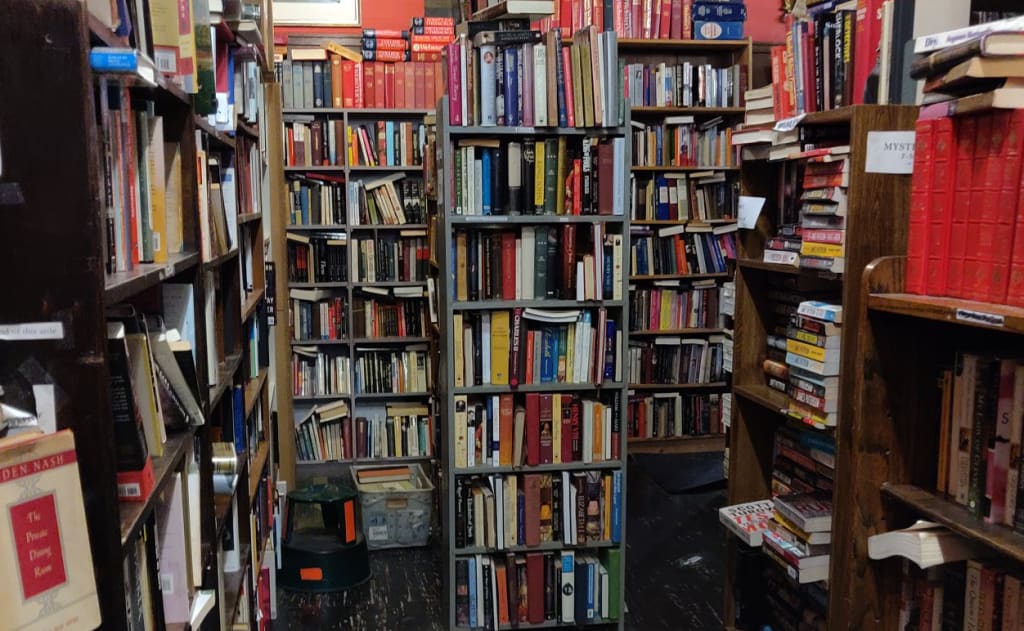
THE SHOP WAS CRAMPED WITH TOWERS OF BOOKS STACKED FLOOR TO CEILING, layered three columns thick against the walls. The dank aromas of paper and glue filled the heavy air, and flakes of crumbling yellow newsprint littered the rough wooden floor. The desk was unstaffed, the old mechanical cash register unguarded, and the back-counter display cases of rare and expensive volumes ripe for looting. I had been in here a few times before, usually when Miranda went on a buying spree to address her latest areas of interest, and the front room was always abandoned when we arrived, but it never stayed that way for long. One of a rotating cast of eccentrics would appear from the next room, looking exactly like the sort of person you’d expect to be running a used bookshop: frumpy, slightly unkempt, uninterested in the finer points of clothing and haircuts. Today, though, no one came.
“Hello,” I called. No answer. Slight shuffling noises, punctuated by percussive clacks, wafted in from the warren of aisles and dead ends that I knew lay beyond the front room. I stepped through the doorway, trying to trace the source of the sounds, rounding a corner, past a shelf filled with old ‘70s Erich Segal bestsellers and a teetering pillar of National Geographics, only to find myself at a crossroads, then another, and another. “Hello” I called again. I was deep inside the building now, the passages narrower, the air thick with the must of ancient volumes, the light so dim that I had to feel my way along the shelves with my free hand. I was nearly at the point of heading back—surely I wasn’t supposed to be here—when I turned one more corner and finally arrived.
Fifteen feet ahead, sitting on the floor under the sickly amber glow of a bare bulb, a young woman with bushy dark hair was absorbed in the task of sorting books onto an ancient library cart. She looked inside the front cover of each volume before inserting it into its proper place alongside the others. I recognized their bright-yellow spines: Nancy Drew books, just like the ones Miranda and I had bought for Claire years ago, and left behind when she moved to New York.
“Excuse me,” I said. The woman’s eyes were glued to the open book in her hand. “There’s no one at the front desk.”
She turned her head, her gaze slowly shifting to meet mine, moving as if she were underwater. “Oh?”
“Yes, I, um . . . I have some books I might want to sell.”
“I was hoping to see you.” Her eyes had already refocused on her book. “I have to put these away. Parents buy them for their children. The children sell them when they grow up. Then they buy new ones when they have children of their own.” She handed me a copy of The Secret of the Old Clock, open to the first page and a note scrawled in blue ballpoint:
To Marsha
From Mom and Dad
We love you!
Christmas 1975
I returned the book with a creeping sense of guilt. “You were hoping to see me? I think you’ve mistaken me for someone else. We haven’t met.”
She settled back against the cart, finally directing her attention to me in earnest. “I’ve worked with books for a long time. I rarely find one that I have never encountered. Show me one that’s interesting and unusual, one that I have never seen.” She smiled slightly, waiting for me to meet her challenge.
“Well . . .” I unwrapped my bundle and separated one book, a large-format hardcover, from the others. “This is The World Atlas of Tobacco. It was published in 1957 by the Tobacco Institute. The paper is milled from tobacco, the dust jacket is made from tobacco, and it has bound-in samples of every variety of tobacco from across the globe. See?” I turned the pages so she could see the tobacco leaves stitched into the spine, each one accompanied by a description and a map showing where that variety was grown. “Even now, if you get close, you can still smell it.” I bent my head into the book and inhaled. “Funny thing: We weren’t even smokers. I think this is the most valuable book she owned. Only a few copies were produced. Here, have a look.”
“Who is she?”
“My wife, Miranda. These were her books.”
The woman gently cradled the book in the bend of her arm, turned the pages, and scanned the text, delicately rubbing a few of the brittle leaves between her fingers. She raised her eyebrows. “This is, indeed, an interesting and unusual book, one that I have never seen before. Thank you.” She closed it and handed it back to me. “Why do you want to sell it?”
“Miranda collected a lot of books. A whole houseful, actually. I love the house, but I can’t afford to keep it. It’s old, it needs work, the roof leaks. I can’t stay there. I need to move. I have to sell the books.”
“Miranda is no longer with us?”
My throat tightened and I looked away. “No, she isn’t.”
“Hmmm.” Her eyes drifted to a nearby bookshelf. “I also have a book that is interesting and unusual. One that you have never seen.” Her finger glided along cracked spines, leaving a clean trail in the dust, until she found her target. She pulled the volume from its home and held it toward me without extending her arm, forcing me to bend down to meet her.
It was a plain black book, about five by eight inches and, other than the dust along the formerly exposed edges, it showed no signs of age. I opened the cover and froze. Photos of Miranda and Claire were glued inside. Notes, written in Miranda’s hand, described birthdays, Claire’s first day of school, our observation of Saturn through the backyard telescope, everything from the extraordinary to the mundane. Movie tickets, report cards, old letters, and scraps of Claire’s artwork were stuck between the pages. It was a record of my family’s life, composed by Miranda, and I had never seen it before. I snapped the book closed. “How did you get this?”
She smiled slightly. “Would you agree that it’s interesting and unusual?”
“Yes. How did you get it?”
She placed her hands on the cart and pulled herself to her feet. “If you owned that book, would it be the most valuable one in your collection?”
“Of course it would be.”
“Then what a pity Miranda never wrote it.”
Stunned, I flipped through the book again. It was empty, only white lined pages. Years of memories that had been meticulously recorded between the covers had vanished. I looked up, silently pleading for an explanation.
“She had so many books, yet she never wrote one of her own.” She handed me a pen. “But you can. That’s an empty notebook. That’s all it is. Its value depends on what you do with it.” She settled back to the floor. “I have to get back to work. Take Miranda’s books home with you. And you can have that notebook, but you assume responsibility for its contents. Fix the roof.”
“Its contents?” I fanned the pages again and saw something that I was sure hadn’t been there before. I removed it and held it up to the feeble light. “Did you know there’s a hundred-dollar bill in here?”
“I guess it’s your lucky day. I find the oddest things between the covers.” She opened another volume of Nancy Drew. “This one says, Hannah, please get well. We miss you. I wonder what happened to Hannah . . .” Then, her eyes still on the inscription, she pointed to the darkened space beyond her cart. “That door will take you back to the front room.”
I SAT BEHIND THE WHEEL holding one more book than I had when I arrived. I tried to convince myself that the whole thing had been a hallucination, that I could walk back into the shop and all would be just as it had been in the past. But there was no mistaking the hundred-dollar bill in my pocket. I checked. It was still there. I half expected it to vanish, just like the briefly glimpsed contents of that little black book. I picked it up and examined it again. In the bright sunlight I could see mold spots along the spine. It had never been used, but it also wasn’t new. I opened the cover and a flurry of bills fell into my lap. More spilled out as I tried to collect them. I grasped both covers, spread the book wide, and shook until the blizzard of paper finally ceased. I gathered the bills and counted: twenty thousand dollars, the stack far thicker than the book it fell out of. You assume responsibility for its contents. Fix the roof.
I would. But there was something I had to do first. I uncapped the pen and started to write.
About the Creator
Jason Liller
I am happily buried in books!
Keep reading
More stories from writers in Families and other communities.
Wise~Guys
— Look Behind what's in Front of You ~ Make Good Choices — Hey, So how you Doin'..! Made~Men — Mobster Movies romanticise a distinctive, elegant appearance, impeccable attire style, along with the 'Families' expressive lingo. Making their 'Bones' gave them Panache — with vintage fedoras, tailored pin-striped suits, mirror-polished wing-tip shoes adorned with tassels; with their 'Gun Moll' gorgeous dates on their arms.
By Jay Kantor24 days ago in Families
The Wise Rooster
The Wise Rooster “You are fortunate,” the ox said to the donkey, “because I plow the fields all day while you live in comfort.” The donkey replied, “If you listen to me, you too can find peace. Pretend to be sick tomorrow while working, and the owner will not make you work.”
By Sudais Zakwan3 days ago in Families
Thoughts on Vocal and the way the world is
"Death cannot stop true love, only delay it." – Wesley in The Princess Bride. I decided to come back to Vocal on a very cold and dark night at the end of December. I had been, and still am, convalescing from a horrible staph infection that had gone misdiagnosed for months. This, paired with the increasing challenges of being healthy, making the best choices for my co-parented child, being a wife, and being a director at a new job, was a lot to manage.
By Jazzy 7 days ago in Confessions



Comments
There are no comments for this story
Be the first to respond and start the conversation.