
What is the Final Stage of Frontotemporal Dementia?
Navigating the Stages of Frontotemporal Dementia: Symptoms, Care, and Hope for the Future


Frontotemporal dementia is a complex neurological disorder primarily affecting the frontal and temporal lobes of the brain. Knowing the progression, especially the last stage, is important to the patients, caregivers, and the medical professionals. This article explores the progression, symptoms, and caregiving challenges in the final stage of FTD while addressing frontotemporal dementia life expectancy.
What is Frontotemporal Dementia?
FTD, also referred to as frontotemporal lobar degeneration (FTLD), is a series of disorders that result from the progressive loss of nerve cells within the frontal and temporal lobes. The degeneration that occurs results in a decline of specific functions associated with the areas. Unlike Alzheimer's disease, which usually begins with memory loss, FTD often begins with noticeable changes in personality and behavior.
Causes and Risk Factors of FTD
The causes of FTD are unknown, but several factors are contributing to this disease. The research established that some of the most important contributing factors include the following:
- Genetics: About 40% of cases have a genetic predisposition. Mutations in specific genes, such as MAPT, GRN, or C9orf72, are associated with familial forms of the disease.
- Age: FTD most frequently affects people between the ages of 40 and 65, thereby being one of the leading causes of dementia in younger groups.
- Unknown Causes: In many cases of FTD, there is no obvious family history or genetic mutation, which suggests that there may be other environmental or lifestyle factors involved.
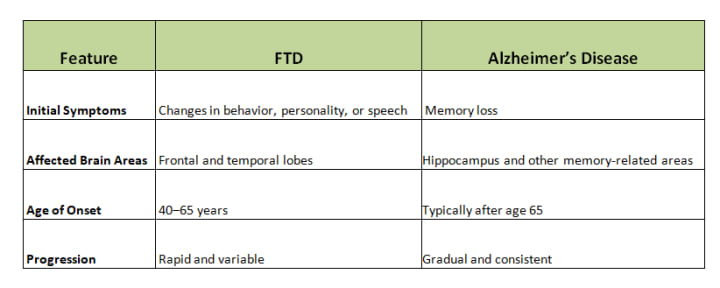
How FTD Differs from Alzheimer’s Disease
While both FTD and Alzheimer’s disease are forms of dementia, their presentation, progression, and impact differ significantly:
Frontotemporal Dementia Subtypes
FTD has been divided into subtypes based on the predominant features:
- Behavioral Variant FTD (bvFTD): Characterized by marked changes in personality, behavior, and social interaction.
- Primary Progressive Aphasia (PPA): Two main variants: non-fluent/agrammatic and semantic. The former primarily impairs language skills.
- Movement Disorders: Some types of FTD include motor symptoms in addition to the above, such as corticobasal syndrome (CBS) and progressive supranuclear palsy (PSP), which have symptoms of tremors, stiffness, or coordination impairments.
Stages of Frontotemporal Dementia
Frontotemporal dementia is a progressive neurological disorder that develops in stages, each with its symptoms and challenges. Although the progression rate varies from one individual to another, knowing these stages can help families and caregivers prepare for the changes and offer effective care. Generally, FTD is divided into three stages: early, middle, and final.
Early Stage: Initial Symptoms and Diagnosis
Early FTD generally starts gradually, and identification is therefore difficult. In contrast with Alzheimer's disease, which presents first as a memory impairment, the initial symptoms of FTD include changes in behavior, personality, and speech.
Important Features of the Early Stage:
- Behavioral changes: Inappropriate apathy, decreased empathy, or inappropriate social behavior. These may manifest as impulsive behavior or poor judgment or neglect of personal hygiene.
- Emotional Changes: Reduced emotional control, resulting in mood swings or irritability.
- Language Problems: Anomia, reduced vocabulary, or unusual speech patterns in the case of Primary Progressive Aphasia (PPA).
- Diagnostic Challenges: Symptoms are often mistakenly attributed to mental health disorders such as depression or anxiety, which delays an accurate diagnosis.
Care Planning Considerations:
- Encourage early medical consultation for behavioral or language changes.
- Start planning for future care and explore support resources.
Middle Stage: Advancement of Cognitive and Behavioral Symptoms
In the middle stage, symptoms are more pronounced, and the individual's independence is compromised. Cognitive decline, physical changes, and emotional instability are more apparent.
Important Characteristics of the Middle Stage:
- Cognitive Symptoms: The patient may be unable to make decisions, plan, or organize activities.
- Language Decline: Speech becomes non-fluent or non-sensical, and the patient's ability to understand is compromised.
- Behavioral Escalation: Obsessive or compulsive behaviors may develop, along with more significant social withdrawal or inappropriate behaviors.
- Physical Symptoms: Muscle weakness or rigidity may present, especially in movement-associated FTD subtypes.
Care Considerations:
- Develop a routine and make things easy to do.
- Refer the patient to healthcare professionals for management of symptoms.
- Counsel the caregivers on managing stress and fatigue.
Final Stage: What to Expect
In the final stage, FTD results in serious cognitive, physical, and emotional loss. The individual becomes unable to perform daily activities and thus requires full-time care.
Features of the Final Stage:
- Severe Cognitive Decline: The patient is unable to recognize family members or contribute to meaningful conversations.
- Physical Decline: Loss of mobility, muscle rigidity, and difficulty swallowing (dysphagia) become common. These changes can lead to complications such as malnutrition or infections.
- Increased Dependence: Individuals become entirely dependent on caregivers for basic needs, including feeding, bathing, and toileting.
- Behavioral Symptoms: Agitation, apathy, or extreme emotional withdrawal may dominate.
Care Considerations:
- Focus on comfort measures and palliative care to improve quality of life.
- Work with healthcare providers to address physical complications and provide emotional support.
- Engage in end-of-life planning, ensuring the patient’s wishes are respected.
Transition Between Stages
The progression from one stage to another is not always linear, and symptoms can overlap. The duration of each stage also varies widely, ranging from a few years to over a decade.
Frontotemporal Dementia Life Expectancy
The average life expectancy for patients with FTD is 7-13 years from the onset of the disease. The pace at which patients progress through the phases and eventually end up will largely depend on age, their health status, and what kind of FTD subtype exists.
Knowing the phases that are involved in FTD can help families and caregivers prepare the journey with empathy so they might provide the best support and care possible.
Factors Influencing Frontotemporal Dementia Progression
The progression of frontotemporal dementia (FTD) is influenced by several factors, each affecting the speed and severity of symptoms as individuals move through the stages.
Genetic Factors:
- Some genetic mutations, such as those in the MAPT, GRN, or C9orf72 genes, affect the rate of progression and type of symptoms.
- Early onset and rapid symptom development can be seen in people with a family history of FTD.
Subtype Variability:
- Behavioral variant FTD (bvFTD) tends to evolve differently than language-based subtypes, such as Primary Progressive Aphasia (PPA).
- Movement-related subtypes, such as corticobasal syndrome (CBS) or progressive supranuclear palsy (PSP), may have severe motor symptoms, complicating care needs.
Age and Overall Health:
- Younger patients may have a more aggressive progression.
- Comorbid conditions, such as cardiovascular disease or diabetes, can exacerbate symptoms and lead to complications.
Environmental and Lifestyle Factors:
- Access to early diagnosis, quality care, and symptom management can impact the quality of life and slow symptom progression.
- Emotional and social support for the patient and the caregivers can help effectively manage behavioral and psychological symptoms.
Conclusion
Understanding the stages of frontotemporal dementia is an enlightening process that gives caregivers tools to manage challenges compassionately and understand the disease progression. FTD, of course, presents some tremendous hurdles, but advances in research and support systems do bring hope for better care and improved outcomes for affected people. By creating awareness and collaboration, families can manage the complexities of FTD with resilience and dignity.
About the Creator
Shelia Bailey
Shelia Bailey is a dedicated and passionate writer whose diverse interests span health, technology, senior care, and children’s topics.
Keep reading
More stories from Shelia Bailey and writers in Families and other communities.
How Quickly Does Frontotemporal Dementia Progress?
Frontotemporal dementia, or FTD, is an aggressive and rapidly progressing neurologic disorder that dramatically affects the patient and others, mostly those below 65 years of age. It affects the personality, behavior, and language skills in most individuals before it impacts anything else. This information on how frontotemporal dementia develops can be very valuable for families, caregivers, and medical professionals involved in patient care and planning.
By Shelia Baileyabout a year ago in Families
Wise~Guys
— Look Behind what's in Front of You ~ Make Good Choices — Hey, So how you Doin'..! Made~Men — Mobster Movies romanticise a distinctive, elegant appearance, impeccable attire style, along with the 'Families' expressive lingo. Making their 'Bones' gave them Panache — with vintage fedoras, tailored pin-striped suits, mirror-polished wing-tip shoes adorned with tassels; with their 'Gun Moll' gorgeous dates on their arms.
By Jay Kantor18 days ago in Families




Comments (1)
This is an excellent article that provides a comprehensive overview of frontotemporal dementia (FTD), including its causes, symptoms, stages, and caregiving challenges. The information is presented in a clear and concise manner, making it accessible to both medical professionals and lay people.