
What He Never Asked For
Some sacrifices are so quiet that the people who make them are never thanked—until it’s almost too late.

Story
When people talked about sacrifice, they usually spoke about major moments—heroic actions, tragic goodbyes, or lives changed overnight.
No one talked about the minor ones.
The kind that happens every day without an audience.
Imran was the kind of man people rarely noticed. He worked as a delivery driver for a local grocery supplier, waking up before dawn and returning home long after nightfall. His clothes always smelled vaguely of dust and engine oil. His phone screen was cracked. His hands were raw in a way that never entirely healed.
He lived with his wife, Sara, and their two children in a modest apartment on the third floor of an aging building. No elevator. The stairs were tight, the lights fluctuated, and the walls echoed the sounds of other families attempting to exist silently.
Their son, Zayan, was twelve—curious, restless, and full of questions. Their daughter, Lina, was eight and exceptionally perceptive, perceiving things adults assumed children never noticed.
Imran hardly commented about his day. When asked how work was, he answered the same way every time.
“Alhamdulillah. It’s fine.”
What he never said was that his knees hurt frequently. That he skipped meals most days to save money. That he had been driving with failing brakes for weeks because repairs would mean fewer groceries on the table.
Sara knew some of it. Not all.
Every month followed the same trend. Rent first. School expenses next. Utilities. Food. Whatever was left—if anything—went into an envelope labeled “Later.”
Later never came.
Zayan had expanded faster that year. His school uniform sleeves barely touched his wrists, and his shoes pinched at the toes. One evening, Sara stated it casually while folding laundry.
“He needs new shoes soon,” she remarked.
Imran nodded without hesitation.
“Yes. I’ll manage it.”
He said it the same way he said everything—with quiet assurance, as if solutions simply arrived when needed.
The next morning, he left earlier than usual.
What no one knew was that he had sold his phone over his lunch break. Not a new phone—an ancient one with a cracked screen—but it was still worth something. Enough for shoes. Almost enough.
To cover the rest, he skipped meals for the rest of the week.
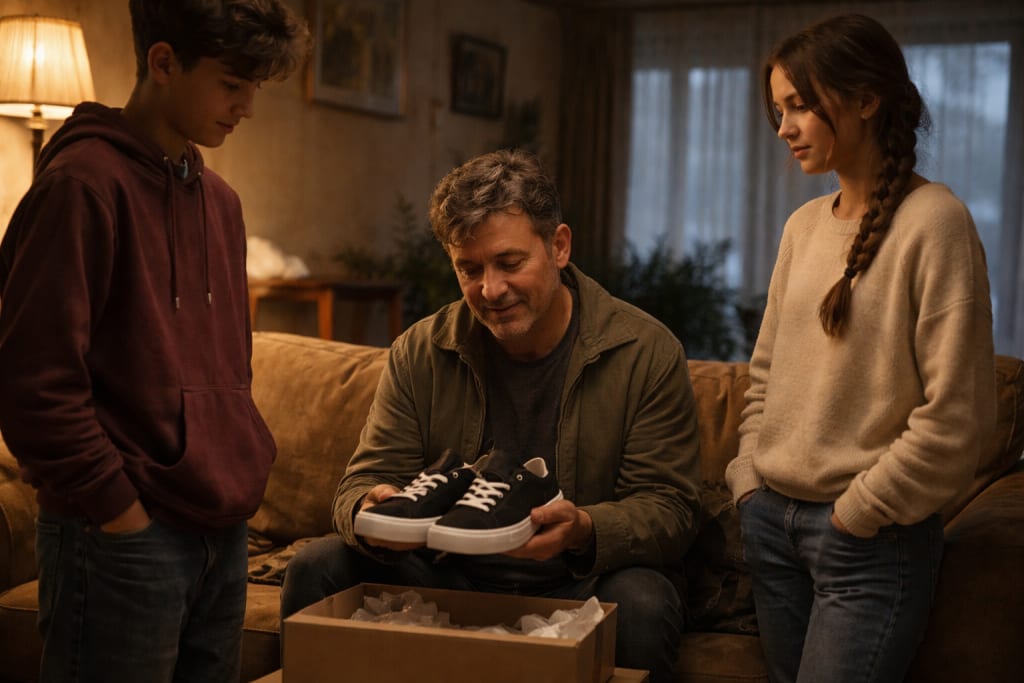
Zayan received the sneakers on Friday. New. Clean. Perfect.
“They’re awesome!” he shouted, running around the living room.
Imran smiled and watched, sitting peacefully on the sofa, caressing his leg absentmindedly.
Lina observed something that day. Her father didn’t join in. He didn’t stand up. He didn’t chase them the way he used to.
That night, she watched him meticulously patching the sole of his own worn shoe, attempting to make it last a bit longer.
Years passed.
Zayan excelled in school. Lina matured into a sensible adolescent. The flat kept the same—same flickering lights, same tiny stairs—but the youngsters imagined it bigger than the space allowed.
Imran aged swiftly.
By the time Zayan attended university, Imran’s back pain was continuous. His doctor prescribed rest. Physical treatment. Fewer hours.
Imran bowed nicely and returned to work the next day.
Rest didn’t pay tuition.
One cold evening, Imran didn’t come home on time.
Sara waited. Then called. No answer.
An hour later, a coworker knocked on the door.
Imran had slumped at the warehouse. Exhaustion. Dehydration. Untreated pain.
Nothing dramatic. Nothing heroic.
Just a body that had finally said no.
At the hospital, Zayan sat silently beside his father’s bed, staring at the familiar hands—hands that had paid for books, shoes, food, and dreams without ever asking for recognition.
“I didn’t know,” Zayan whispered. “I should’ve known.”
Imran opened his eyes slightly and smiled.
“You were supposed to live,” he murmured softly. “Don’t worry.”
Recovery was slow. Imran couldn’t return to a full-time job.
So Zayan took a part-time job. Lina helped with tutoring younger kids. Sara discovered more hours.
For the first time, Imran was the one being taken care of.
Months later, Zayan brought something home. A little box.
Inside was a phone. New. Not costly, but solid.
“For you,” Zayan said. “No cracks.”
Imran paused.
“You didn’t need to—”
“Yes,” Zayan interrupted gently. “I did.”
Imran held the phone like it was something fragile. Something unearned.
That night, Lina placed a pair of new shoes by his bed.
Imran sat quietly for a long time.
Some sacrifices are loud and evident.
Others build entire lives in silence.
And often, the greatest present is not what is given—but finally being recognized.
Disclaimer
This narrative is a work of fiction. Any resemblance to real individuals or events is coincidental. The tale is designed to mirror common emotional reality through fictional characters.
About the Creator
abualyaanart
I write thoughtful, experience-driven stories about technology, digital life, and how modern tools quietly shape the way we think, work, and live.
I believe good technology should support life
Abualyaanart
Keep reading
More stories from abualyaanart and writers in Families and other communities.
The Chair That Stayed Empty
story There was always one chair in the house that no one sat in. It was near the window, at a small slant, and it caught the afternoon light. The cushion had sunk in the middle since it had been used for so long. Ammi would straighten it every night, even though no one sat there anymore.
By abualyaanartabout 3 hours ago in Families
Wise~Guys
— Look Behind what's in Front of You ~ Make Good Choices — Hey, So how you Doin'..! Made~Men — Mobster Movies romanticise a distinctive, elegant appearance, impeccable attire style, along with the 'Families' expressive lingo. Making their 'Bones' gave them Panache — with vintage fedoras, tailored pin-striped suits, mirror-polished wing-tip shoes adorned with tassels; with their 'Gun Moll' gorgeous dates on their arms.
By Jay Kantor29 days ago in Families




Comments
There are no comments for this story
Be the first to respond and start the conversation.