
What happens when we sleep?
The Magic of Sleep: What Happens When We Drift Off
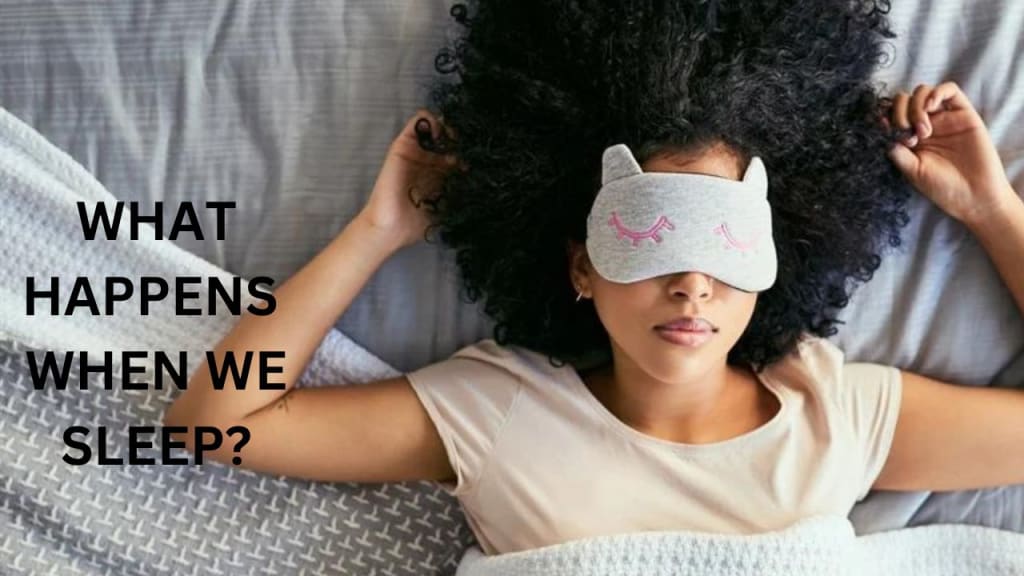
It turns out that there are two separate processes in the brain that help us create sleep. One is called your Sleep Drive, and the other is called your Sleep Rhythm. Sleep Drive is a lot like hunger. Throughout the day, much like hunger, you get hungrier and hungrier, and when you eat, your hunger begins to dissipate. Similarly, when a cell eats a piece of glucose, something comes out the back end, and one of those things is called adenosine. Adenosine works its way through our system and gets to a very specific receptor site in our brain. As adenosine accumulates, you get sleepier and sleepier and sleepier. That's Sleep Drive.
Sleep Rhythm, known as your circadian rhythm, is also like hunger. Have you ever noticed that you get hungry at particular times throughout the day, like breakfast, lunch, and dinner? That's your circadian rhythm for feeding. Turns out, sleep has its own circadian rhythm. Most people have the tendency to get sleepy somewhere between 10 and 11:30 at night.
Now, you might be wondering about those stages of sleep? what are those? During sleep, we usually pass through five different phases or stages: wake, Stage 1, Stage 2, deep sleep (which is a combination of Stages 3 and 4), and REM sleep, which stands for Rapid Eye Movement. Your brain actually goes through sleep stages in a very particular order. Usually, you go from awake to Stage 1, Stage 2, down into Stages 3 and 4, back to Stage 2, and then on into REM. That would be considered one sleep cycle, and as a general guideline, sleep cycles last somewhere between 80 and 120 minutes.
During Stage 1, or light sleep, we drift in and out and can be awakened easily. Our muscle activity slows, and if you wake up at this stage, you often remember fragmented visual images and experience sudden muscle contractions called a hypnic jerk, often preceded by a sensation of starting to fall—that’s where we get the idea of falling asleep.
When we enter Stage 2, our eye movement stops, and our brain waves become much slower, with occasional bursts of rapid waves called sleep spindles. In deep sleep, extremely slow brain waves called delta waves begin to appear, interspersed with smaller, faster waves. It's very difficult to wake somebody during deep sleep; there's no eye movement or muscle activity. If you wake up during this stage, you often feel groggy and disoriented for several minutes after.
When we switch into REM sleep, our breathing becomes much more rapid, irregular, and even shallow. Our eyes jerk rapidly in various directions, and our limb muscles become temporarily paralyzed. When people wake up during REM sleep, they often remember their dreams, which is kind of a fun aspect.
But what influences the quality and length of sleep? Since sleep and wakefulness are influenced by different neurotransmitters in the brain, food and medicines that change the balance of these signals affect whether we feel alert or drowsy and how well we sleep. For example, caffeine stimulates some parts of the brain and can even cause insomnia. Many antidepressants suppress REM sleep, and heavy smokers often sleep very lightly and have reduced amounts of REM sleep—they also tend to wake up after three or four hours of sleep due to nicotine withdrawal.
And then there’s alcohol. Many people who suffer from insomnia try to solve the problem with alcohol, the so-called nightcap. While alcohol does help people fall into a light sleep, it robs them of REM and deeper, more restorative stages of sleep. Instead, it keeps them in these light stages of sleep, which they can be easily awoken from.
Your environment turns out to be a big deal, too. We lose some of the ability to regulate our body temperature during REM sleep, so abnormally hot or cold temperatures in our environment can disrupt this stage of sleep.
So, how much sleep do we really need? The amount of sleep each person needs depends on many factors, including age. Infants generally require about 16 hours a day, while teenagers may need closer to nine. For most adults, seven to eight hours a night appears to be the best amount of sleep, although some people may need as few as six or as many as ten.
Women in the first three months of pregnancy often need several more hours than usual, and people tend to sleep more lightly and for shorter spans as they get older, although they generally need about the same amount of sleep as they needed in early adulthood. The amount of sleep a person needs also increases if he or she has been deprived of sleep in previous days. Getting too little sleep creates what we call a sleep debt, which is much like being overdrawn at the bank, and eventually, your body will demand that the debt get repaid.
Why is sleep important to your health? Remember, sleep and sleep-related problems play a role in a large number of health disorders and affect almost every field of medicine. Problems like stroke, asthma, high blood pressure, epilepsy, pain, and emotional conditions like depression and anxiety are all exacerbated by lack of sleep.
About the Creator
Ayanronbi Faith
Creative writer from a far away land who loves fiction, mystery, satisfying curiosity, facts, news and poetry. Take a chance, you'll be thoroughly entertained and amazed.
Reader insights
Outstanding
Excellent work. Looking forward to reading more!
Top insight
Eye opening
Niche topic & fresh perspectives
Keep reading
More stories from Ayanronbi Faith and writers in Families and other communities.
SIX DEAD PEOPLE Who Came Back to LIFE at Their OWN Funerals
One of the biggest mysteries in life is what happens after we die. Some people believe in reincarnation, others think we go to heaven or hell, and some believe we just cease to exist. But one thing most of us agree on is that when someone dies, they usually don't come back. I say "usually" because I don't want to upset any vampires, zombies, or ghosts out there. Sometimes, though, people do come back from the dead without needing to eat brains or sparkle in the sun. Here are some amazing stories of people who were thought to be dead but miraculously came back to life.
By Ayanronbi Faith2 years ago in History
Wise~Guys
— Look Behind what's in Front of You ~ Make Good Choices — Hey, So how you Doin'..! Made~Men — Mobster Movies romanticise a distinctive, elegant appearance, impeccable attire style, along with the 'Families' expressive lingo. Making their 'Bones' gave them Panache — with vintage fedoras, tailored pin-striped suits, mirror-polished wing-tip shoes adorned with tassels; with their 'Gun Moll' gorgeous dates on their arms.
By Jay Kantor20 days ago in Families



Comments
There are no comments for this story
Be the first to respond and start the conversation.