

It was a typical Wednesday for Erin or started that way at least. The alarm blared in her ear at 6:45am as usual, slowly pulling her eyelids open. She heard the salvation of the coffeemaker across the room start it’s grumbling so she knew it had survived one more morning. The next challenge would be if her little Nissan would do the same for her journey to work, the engine struggling each day more and more as the belts squealed like a chorus of mice. She’d say a short prayer and shut her eyes and so far, Black Betty had faithfully turned over for the past five months, despite the incessant check engine glow.
Erin pulled herself into a sitting position, stretching her legs before letting her feet hit the freezing wood floor. October in Maine was ruthless, seeping through the cheap apartment walls and crowding every room like a friend who stays on your couch a little too long. The cold nestled in the floorboards, filling each seam and crack like molasses. She shivered and wrapped her robe around her, shuffling in her fleece-lined slippers to the bathroom.
After a scalding shower to break the chill, she headed out to her first job, breathing a sigh of relief when the car sputtered to life after try number two and patted the steering wheel like you would a dog who just sat on command.
The small publishing company wasn’t far, about ten miles from her apartment building. It sat along a road that wasn’t quite a parkway but still not a residential street. The mid-sized, Victorian style house –formerly a psychiatrist’s office—sat solemn and stark, the white porch and prominent trim almost blinding against the gray morning sky. It had seen better days, the porch desperately needing paint and the old siding starting to rot. Erin always looked upon the house with a twinge of sympathy, as if it still contained all the hopelessness and heartache it had ever heard from its past, the walls absorbing the pain like a sponge, and the sadness like a mold now eating from the inside out. If walls could talk, she mused, walking through the heavy wooden door.
The downstairs of the house—the skeleton of a former living room, dining room, and parlor—had been converted to a makeshift staging area for laying out pages and editing the pieces and parts of the small magazine Erin helped put together. The Blue Hill Reader, quaint but regionally popular, had the typical news, town events, engagements, and even a comic strip done by a talented high school freshman who wanted to be a New York Times editor one day. Erin admired his ambition. It reminded her of her own, back when she still had a hope, or at least a chance to leave this sleepy place. She’d always dreamed of going to Boston and getting lost among the tall buildings and cobbled side streets, anything more poetic than this town that got excited about how old man Wentworth still rowed his boat to go lobstering.
She walked in, glancing over to Nikki, a recent college grad who’d started with the Reader about three months after Erin. She was in between graduating and her first “real” job. She was headed to Connecticut in a couple months where she had an entry level spot and a furnished apartment waiting, courtesy of her parents who owned the fish processing plant. Nikki was hunched over a cutting table her long blond hair hiding her face as she got ready to trim some pictures of a lobster boat.
“Morning,” Erin said, “you might want to even up your left side there.”
Nikki looked up suddenly and laughed, rolling her eyes. Her hair, a beautiful natural blond, had been precisely cut on the right side. About an inch of it lay on the floor under the table with the photo trimmings.
“You’re hilarious,” she smirked, “but yeah, this is the third time I’ve done that, I think?”
Erin just smiled and shook her head, watching Nikki push her hair behind her ear, before falling back to its precarious position. Nikki was the textbook carefree girl you couldn’t help but like. She was a bit clumsy, obviously, but genuine, and Erin had never seen her in a bad mood. Why she would be though—the girl has the world on a string. Nothing holding her back. No invisible chain locked around her ankle like Erin’s that cut into her life and felt like a lead blanket on her chest every day.
Her phone ringing snapped her out of the daze, and she jumped in her chair. Nikki jumped too and narrowly missed chopping another inch off.
Her mind raced, wondering if she’d paid her electricity bill? Heat? She was sure about the rent, vividly remembering being on her hands and knees in couch cushions after paying that one, desperately looking for change for gas money.
“Hello?”
“Ms. Andrews?” A woman’s voice asked, the tone rigid and unfeeling.
“Yes?” Erin’s stomach dropped, feeling like it was filled with sand.
“Ms. Andrews, it’s Mrs. Becker from the rehab center. I’m sorry, but Mr. Andrews passed last night, must’ve been in his sleep. I do need you to come by…there’s some papers to sign.”
Erin didn’t hear what Mrs. Becker said after the first sentence. The rest was just words echoed into her ear where they fell like raindrops onto the ocean, disappearing and losing each precious shape.
“Ms. Andrews?”
Erin blinked and shook her head, trying to jostle those words back to life. Her hands ached and she realized she had a death grip on her phone and the other on the edge of her desk as if she was going to float out of her chair.
“Yes…um…I’m still here.”
“I’m sorry but we do need to you come by as soon as you can. I hate to do this too, since I know you worked out a payment plan, but we will need that balance settled.”
All she could do was shut her eyes and bite her lip. The sand in her stomach felt solid like cement, and it felt like she was sinking in her own quicksand with nothing to grab onto.
“I’m on my way.”
She ended the call and sat staring, her hands still clenched like clamps. She slowly loosened her grip, hoping she’d fly away, watching to see if she would.
“I’ve got to go,” Erin said quickly, pushing that sand down from her throat, “Family emergency.” She grabbed her things and rushed out the door, not waiting for a reply from Nikki, who stood there wide-eyed and nodding.
The drive felt like an hour, but it was only twenty-two minutes to the center, a drive she’d done for the past five years, three months, and four days after her two jobs. She had always wondered what it would be like when that chain to here broke, when that lead blanket got lifted from her chest. The thoughts had risen like a tide and she’d pushed them back, feeling guilt like angry butterflies in her stomach. How could she hope for that silly Boston life while her grandfather had needed her here? He was all she had for as long as she could remember, and she was all he had when the forgetting had started. When he’d started to call her Samantha—her dead mom’s name—and used the stove to dry his wet socks, Erin knew something was wrong.
She sat in the parking lot, staring at the one-story brick building that sprawled at the edge of a grove of trees. The dark brick had its own rot, like her office, black stains rising from the earth, it’s own sadness leaching from inside out.
It was the only place that was willing to let her do partial payments. If she could have paid someone to care for him even at her tiny place, she would have. As it was, she could barely afford not to freeze and she could definitely write a cookbook on ways to prepare Ramen noodles.
On auto-pilot, Erin went inside. Right, second left, room 118. Outside the open door, Mrs. Becker stood, clipboard in hand.
“Ah, Ms. Andrews. I’m sorry for all this but thank you for coming so quickly. Just one of those things, you know.”
Erin had no words, and Mrs. Becker didn’t seem to mind, pointing out the lines for her signature promptly snatching Erin’s nearly maxed-out credit card.
Alone, she sat on the wooden chair next to the bed, staring blankly for evidence of him but it was all gone and tucked into the new sheets and military corners. Not a wrinkle left.
There was a small box left on the side table. Inside a few pictures lay, the few she’d hung on the wall, and on the bottom, a small black notebook. Erin took it out, never having seen it before. Her grandfather certainly couldn’t have used it, his mind typically in Germany or decades away when he was a boy.
The first page said “Adventure Log”, scrawled in his left-handed slant. She smiled, remembering how he’d always say, “Time for an adventure!” and whirl her around, her feet off the ground. She could still feel the wind in her hair and his smell as he pulled her close, faintly like pine and black licorice.
As she flipped through the pages, Erin realized that every “adventure” was detailed here. The trips to the beach, the local lighthouse, nature trails, all of that, but there were also coordinates listed, longitude and latitude. Odd, she thought. It must’ve started after his mind started to forget things like what a comb was for.
At the end of the list—a list chronicling all of Erin’s childhood—the final entry said, “Your turn,” the writing barely legible with the last set of numbers.
She smirked, and looked up, “ok Gramps. You got me on this one.”
Outside, leaving that prison they’d now both escaped, she kept staring at the last entry.
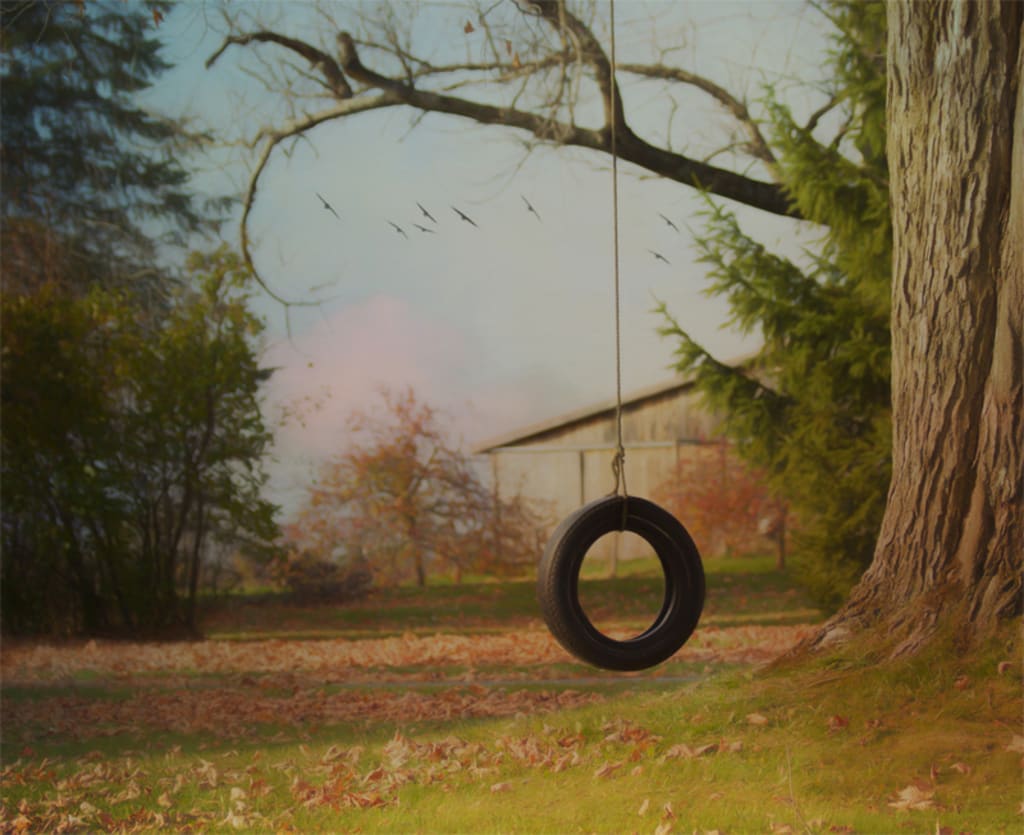
“Why not,” she said, and punched in the last numbers on her phone. Oddly enough, it was the old house, or not quite the house. The map pinpointed the old oak with the tire swing in the backyard.
Frowning, she got in her car and headed that way, only a few miles down the road. The Mathers family lived there now but they weren’t home as she pulled up, the little cape house a deep ocean blue now.
At the oak in the backyard, she stood, closing her eyes and finally letting a tear fall as she pictured them both laughing in the grass under this old tree.
“Why here Gramps?” She whispered, looking along the gnarled bark, up to the little hollow that a small horned owl had used one summer. She’d store trinkets there once he had moved on, so out of curiosity, she reached in to see if she’d forgotten anything.
Amongst a handful of sea glass, she grabbed what felt like a wad of duct tape. Confused, she took it out. The package, little bigger than a checkbook, was wrapped entirely in the tape, maybe to keep it dry.
Sitting in the tire, she carefully unwrapped each layer, the last attached to a black bag, so she simply ripped into it, spilling the contents across her lap and onto the ground.
Erin sat, stunned, as thousands of twenty-dollar bills decorated the grass.
Then she laughed. It started as a giggle, and spilled into something pure, overflowing and tears of hurt and joy ran down her cheeks. She leaned back in the swing, closing her eyes and feeling his push, higher and higher. As she swung, her long hair was carried behind her, the wind flowing through it like his fingers, and when she inhaled, she could smell pine and black licorice.
About the Creator
Jess Osborne
Not a starving artist (I stay well fed), but starving to get back into writing, so here I go. *Cracks open a beer* Is this how that works? Maybe I don't want to channel Hemingway...
Keep reading
More stories from Jess Osborne and writers in Families and other communities.
Chisels
I don’t know about you, but I’m having an eerie sense of déjà vu these days. I think the only thing that’s a bit different is I’m not counting my stash of toilet paper and making sure I keep a few packs of Ramen noodles to spare. Wait. Who am I kidding? I always do that for those midnight rumbling stomach cravings. Come on, we all do. I know you’ve got a box of Little Debbie Oatmeal Cream Pies in the pantry for that, Susan.
By Jess Osborne5 years ago in Motivation
Christmas Abroad: Celebrating the Holidays Without Family
I moved to South Korea in 2017. I was twenty-two years old and excited to start my career as an English Second Language Teacher. With a Bachelor's degree and six hundred dollars in my bank account, I set off for Busan.
By Kera Hollowabout a month ago in Families
The quiet sound of families breaking
There is a kind of silence that is louder than any noise. It is the silence of a child waking in the night and realizing their parent is gone. It is the silence of a kitchen table with one chair suddenly empty. It is the silence of a home that still looks the same, but no longer feels the same. Across the United States, thousands of families live inside that silence. Not because of war. Not because of disaster. Not because of death. But because of policy.
By Kaylee Souther4 days ago in Families




Comments
There are no comments for this story
Be the first to respond and start the conversation.