
We Discovered Africa In A Town Next Door
Crossing boundaries to the town next door

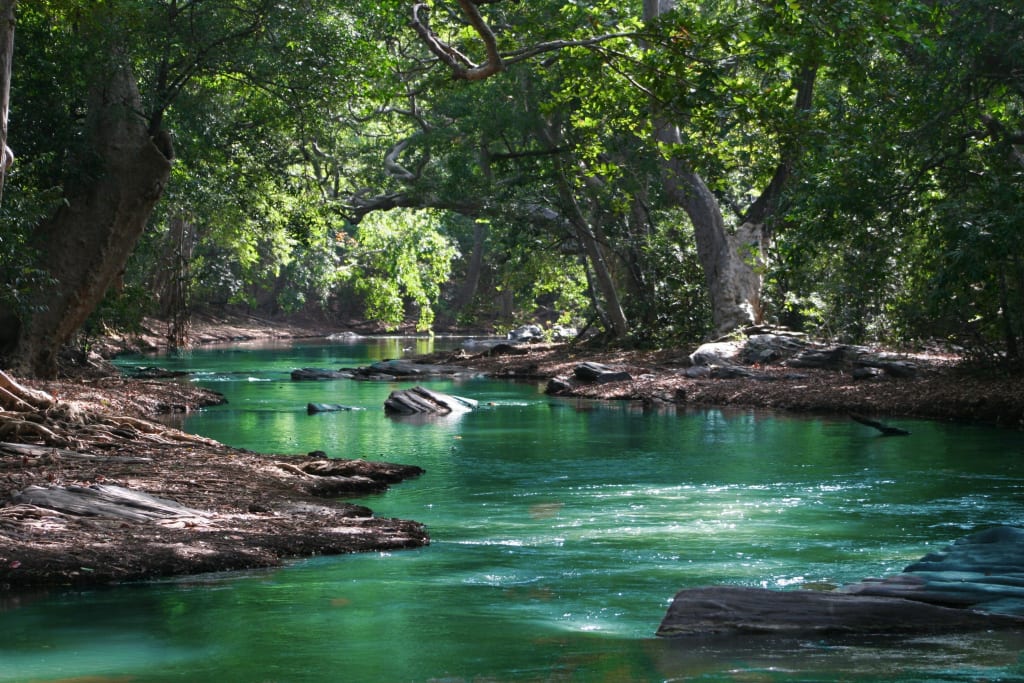
We Discovered African In A Town Near Chester: Crossing boundaries to the town next door
John W. Gilmore
We called it Africa when we were children. It was a very large swath of undeveloped land in Eddystone PA, running along a little creek right beside the fish store pet shop and across from a grocery store with a smaller clump of undeveloped land behind it. Since it had no name, as far as we were concerned, it was White Africa and the other side Black Africa. There was a creek running through White Africa, but you couldn’t really swim there.
Rumor had it that many strong swimmers had drowned in that creek because of strong undercurrents, or mud bottoms that sucked them down and held them under. The only nearby spot that was part of that creek that we could swim in was Pott’s Pond, which was a small widened out area in the creek with still waters like a pool, and a small waterfall where many people dove off the tall rocks into the water below.
We would ride our bikes all the way from the East Side of Chester into the uncharted territories of Eddystone, not really knowing what to expect. It wasn’t really that far, but culturally, it was galaxies away. Chester, you see, the East Side of Chester, was full of working class Polish and Italian Immigrants, with a few African Americans and Puerto Ricans thrown in to add a little color.
We all got along very well, except for the little battles that people seemed to have within their own small ethic or racial groups. I, of course, lived in a community that got more and more African American as time passed. I think that the residents or landlords in Eddystone fought like crazy to keep that from happening, even though we went to school with their children and knew some of them very well.
Thus why we never knew what to expect in Eddystone. It was, therefore, wise to ride bikes there in case we needed to make a quick escape, or avoid the place altogether.
We would often walk sometimes, but not very often, to buy fish at the fish store pet-shop on 9th St. We were weary of our surroundings even then. On our bikes we were even uncomfortable, until we got to Africa. In Africa we were alone and free in the undeveloped land to do as we would. That was a great experience for a group of children who were often monitored, or surrounded by groups of adults.
We wandered around the many trails that had been cut in, or walked down by God knows who, for most of the day, and had a chance to really explore nature in real time. It wasn’t TV. It wasn’t watching nature documentaries. It was really experiencing nature. I am just sorry that most children living in the cities nowadays don’t have the chance to do that. They can go to parks, but it really isn’t the same.
We rode our bikes there before people talked about mountain bikes, or people talked about how one could draw on the beauty of nature to deal with stress and to center themselves. We rode through narrow trails, rocky trails, even wide smooth trails big enough for cars, naming and claiming them as we went along, probably the way that the explorers named cities and towns.
It was exhilarating to see the various plants, to look under the rocks and see gardener snakes, worms and sow bugs, and to go down by the little creek and skip stones on the water, or just sit and watch the water lazily flow by. One day we found a giant piece of Styrofoam someone had left there.
It was about 4’ by 4’ and about 2’ thick, almost a cube. We carried it to the unswimmable creek and took turns, two by two, floating on top of it and paddling out into the water looking around, and trying to look deep to the bottom, where people were supposed to have actually gotten stuck, and drowned. We did this for almost half of the day taking turns and laughing about what our parents would have done had they known what we were doing.
Most of the time when we went near that part of the creek it was secret, even more secret than when we went to the same creek farther up, at the back of Washington Park, where people regularly swam. Our parents still didn’t trust it, but we kept going without letting them know.
We would hide our trunks or shorts in the rocks near the creek because we knew we would get in trouble if our parents caught us leaving the house with them. One friend got a whipping because his father saw a spot of water on him one day after we got home and saw his trunks. We wouldn’t make that mistake again. He didn’t stop going, he just left his trunks in the rocks and made sure to dry off better.
That part of the creek wasn’t really dangerous. The water wasn’t that high and despite what most parents think, children are very adept most of the time, at taking care of themselves in groups. Groups of children who are allowed to hang out together and play together in a healthy environment learn to take care of each other.
They learn leadership and negotiating skills through playing games as they make up the rules, organize the games, and agree on how they will behave. During the worst times when people fight they learn about fairness, about what is offensive and not offensive in a group, and how to win, lose, or draw.
Most of the games now are organized or managed by some adult. They are formal. Children are given a set of rules and a structure. They miss out on learning how to negotiate with each other, and how to get along with some of the other children they may not even like without being forced.
That is what I think is missing today. We try to protect our children from harm, which is a good thing. Taken too far we find that we protect them from life and make them learn the hard lessons much later in life when the mistakes come at a bigger cost.
We had all of the fun and learned so much out there in nature playing because we had unscheduled time during our summers. Perhaps some day we will rediscover the importance of unscheduled time for ourselves and our children, and will dare to cross the boundaries into unknown territories to experience the world around us, as we did when we went to Eddystone.
It wasn’t always pleasant. Sometimes, due to race problems, conflicts arose, but even then, the fact that we knew each other from being in the same classrooms and playing with each other in the school yard helped iron things out. Maybe that is something we can all work on...the creation of community and mutual understanding in place of huddling in fear.
Children can learn to do all of the things I've listed above when raised in healthy environments with caring parents. Most of all, they can learn them when they have enough time to experiment, to be creative, and to have access to the beauty of the undeveloped wild. Too bad such places seem to be shrinking, or fenced off more and more because of the fear of lawsuits, or very, unhealthy adults.
About the Creator
Om Prakash John Gilmore
John (Om Prakash) Gilmore, is a Retired Unitarian Universalist Minister, a Licensed Massage Therapist and Reiki Master Teacher, and a student and teacher of Tai-Chi, Qigong, and Nada Yoga. Om Prakash loves reading sci-fi and fantasy.
Keep reading
More stories from Om Prakash John Gilmore and writers in Families and other communities.
What's Next Your Highness
We were escorted down a long hallway that took many twists and turns almost like a maze. There was no way we could have found our way out of there had we escaped. Yet again, there was no place to escape to. We came to a small doorway at the end of a hallway. It was so narrow we had to turn sideways to slip through. The guards closed and secured the door behind us.
By Om Prakash John GilmoreExclusive • 8 months ago
Wise~Guys
— Look Behind what's in Front of You ~ Make Good Choices — Hey, So how you Doin'..! Made~Men — Mobster Movies romanticise a distinctive, elegant appearance, impeccable attire style, along with the 'Families' expressive lingo. Making their 'Bones' gave them Panache — with vintage fedoras, tailored pin-striped suits, mirror-polished wing-tip shoes adorned with tassels; with their 'Gun Moll' gorgeous dates on their arms.
By Jay Kantor23 days ago in Families
The Blue Ridge Stalker
Tom had left the Ford down the way, its spark plugs finally exhausted and no mechanics for a dozen miles back through the foothills to Strossburg. No matter, he had worn his boots—almost as if he planned for this to happen. The puzzle he sought to solve emanated from the woods clinging to the slopes above; the valley behind held no mysteries.
By Stephen A. Roddewig3 days ago in Fiction




Comments
There are no comments for this story
Be the first to respond and start the conversation.