
The Walk.
Nothing could separate their souls, not even death.

Maggie opened the coat closet and took out a jacket. In late September the Minnesota mornings were cool but not yet cold enough for a heavy coat.
She stepped out the door and, when she reached the end of the porch, grasped the railing. Three steps down to the sidewalk, Maggie reminded herself. At seventy-nine-years-old what she didn’t need was a broken hip.
After she reached the park across the street, Maggie moved to the right side of the concrete pathway designated for walkers.
Soaring century-old oak and elm trees filled the park, their branches thick with golden, orange, and crimson leaves. The high-pitched chirps of birds flying overhead, as well as the laughter of children, made Maggie feel as if she was connected to the world, if only as an observer.
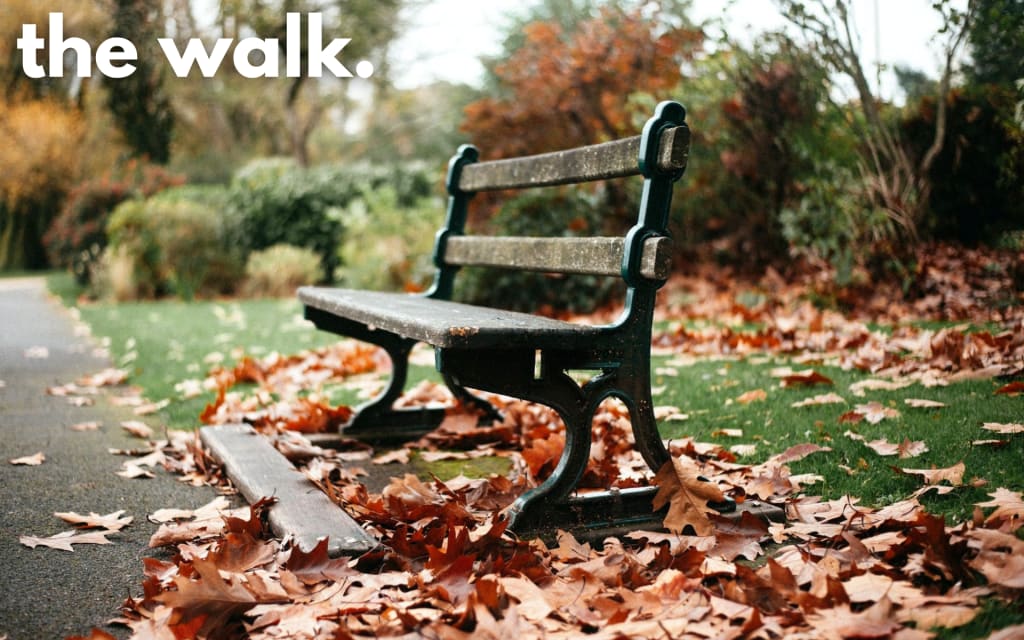
When she reached the bench where Maggie and her husband Will used to sit and chat during their walks she sat down. A gentle breeze caressed her cheeks as she thought about how Will used to make her laugh with one of his corny jokes. There were still times she’d call out for him, forgetting he was gone.
Maggie closed her eyes, relishing the warmth of the sun. A few minutes later when she started to stand she noticed what looked like a small book underneath the bench. She was about to bend over and retrieve it but decided against it, fearing she might lose her balance.
“Ma’am, can I help you?” she heard, turned, and saw a young couple behind her.
“Oh, goodness,” Maggie said, startled. “Looks like someone lost an address book and I was going to try to pick it up but…”
“I’ll get it for you,” the young man interrupted.
“Maybe you could see if there’s a name inside,” Maggie told the young man with a mop of black hair, watching as he gripped the corner of the book and tugged. It took a few yanks to pull out a small book.
“This has been here for a while,” he said, slapping the cover against his knee a few times, shaking out particles of dried dirt and grass. “Here you go,” he said politely as he handed the book to Maggie. “You never know if whatever is in there might be important to someone.”
Maggie looked down at the weathered cover. “Thank you. I’ll take a peek and see if I can find a name or maybe a number I can call.” She fumbled to push the book into the pocket of her jacket.
The young woman with long blonde hair laid a gentle hand on Maggie’s shoulder. “Can we help you to where you’re going?’ she asked, her youthful blue eyes glued to Maggie’s.
It used to upset Maggie when someone asked if they could help. It was when she accepted she just might need help one day that she started extending her gratitude to thoughtful people.
“You’re very kind but I’ll be fine,” Maggie answered.
When she reached her home, Maggie ran a hand over the smooth sign on the right-hand side of the front door that read, “Welcome to the Seiverts.” Will had been so proud of the plaque. She’d watched as he nailed three two-by-eighteen-inch planks together and then stained and sealed them. A couple of days later he’d stenciled the words on the wood and then painted each letter a bright red.
After she hung up her jacket, Maggie walked down the hallway and into the kitchen. As she made a cup of tea she reminded herself to call Michael and Kate and invite them to Sunday dinner. Dinner at Maggie’s used to be a tradition but now only happened when Maggie felt up to it. It was worth the trouble because whenever the five grandchildren visited the house came alive again.
As much as she dreaded the conversation, Maggie would tell the kids she was putting the house up for sale. The roof was leaking and there was no way Maggie could afford a new roof. The price of hiring someone to shovel the driveway during the winter months, as well as the upkeep of the yard, grew more expensive each year. The mortgage was paid off which helped but social security only stretched so far. By the time she paid taxes, utilities, bought groceries, and paid a handyman to do small repairs, there was nothing left. There was no way Maggie would take out a home loan, not at her age.
God knew she didn’t want to leave a home filled with memories of her and Will’s life together. But she no longer had a choice. She would never tell Michael and Kate the truth. They’d offer to help, and the last thing Maggie wanted is to be a burden to her children.
Maggie carried the hot tea into the small den at the back of the house and placed the steaming cup on the end table. After she sat down, her eyes moved across the gallery of framed family photos that hung on the wall. When her eyes rested on her and Will’s wedding picture she smiled, thinking they looked like children. A youthful Maggie with teased shoulder-length hair and not a wrinkle in her face, and Will; so tall and handsome, his arm around Maggie’s shoulder.
“It’s not your fault,” Maggie said, staring at Will’s face. Will had never made a lot of money and they knew the day would come when they’d have to sell and use their equity to live on. Back then, however, it didn’t matter where Maggie lived as long as she and Will were together.
She pulled her legs up, resting them on the ottoman. Settling back into the chair, Maggie opened the book she’d been reading. As happened every day, she’d fallen asleep waking a couple of hours later with the novel nestled on her lap.
After dinner, Maggie called Kate and Michael, assuring them she was fine, and then went upstairs to get ready for bed, She turned out the light in the bathroom and, on her way to her bedroom remembered the black book.
After the trip down and back up the stairs, Maggie snuggled underneath the covers. When she found no name or number inside the front cover and thumbed her way to the last page, she noticed every page was filled with writing. Some of the pages had dark smudges of what looked like dried dirt Maggie assumed was caused by rain or snow seeping into the pages. When she reached the back page she still couldn't find the owner's information.
She placed the book on the nightstand but after a few minutes of tossing and turning, she turned the light back on. Opening the book to the first page she rationalized if she couldn’t return it what would be the harm to take a peek inside.
June 2, 2013. As her eyes traveled down the first and then the second page she realized she was reading a memoir with page after page of simple, yet beautifully written prose about one family.
A third of the way through, her muscles began to tighten, and her heartbeat sped up. What was going on? The dates, times, and even certain events seemed to parallel her life. A lump in her throat, she flipped to the last page.
June 5, 2017, she read. “Maggie, if you are reading this I’ll be gone.” Maggie felt as if she couldn’t breathe. "Always know you will be with me wherever I go.”
Even though some of the letters blurred from being underneath the bench for a period of time, Maggie was able to piece the sentences together. Tears streaming down her face, she shook her head back and forth slowly. “Will…Will,” she said, her voice breaking.
As difficult as it was to comprehend, Will was the author of this book. She had no idea he even had a book, let alone kept a diary of their lives. The birthday entries were Kate’s….Michael’s…their grandchildren. He’d even listed the names of restaurants where they’d celebrated anniversaries.
After she calmed, she remembered the night before Will died he’d told Maggie he was going for a walk, which was unlike him to go out when it was getting dark.
“Want me to tag along?” she’d asked.
“Nah, I just want to take a quick walk around the park,” he’d answered. “Clear the cobwebs out.” Now she knew why. He’d lost the book and went to look for it. But why had no one found it before now? You’d think a groundskeeper or someone would have spotted it.
Will died on June 6th, the day after his final entry. He’d come up behind Maggie when she was doing dishes, laid his chin on her shoulder, and clasped his hands around her waist. Seconds later, he fell to the kitchen floor, struggling to breathe. There was nothing anyone could do to save him. He’d died instantly from a massive heart attack.
This was Will’s good-bye; the good-bye they’d never had. Maggie pulled the book to her breast, hugging it tightly. Tears blurring her vision, she whispered, “Thank you.”
She picked up where she’d left off knowing she wouldn’t be able to sleep if she didn’t finish reading Will’s words.
“Remember where we used to hide the kids' Christmas presents when they were little?” were the last words Will wrote.
Maggie was confused. What did this mean?
She tossed and turned until she finally put her robe on, turned on the light in the hallway, and went down the stairs.
There was a reason Will mentioned the hiding place and she had to find out why.
The door underneath the stairs creaked when she opened it. She couldn’t remember the last time she’d been in here. After she pushed cobwebs aside, she pulled the chain to turn on the light. She found the large antique chest where they used to hide Christmas presents against the wall. After Maggie noticed an envelope taped to the top of the chest, she opened it, and pulled out a letter.
Dear Maggie, I hope you don’t think I was deceptive but I’ve been putting away a bit of money for years, hoping one day you could buy new furniture or put a larger down payment on a retirement home you fall in love with. It’s up to you how you choose to spend it.
Love always, Will.
Money? Maggie was even more confused. She set the letter on the floor and unlatched the hook on the old trunk. What she discovered inside took her breath away. Trembling, she’d never seen so much money.
Sobbing, she slowly went down to her knees. Reaching inside, she found the bills were at least a foot deep. “Will...Will,” she managed, her voice breaking.
It didn’t feel real when Maggie stuffed grocery sacks with twenty- and fifty-dollar bills and then transferred money to the den. It was almost three in the morning when she finished stacking bills into one-hundred-dollar increments. It made sense to Maggie that Will had kept the money in their home as they'd been raised by parents in a generation who didn't trust banks.
By the time she counted and then recounted again, Maggie was emotionally and physically drained. She sat down on the edge of the ottoman, shaking her head slowly back and forth, still not believing her eyes. Somehow, Will had managed to put away twenty-thousand dollars which would be more than enough to cover the cost of a roof and keep Maggie in the house, if only for a few more years.
Maggie now knew the answer to a question she’d asked herself a million times: The answer was yes, Will was watching over her. And, there was no doubt it was Will who had led her to the little black book.
About the Creator
Kimberly Shursen
Author Kimberly Shursen is the mother of three adult children and a grandchild she adopted at birth.
An advocate for children's rights, and director/marketing, Shursen is a seasoned author of political, legal, and psychological thrillers.
Keep reading
More stories from Kimberly Shursen and writers in Families and other communities.
THE STORY OF LUKE
Many, if not most of us, have fond memories of our childhood. We laughed and giggled as we learned to swim in public pools, played kick-the-can during the summer months until dark and, during frigid winter months, sledded down steep hills, built snowmen, ice skated, or learned how to ski.
By Kimberly Shursen5 years ago in Families
Wise~Guys
— Look Behind what's in Front of You ~ Make Good Choices — Hey, So how you Doin'..! Made~Men — Mobster Movies romanticise a distinctive, elegant appearance, impeccable attire style, along with the 'Families' expressive lingo. Making their 'Bones' gave them Panache — with vintage fedoras, tailored pin-striped suits, mirror-polished wing-tip shoes adorned with tassels; with their 'Gun Moll' gorgeous dates on their arms.
By Jay Kantor23 days ago in Families
The Path to Salvation
The late autumn evening air filled the monk's lungs, but it wasn't the season that chilled his bones. The heavy-handed presence of evil he had sensed upon entering the woods surrounding this mountain village had not bothered to conceal itself from him.
By Made in DNA2 days ago in Fiction



Comments