
The Ukrainian Work Ethic
Our roots grow deeper during times of war

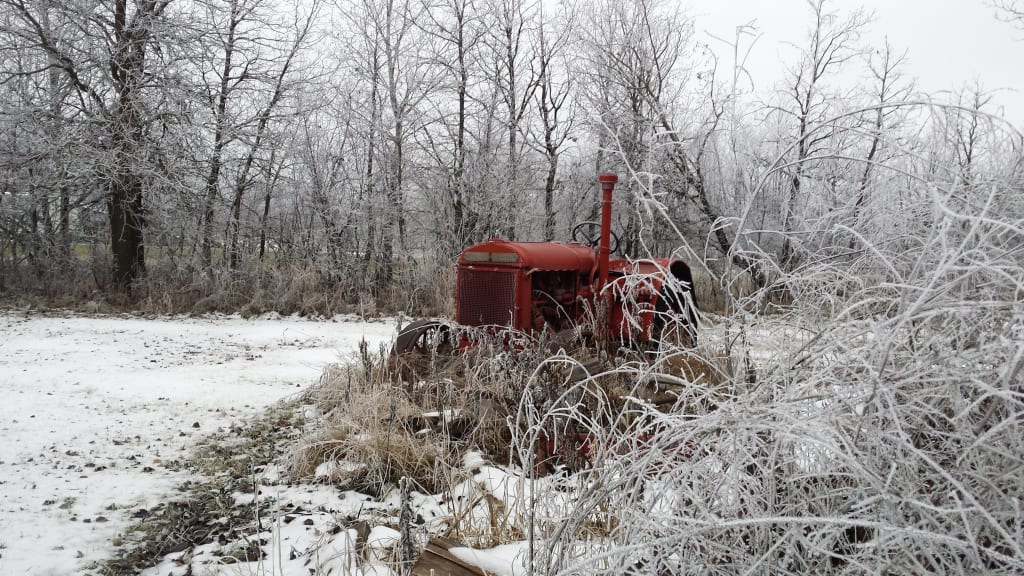
My Gigi was the first one of our family who was born on Canadian soil. My Dad hadn't spoken about him much since he passed away 24 years ago, unless he was talking about the farm. It wasn't until the war started that I began to realize how little I knew about him; I knew he was a farmer his whole life, and was a quiet, seemingly grumpy man. He died when I was six. The only other thing I knew was that he was a proud, stick-in-the-mud Ukrainian.
By the time I started university, my paternal grandparents - my Gigi (Ukrainian-Canadian slang for Grandfather) and Baba (Ukrainian term for Grandmother) had long since passed away. My Dad grew up on a farm himself, about four hours from Winnipeg in a village called Pine River, where my Baba and Gigi still lived. We saw our grandparents about three or four times a year, when we would spend a week of summer, Easter or Christmas holidays at their home with all of my extended family. The Tymchyshyns are of a dark-haired, olive-skinned lineage. All of my cousins, aunts and uncles - as well as my older sister - sport thick, curly black or chestnut hair and a deep, caramel-brown tan in the sun. Everyone in my family has the famed Ukrainian beauty signet of 'kari ochi' or 'brown eyes'. Taras Schevchenko wrote poems about the beauty of dark-browed, tawny skin Ukrainians with their bottomless sable eyes and soft aquiline noses. Folk songs and paintings praise this hallmark of cultural beauty in Ukraine. Our family gatherings were a sea of ethnically-identifiable Ukrainians - strong, dark features like the Carpathian mountain forests where we hail from.
Except for me. I popped out as pale-skinned as an underripe honeydew melon. A shock of pin-straight, white-blond hair accompanied my light, ice-blue eyes. My maternal grandmother was Finnish, and it appeared that genetics had bundled up and waited until I came along - leaving me to look like some snow-baby found on a reindeer trek in Lapland.
"That kid is a Tymchyshyn?!" My relatives all laughed when I arrived home from the hospital. As I got older and reached adulthood, my hair began to darken to a deep brown, my cheekbones rose out and my hair began to spring into curls. While I remain with skin the colour of pancake batter in the winter, I'm blessed with the southern European tan in the summer. When I look in the mirror now, I see the same sort of people that would show up for my big family gatherings.
When I enrolled in the Ukrainian Studies program at university, it was after a summer of travel to Eastern Europe. My Dad was excited for me to be studying Ukrainian. It was his first language, but he barely had the opportunity to speak it with anyone anymore. We spoke English in our home. We spoke English in our community. Despite growing up with Ukrainian culture being the predominant culture in our home, we were missing the linguistic side of our roots. My Dad finally had someone to practice with.
I spent the next decade traveling to and from Europe, and spent some time living and working in Ukraine in 2016. My relationship with Dad began to shift into territory of shared interests about Ukraine and our history as Ukrainians living in the Canadian diaspora. My Dad has always been a storyteller - it's a running joke among family and friends that he will still be talking in his coffin when he goes. He began to tell me more about his growing up in a Ukrainian bloc community in the Prairies; he would mention difficulties he faced when moving to Winnipeg in the 1970's dealing with prejudices against Eastern Europeans among white, Anglo-Saxon, Canadian society. He was proud that I was learning about our culture and our heritage - especially our language. He hadn't had the opportunity to travel to Ukraine when he was younger. We could suddenly share private conversations and jokes, much to my Mom and sister's chagrin. I felt more Ukrainian. I felt like I belonged with my family more than ever.
Conversations in our family last a long time. We've always eaten dinner at the dinner table; I was always shocked when I went to friend's houses for dinner as a child and we were allowed to eat in front of the television. Our kitchen was always loud; it's where the arguments and sibling fights took place, but also the early Sunday mornings when the sunlight would stream through the window into the bright kitchen with tangerine-coloured walls. Dad would make a stack of rye toast and a full pot of black coffee at 7am sharp. My sister and I, bleary-eyed from whatever small-town weekend plans we had, would fight over the bathroom while my Mom tried to hurry us through the morning routine that would eventually bring us to Sunday morning Mass. My Dad would be sitting on the phone every Sunday morning as long as I could remember, speaking in Ukrainian to his best friend, Les. Les is from a village nearby to where my Dad grew up, and even today, they spend about an hour talking on the telephone every Sunday morning without fail. From my Dad's booming voice on the end of the conversation that I could hear, I learned a few choices words in Ukrainian as I got older. I always imagined that Les was silent on the other end of the telephone because my Dad's stories were so long that surely, he had fallen asleep. I always used to think he was really quiet and reserved as a kid; turns out it was just in comparison to his chatty compatriot.
My Dad has always been a chatterbox on and off the phone. At my sister's wedding reception, when he got to the podium to speak, one of the family members shouted from the tables, "Keep it short!" My Dad glanced up without skipping a beat and growled, "keep it quiet" before tossing my cousin a wink and a smirk. He did keep his speech under seven minutes, which we all found to be the true celebration of the day.
When my sister had her first child, she would be up feeding when my Dad would call her at 7:00 in the morning, as if he was waiting for the clock numbers to tick past the 6 on the hour slot. He'd ask what she was up to, what my newborn nephew was up to; my sister would sleepily reply the same thing she had told him three times that week. It was alright though, he always had something to tell her despite the many obvious yawns or distracted baby noises were going on. When my Dad retired after 35 years as a heavy-duty diesel mechanic, our entire extended family needed an extra charging cable where ever they went; my Dad might call and it wouldn't be a short conversation.
Throughout his life, my Dad had been a tough, hard worker. It wasn't only in his career when he would spend long winters north of the Arctic Circle or working in -40 Celsius temperatures that he was tough; the many projects around our house, land and family cabin speak to that. When we were kids, it was the massive vegetable garden that he excitedly planned out every spring. Later, once he settled into retirement, it was building a sauna at the cabin and a new boat dock. At both the cabin and at home, it was the lawn.
Like many fathers, my Dad takes great pride in his lawn. Finding ways to keep the entire family invested in the lawn was his second favourite hobby. He and my uncle had managed to find and fix three John Deere garden tractor mowers, as well as the assortment of letter decals in which they spelled out the names of my Mom, my sister and myself. They were both grinning from ear-to-ear when my sister, my mom and I came home from the shopping to find our names emblazoned on three lawn mowers in the driveway. My Dad wheezed through laughs as we all rolled our eyes. My sister and I escaped to the house as he called after us, "You both have one now, so you don't have to fight over who gets to mow the lawn!"
When I arrived back from Ukraine in 2016, I found myself in a post-travel ennui. I felt lost and unsure of what I wanted to do; I thought at the beginning of that year that I had it figured out. When I arrived in Ukraine that spring, I was sure that I wanted to stay long-term and teach at the school where I had a position for the summer. However, as the months slid by during my stay in Kyiv, I grew homesick. Travel wasn't new for me; I had been to twenty five countries and had lived abroad for years at a time by this point. Russia's war in Ukraine had begun two years previous from the time I arrived. There was a strong military presence in the capital, which took some getting used to. I hadn't ever lived in a city where military personnel were in every public building and metro station. I was teaching English to a group of refugees from Donbas, students in high school who had fled the violence from Russian forces in the East. As I started to make friends, I started to feel alienated from the country. I didn't feel brave like the other 25 year old university students who had fought for democracy in the Maidan Revolution two years before. I didn't feel brave like my friends who pulled down the Lenin statue in Kharkiv during the protests, or like my students who had fled shelling and bombs that destroyed their homes and schools. I tried to swallow the feeling down - the guilt-ridden, homesick ache - and told myself I'd decide the day after my birthday that June. Two friends from Canada were arriving in Kyiv to meet me, and my Ukrainian friends had organized to meet us at a trendy, student-filled hookah & cocktail bar. Before leaving my dorm to head out that night, I called my dad and started speaking to him in Ukrainian. I could hear him smiling on the other end as he continued the conversation and I tried not to choke up.
The next morning, I changed my flight to go home at the end of my term. I felt more Ukrainian than ever, but I also felt like I didn't know how to belong. I had made my decision. I booked a train to Lviv to see some friends in the final week of summer before heading home. A week after I left Kyiv, a journalist was killed from a car bomb on the same street I lived on. The news sat like a lead ball in my stomach on the flight home. I wanted so badly to work through whatever guilt and fear I had. I wanted to stay in Ukraine. As I left my ancestral homeland, I made a promise to return... once I had it figured out.
Over the next four years, I threw myself into back-breaking hospitality jobs. I distanced myself from the degree I had just finished, still ruminating on the guilt I had brought home from Kyiv. I would go through cycles of obsessively checking the news in Ukraine to ignoring it completely. I felt disconnected from my heritage. I took a job in fine dining, and then a demanding management job in a food retail shop. I focused on my love of food, wine and hospitality but found myself sinking deeper into quicksand while I tried to work myself to the bone. I had convinced myself that I had to prove myself to my bosses in every way, because I was raised with a strong work ethic - a Ukrainian work ethic - which I prided myself on. My boss would make jokes about me being such a hardworking Ukrainian; and I'd secretly relish it despite being completely blind (from my own stubborness and over-eager dedication) to the fact that I was dutifully running personal errands for them. My Dad picked me up from work for a family dinner one Sunday evening in December, after a particularly long week. He saw how tired and worn-out I was. "Look, it's obvious that you're working hard, but you have to be recognized for it. You have to still enjoy it."
The following spring of 2020, I took my Dad's advice and began searching for another job. During the first week of March, I was excitedly telling my Dad about a final interview I had with a wilderness trek company. It was unlike any job I had before, but I was certain that my love for fishing and the outdoors would bring me some joy. I was on the phone to him when an email popped up on my notifications. I opened it to find that the company was postponing all hiring until more information developed surrounding the novel coronavirus.
In the following weeks, as we entered into lockdown and global confusion, my Dad was called into his doctor's office. He had been having vision problems, and so his doctor had ordered an MRI. His doctor informed him that he had a tumor at the base of his brain stem, in his nerve column. Because of the placement of the tumor, a biopsy was impossible. They would have to operate on my Dad to remove the tumor, or as much of it as they could. Best case scenario was that he would spend about a month in recovery, and they would zap whatever was left with radiation afterwards. He had never spent a month in the hospital before and he would be alone. The hospital had a zero-visitation policy because of the coronavirus pandemic. Worst case scenario - well, it was the same as the worst case scenario for any brain tumor.
I have a friend who likes to joke that my Dad was a cat in another life, and that in this one he has a horseshoe up his ass. My Dad decided to take the 'best case scenario' as a challenge, and at 67 years young he walked out of the hospital after a major brain operation - a week after it was performed. We all joked that the nurses and doctors just couldn't deal with the non-stop talking. We were excited to have the chatter back on our side of the hospital doors, though.
Shortly after this news, I was diagnosed with depression and an anxiety disorder. I went on stress leave from my job. I felt detached from myself and like I was constantly spinning out of control while being enveloped in a dark-grey fog. I went to the family cabin for a few weeks that summer to clear my head. My Dad called every day to see what the weather was like at the cabin; if there was wind on the lake or how long the grass was. He and my mom showed up one weekend, "just to cut the grass" while bringing steaks, fresh summer corn and a jug of dry red wine. I knew it was his way of checking in on me.
As the year continued on and I began working with my doctor on a medication and mental health programme, my Dad finished his radiation treatment and was given a clean bill of health after his final radiation appointment in December. They couldn't find any more traces of the tumor, and he could look forward to getting back to his yard projects. We were thrilled, and we celebrated with champagne. He hadn't been able to travel all summer, so my Dad talked about how he wanted to take a family trip in the springtime to Pine River. He wanted to cut the grass at the cemetary where my Baba and Gigi were buried, and he could finally get me to read the names on some of the gravestones, as he doesn't read the Cyrillic alphabet. It felt like we had something to look forward to, but it was also a celebration just to be talking about it. It was the first time we could all have a drink together since lockdown had begun earlier that autumn.
Two months later, my Dad was called into his doctor's office again. He was diagnosed with pancreatic cancer.
The prognosis for pancreatic cancer is, in essence, to put your affairs in order. The surgeon booked Dad's surgery for a week later; waiting longer would increase the chances of the cancer spreading to his other organs.
The day of his surgery came, and the surgeon was able to remove the entire tumor on his pancreas. He clearly didn't remove the horseshoe though, because after a rough six months of pro-active chemotherapy treatment, my Dad was given a thumbs up from his doctors. In May of 2022, he was told that all tests point to him being cancer-free.
I was sitting on my couch in my apartment on the evening of February 23rd, around 11pm when my phone started flooding with messages, some in English and some in Ukrainian. I turned on the news and the lead ball that I still carried with me dropped down from my stomach into my guts. Russia was bombing Ukraine. They were shelling Kyiv. I texted my sister with my hands shaking, tears flowing down my face, "They're bombing Kyiv. They're bombing the whole country."
I didn't sleep that night. When my Dad called me in the morning, we just talked about the weather. Neither of us were ready to talk about the bombs that had falled that morning in Kyiv, or the Russian forces now invading the country. "Take care," he told me, "and get some rest."
In the following months, rest was sporadic. I had left another stress-filled job at the beginning of February, so I found my days filled with blank stares at the walls of my apartment, and back-and-forth texts to my friends in Ukraine throughout the day. Social media became a horror and a crutch. I found myself in the online activism community, which fortunately led to me joining a support group for war trauma in the diaspora. The only thing that seemed to break up the cloud that had taken over my day-to-day was visits from friends, or phone calls from my Dad. I desperately tried to throw myself into work again, but this time I was dismantling Russian disinformation on forums and social media, and calling out-of-province friends for sources they had used in university during their Ukrainian Studies degrees. I felt like I was doing something important, that I could challenge this war machine too.
My ability to function drew to a half during the first week of April, when Russian forces withdrew from the Kyiv region and the first press photos came out from the regions they had occupied.
Bucha. Irpin. Hostomel.
I had studied genocide extensively at university. Having a degree in Eastern European studies means that it's inevitable. However, nothing could have prepared me for seeing the horrors that the Russians left behind. In every photo, I saw the faces of my friends; my students; my family and myself. Grey fingers holding house keys in mass graves, with a European Union keychain lying in the sand. Dark hair, dark brows. Blood soaking into floral patterned scarves on the ground. It's not easy to turn away when you recognize your people - yourself - in those pictures. It's not easy to forget. That stuff carves itself into your memory and pulls pain out of your DNA like you could not have previously imagined.
When my body began to feel like it was on fire and my muscles turned to stiff leather, my doctor told me I had suffered an acute stress response. That was why my body had suddenly tensed up, resulting in a herniated disc and inflammation symptoms across my body. I was in a blur of pain meds for weeks. My Dad would call every other day to check in. When I finally found myself on the other side of the injury and burnout, I began to regroup. I talked with my Dad about our summer gardening projects and what kind of work I was going to start with the non-profit I had started. I had a plan for the projects I was working on, and I was feeling like my work had a helpful direction. I felt like myself again, and I felt like I was becoming a stronger Ukrainian. I had purpose in what I was doing for the first time since 2016.
At the end of June, my mom asked my sister and me to come out to my parent's house in the country. My Dad was in a town near Pine River with his Sunday morning mate, Les. At one point in the afternoon, I looked out into the backyard at my great-grandfather's tractor, displayed by my Dad next to the garden shed. I walked into the living room, where my sister and mom were sitting. I looked at them, my brow furrowed in curiousity,"I don't know anything about Gigi... or great-Gigi for that matter. I barely remember him."
"He was quiet," my sister assured me.
"He was grumpy. He'd talk to Dad in Ukrainian, though.", said my mom.
"I do remember finding something in the Pine River history book," my sister added, "that's where Dad gets his storytelling gene from. Gigi wrote a passage about our family history in there."
"He also kept a diary every day for his entire life. He'd record the weather, the farm work that was done that day, if any calves were born, or if hay was cut. As far as I know, he kept it every day until he passed away." my mom said.
I sat there, surprised at my own ignorance. I had never thought to ask about Gigi, but the tractor jogged something in my head. I thought of the farmers in the fields of Ukraine, still working around shelling and occupied territories. They were risking their lives for the harvest; I felt the lead ball of privilege sink deeper. I thought about what our family would have been doing, had I been born in Ukraine instead of Canada. I didn't want to lose that connection to our culture; I vowed to ask my Dad about my Gigi - part of the ancestry that my roots were bound with - when he got home.
Two days later, my phone rang. My Dad's number popped up, and he asked me what I was up to. I babbled on about something I was working on, but I stopped as my Dad quietly said, "Well... I had a weird weekend in Pine River."
My Dad continued on to tell me the story of how the previous day, he had gone with Les to the Pine River cemetery to visit my Baba and Gigi's graves and clean up the gravesites. My dad had wanted so desperately to cut the grass. This was a cemetery in the middle-of-nowhere Manitoba. There isn't any municipal service in this particular area - only relatives who have mowers and in this little pocket of the province, those are far and few between now, too. The Pine River cemetery is an old graveyard in an even older, shrinking village. As my Dad drive towards the cemetery, he made a silent prayer to my Gigi that the grass would be cut, and that they would be able to get to the gravesites to clean them up.
As my Dad pulled up, he saw that a large section of the overgrown cemetery grass was newly shorn near my grandparent's graves. Dad was shaking his head in surprise, and a truck pulled up behind my Dad's vehicle. A woman and a man jumped out and grabbed a string-trimmer from the cab. My Dad walked over to introduce himself, and to find that they were the ones who had cut the grass. They also had relatives in the little cemetery, the woman had gone to school with my aunt, and my Dad had worked for her father. Thanking them profusely, my Dad asked for their telephone number, at least to send them money for petrol. They begrudgingly agreed after an argument which resulted in my Dad telling them he would let a hundred dollar bill go flying in the wind if they didn't take it. My Dad took down the woman's telephone number in his notes app as they talked, thanked them again for their work, and he and Les hopped back into the truck to head to a friend's place in town for lunch.
When they got to the house, they all sat around the table as my Dad excitedly told everyone about the serendipitous experience and the lucky wish to my Gigi. His friend asked for the woman's number, since she would be the closest contact in the area for the cemetery and could coordinate anything the couple needed to get the grass cut. My Dad opened up his notes app and froze. He was silent for a moment. He cleared his throat and choked back tears as everyone looked at him, concernedly.
He read out the number. "That's the number from the farm... That was the telephone number my mom and dad had at the farm."
I don't know where my faith stands in terms of a higher power but I believe in my ancestors for certain. I believe that they show up for us in the same ways that our families do on this side. We may not notice the little synchronicities, but I believe that deep roots of our DNA connect us in ways that we cannot understand. In the darkness of genocide and war, life can feel like a tunnel with no light. I've been holding my Dad's hand along the tunnel these past few years, and he's still been the strongest one despite everything. I'm grateful to have him chattering incessantly next to me, and thankful that my Gigi is giving us some little bits of light along the way.
About the Creator
Maarit
Ukrainian-Canadian kid with a love for words, Eastern European history, and paint. My ideal TEDxTalk is me on a stage talking about sheep cheese and pastoral farming practices of the Caucasus to a group of people who can't leave the room.
Keep reading
More stories from writers in Families and other communities.
Wise~Guys
— Look Behind what's in Front of You ~ Make Good Choices — Hey, So how you Doin'..! Made~Men — Mobster Movies romanticise a distinctive, elegant appearance, impeccable attire style, along with the 'Families' expressive lingo. Making their 'Bones' gave them Panache — with vintage fedoras, tailored pin-striped suits, mirror-polished wing-tip shoes adorned with tassels; with their 'Gun Moll' gorgeous dates on their arms.
By Jay Kantor24 days ago in Families
The Banyan Tree
It’s always a “must see” place to visit in our family on my maternal mothers side. When making our way into Haleiwa for our shaved ice and day at the beach. Watching the tourists enjoy the sun and waves. While reflecting and thinking to myself. Am I now considered a “tourist” now? Since I was uprooted at the age of 5, and planted into a small dinky little town that on I5 you pass in the blink of an eye. Then I bring myself back to the banyan tree that my great grandfather planted. I remind myself that my roots are forever solidified in the red volcanic dirt that stains anything and everything it touches. I reflect and remember all my family members who hold this location and tree, as a reminder of where are roots are planted. And I can’t help but wonder, was this my great grandfathers purpose? A place where his family can come back and be reminded of where we are from? And who we are? And no matter where we go? Home is rooted in the hearts and memories that we create. I find myself yearning to learn more about each individual and the lives they lived and the struggles and successes in every day life. As I navigate my own life. Do we have things in common more than a bloodline. Do we think the same? Do we move the same? Do we love the same? Amazing how one act by one person with purpose/intention or without. Can inspire an individual generations later. To dig deeper, question more, appreciate more. Growing up as a child. I heard stories, looked at pictures. Imagined myself in a time in which we may say is much simpler than today. Slower pace, less chaos, black and white less grey. A time that felt more protected and safe in its own way. As a middle age woman. I often find myself reflecting on who I am? Do I carry any of the same traits and thoughts as my great grandparents? The same will and resilience in life’s short comings or maybe even my own? If we could be in each others presence. What would our conversations be like? Would they value me as I value their memory and stories? Would they be proud of who I am? Since I can remember I always had a close relationship with my grandma. She is the woman whom I hold dearest to my heart. A strong woman, who took such great care of her family immediate and extended. Being the glue that held everyone together. So I always understood why she was highly regarded and respected. I can say I took a lot of her traits and teachings, she helped mold me into who I am today. When she passed away when I was 15, it felt as if my entire world and safety net disappeared and took one of the biggest parts of me that I can never get back. Her absence set the tone for many infortunate events in my life. I recently went back to Hawaii with my younger sister. Just like we used to as kids for the summer. We visited the cemetery, all the family time allowed, our favorite food spots. And of course the banyan tree. The feeling is overwhelming in a good sense. To stand in the same spot as my great grandfather did when he planted it. You almost feel his presence around and it brings a smile to my face and a warming in my heart. This is where I am rooted. This is where my story began. So thank you great grandpa Miyoshi Ideguchi, for inspiring your great grand daughter to dig a little deeper into the roots that you have planted.
By Deana Cabison3 days ago in Families
🅼🅸🅳🅽🅸🅶🅷🆃 🆂🅽🅰🅲🅺🆂
"It's 10 in Tuscon! We all know what that means... It's Time for Midnight Snacks with your man, Gerald Gee! Ready to spend the night together? Me too! I'm full of snacks and can't wait to regurgitate them all back into your hungry ears. Crack a brew! Pop some corn! Anything to get ready for one hell of a show where the talk maybe cheap but the words cut deep...
By Lamar Wiggins3 days ago in Fiction
Thoughts on Vocal and the way the world is
"Death cannot stop true love, only delay it." – Wesley in The Princess Bride. I decided to come back to Vocal on a very cold and dark night at the end of December. I had been, and still am, convalescing from a horrible staph infection that had gone misdiagnosed for months. This, paired with the increasing challenges of being healthy, making the best choices for my co-parented child, being a wife, and being a director at a new job, was a lot to manage.
By Jazzy 7 days ago in Confessions



Comments (1)
This was beautiful and inspiring and harrowing. Thank you for writing this.