
The Truth About Age and IVF You Didn't Know
Age plays a major role in pregnancy as well as fertility treatments like IVF, but it doesn’t have to define your journey. Discover insights, success rates, and treatment options that can help you make informed choices and improve your chances of parenthood through IVF.


IVF or any other fertility treatment is a rollercoaster of emotions.
A journey filled with a thousand questions.
But there's one question that, perhaps, whispers louder than the rest:
Am I too old for this to work?
This is a completely valid and incredibly common fear. The truth?
While age is a huge factor in the IVF cycle, it’s not the end of your story. Modern reproductive science has opened up a whole new world of possibilities for hopeful mothers like you.
To better understand those options, you need to know how age is related to fertility treatments like IVF.
The Relationship Between Age and Fertility
When we talk about fertility and age, we're really talking about the quality and quantity of a woman's eggs.
Think of it like a beautiful garden. As the years go by, the soil naturally loses some of its nutrients, and the quality of the seeds it can produce starts to decline.
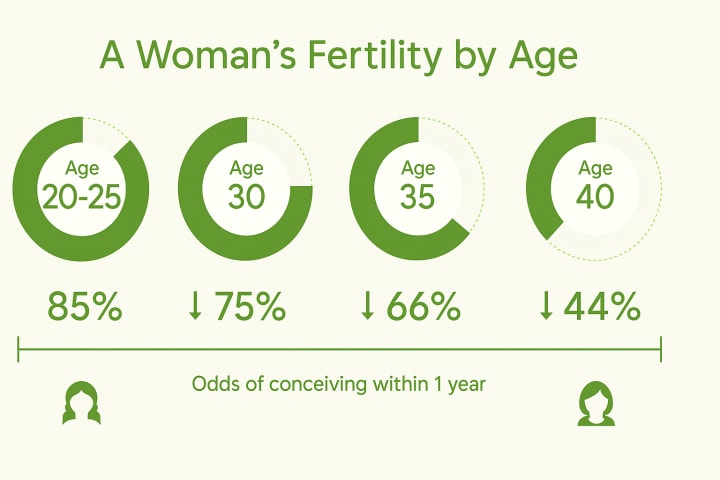
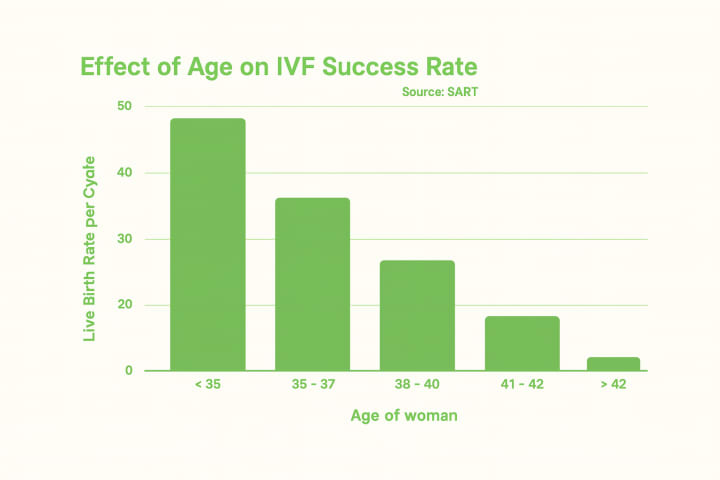
As noted by the American College of Obstetricians and Gynecologists, for most women, this process becomes more noticeable after age 35, and in our 40s, the chances of conceiving with our own eggs drop significantly. A 2019 review emphasizes that advanced maternal age is also linked to declining ovarian reserve and egg quality and by the age of 40, a woman’s chances of getting pregnant every month reduces to around 5%.
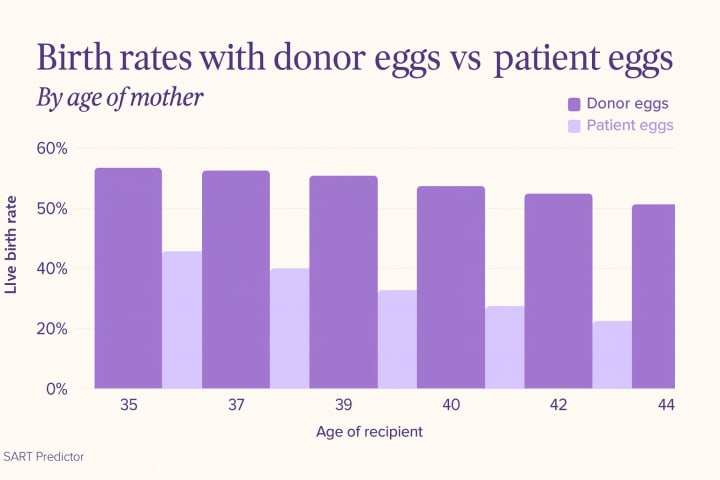
This is where donor eggs can be a true game-changer. One study claims (see further reading) that assisted reproductive treatments using donor eggs is the second best choice to overcome age-related infertility problems.
Since these eggs come from younger, healthier donors—usually in their 20s—they bring a fresh start, like planting a brand-new seed, full of life, in your garden. Data from the HFEA research shows that while live‑birth rates with their own eggs fall below 5 % for women over 43, donor egg cycles maintain over 25 % success regardless of recipient age.
This dramatically improves the chances of a healthy pregnancy, especially for those of us with a diminished ovarian reserve.
How Your Age Impacts IVF Success
Now, you might be wondering, if the egg is from a young donor, why does my age still matter?
Here’s a good way to think about it: the donor egg is like a young, strong sapling.
Your body, the recipient, is the forest floor—a place that has held life for many seasons.
Even if the forest floor has been there for a while, a healthy sapling can still be nurtured into a magnificent tree. The key is making sure the ground is well-prepared and ready to sustain new growth.
As we get older, our bodies are more susceptible to certain health conditions, like high blood pressure or hormone imbalances.
These factors can affect the safety of your pregnancy and the health of both you and your baby.
This is why your fertility doctor will first perform a thorough check-up to make sure your "forest floor" is ready for the journey ahead.
They'll look at your medical history and run tests to ensure you're in good physical condition for a safe and healthy pregnancy.
As a bonus, you can use CDC’s IVF estimate calculator here to compare pregnancy live‑birth outcomes by your age and using your own vs. donor eggs.
Is There a Maximum Age Limit?
You've probably heard a lot of different numbers floating around, but here's the honest truth:
There isn't one set age limit for IVF.
The American Society for Reproductive Medicine (ASRM) emphasizes that health risks tied to age should be carefully considered before moving to any conclusion.
Most clinics have their own policies, but their focus is always on your well-being.
Egg freezing (oocyte preservation) is another option for young women who decide to delay childbirth or expect complications (such as cancer treatment or ovarian removal) in future. The latest egg freezing and vitrification technology has led to an improved live birth rate.
For women in their later reproductive years, the decision to move forward with donor egg IVF is a personal one that depends on your individual health, lifestyle, and medical history.
The chances of success are encouraging for women in their 40s, especially with customized IVF cycles and donor eggs, but it’s a decision that requires careful thought and, most importantly, professional guidance.
Get Professional Advice
Navigating the world of IVF can feel overwhelming, but you don't have to do it alone.
Your Ob-Gyn and fertility specialist are your personal guide on this journey.
They have the experience and use advanced diagnostic tools to identify potential challenges, such as hormonal imbalances or other health issues that might affect your success.
Based on the test outcomes, they can also tailor a personalized treatment plan to your specific needs, improving your chances of pregnancy success.
If you are considering donor eggs, it’s important to partner with a reputable egg donor agency who can provide you with diverse donor eggs options and have detailed information about their donors.
Build a strong support team that will help you understand your options and feel confident and empowered as you move forward.
The journey to parenthood is a testament to hope, resilience, and modern medical science.
While your age is a factor, it doesn't have to be a barrier. With the right guidance, you can make informed decisions and significantly improve your chances to become a parent.
(Notes: This article is for informational purposes only and does not substitute professional medical advice. Always consult your doctor for personalized care.)
Further reading:
ACOG – Female age-related fertility decline: https://www.acog.org/clinical/clinical-guidance/committee-opinion/articles/2014/03/female-age-related-fertility-decline
PubMed – Advanced maternal age and ovarian reserve decline (review): https://pmc.ncbi.nlm.nih.gov/articles/PMC6391863/
Better Health Victoria – Age and fertility: https://www.betterhealth.vic.gov.au/health/conditionsandtreatments/age-and-fertility
PubMed – IVF outcomes and maternal age study: https://pmc.ncbi.nlm.nih.gov/articles/PMC7376777/
Key criteria to check when choosing an egg donor: https://lucinaeggbank.com/female-egg-donors-qualities/
HFEA – Fertility treatment trends and figures: https://www.hfea.gov.uk/about-us/publications/research-and-data/fertility-treatment-2018-trends-and-figures/
CDC – IVF success rate estimator tool: https://www.cdc.gov/art/ivf-success-estimator/index.html
ASRM – Ethics opinion on assisted reproduction and parental age: https://www.asrm.org/news-and-events/asrm-news/press-releasesbulletins/asrm-ethics-committee-delivers-new-opinion-on-assisted-reproduction-with-advancing-parental-age/
ScienceDirect – Maternal age and ART outcomes research: https://www.sciencedirect.com/science/article/pii/S0015028223005939
Vocal – Important facts to know if you’re considering IVF: https://shopping-feedback.today/writers/7-important-facts-to-know-if-you-re-considering-ivf-best-ivf-hospital-in-bangalore/%3C/a%3E%3C/p%3E%3Cstyle data-emotion-css="14azzlx-P">.css-14azzlx-P{font-family:Droid Serif,Georgia,Times New Roman,Times,serif;font-size:1.1875rem;-webkit-letter-spacing:0.01em;-moz-letter-spacing:0.01em;-ms-letter-spacing:0.01em;letter-spacing:0.01em;line-height:1.6;color:#1A1A1A;margin-top:32px;}
About the Creator
RSMCo
RSMC is a leading fertility center dedicated to helping individuals and couples on their path to parenthood. Explore our articles for evidence-based information and trustworthy insights from experts to empower you with knowledge.
Choosing Between Divorce and Legal Separation in California
Ending a marriage or formalizing a separation can be one of the most challenging experiences a person will face in their lifetime. In California, many couples find themselves at a crossroads, unsure whether a permanent divorce or a legal separation is the best choice for their situation. The emotional toll of these decisions is often compounded by financial concerns, particularly the cost of hiring a lawyer, which can make the process feel overwhelming and even unattainable for some. Despite these difficulties, understanding the options available and how to navigate the legal system can help individuals make informed decisions that protect their interests and those of their children.
By The Complete Divorce5 days ago in Families




Comments
There are no comments for this story
Be the first to respond and start the conversation.