
The Quiet House on Elm ridge Lane
Some homes don’t haunt you—they grieve with you. And if you listen closely, they may just help you heal.

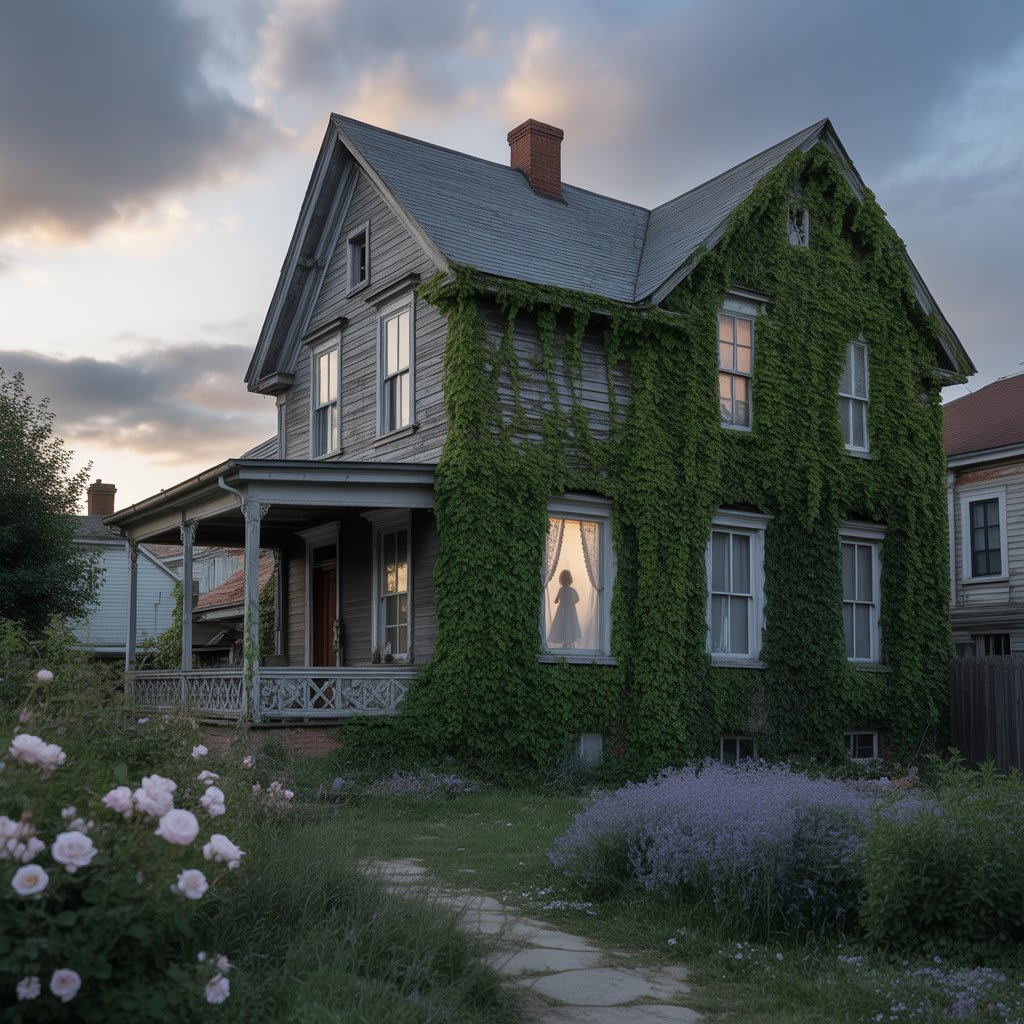
Every town has a house it whispers about. In Millbrook, that house was 47 Elmridge Lane.
It sat at the edge of town like a secret someone tried to bury but forgot to dig deep enough. The yard was wild—thistles sprouting like sentinels, ivy crawling up the walls like green veins. The shutters hung crooked, sighing in the wind. And always, the curtains moved, even when no one was home.
But the thing was, someone was always home. Just not someone you’d expect.
When Clara moved to Millbrook, she wasn't looking for mystery. She was looking to disappear. A divorce in Chicago, a job that fizzled into burnout, and a best friend who’d stopped returning texts. All signs pointed to “start over.” She found an online listing for a fixer-upper in a sleepy Connecticut town and thought: “Why not?”
When she saw 47 Elmridge Lane, she was charmed. The online photos hadn’t done it justice. The wraparound porch, the mossy bricks, the arched front door—it was haunted, yes, but not with ghosts. With potential. And Clara, desperate to rebuild herself, saw in the house a reflection of her own cracked edges.
“People say it’s cursed,” her real estate agent said, only half-joking. “But hey, it’s your funeral—or your new life.”
Clara chose to believe the latter.
The first few weeks passed like a dream. She painted the kitchen, tore up moldy carpets, and rediscovered the satisfaction of doing something with her hands. Every evening, she lit a fire and read under a blanket, surrounded by the quiet hum of a town that didn’t know her name.
But things changed on the thirty-third night.
It started with the music box.
Clara found it in the attic—a delicate thing, dusty but intact, with tiny roses painted on the lid. She wound it up out of curiosity and let it play. A tinkling melody filled the air. Simple, repetitive, lovely.
That night, it played on its own.
She chalked it up to leftover tension from her old life. Anxiety. Stress. Dreams.
But the next day, it happened again. And the next.
The melody would start at exactly 2:13 a.m., a time she now dreaded. She tried locking the box. Burying it in a drawer. Even throwing it out. But every night, the music returned—soft, sad, and inescapably present.
She wasn’t alone in the house.
By the sixth week, Clara had stopped sleeping.
She began researching the house’s history. Old town records, microfiche at the library, late-night forums filled with local folklore. There wasn’t much. One incident stood out: in 1957, a girl named Eloise Martin had vanished from the house during a snowstorm. No forced entry. No signs of struggle. Just gone.
Her mother had been institutionalized months later. The official cause: “nervous collapse.”
Clara found the story oddly familiar.
Then came the footprints.
Tiny ones. Bare. In the dust near the attic steps. She followed them one night with a flashlight and a growing sense of dread.
They led her to a mirror.
Not just any mirror. A tall, gilt-framed one, tucked in the attic’s far corner behind old trunks and yellowed lace. It hadn’t been there before—or had it?
She stared into it, expecting to see her own tired face. But instead, for a brief flicker, she saw someone else.
A girl.
Pale, with tangled hair. Wearing a dress from another century.
Clara screamed, stumbled back, and shattered the mirror with the flashlight.
The reflection didn’t break.
The next day, Clara called a priest. He came, blessed the house, sprinkled holy water on the stairs. She asked if he believed in spirits.
“I believe in pain that doesn’t rest,” he said.
Clara wept that night—not out of fear, but because for the first time, someone had understood. Maybe the house wasn’t cursed. Maybe it was grieving.
And maybe it had chosen her not as a victim, but as a witness.
She decided to stay. Not to fix the house, but to listen to it.
Over time, she learned its rhythms. The creak in the third step was not structural, but emotional—a sigh. The cold draft in the hallway wasn’t faulty insulation, but a memory. The music box was a conversation. If she sat quietly and truly listened, she could hear her.
Eloise.
She was lonely. Forgotten. Trapped in the very walls that had raised her.
So Clara spoke back.
She began reading aloud at night, her voice gentle, soothing. She left small toys near the attic door. And she never, ever ignored the music box.
Eventually, it stopped playing at 2:13 a.m. It played in the evenings instead, like a lullaby.
Years passed.
Clara stayed single, by choice. She grew a garden, wrote articles for a local paper, hosted a book club for women who had also lost parts of themselves. The house became a place of healing—not only for her, but for others.
People stopped calling it cursed.
They called it kind.
Still, some things never changed.
The attic door never stayed locked. The footprints sometimes returned. And on certain nights, when the wind moved just right through the chimney, Clara could hear a laugh—small, delighted, like a child seeing snow for the first time.
She would smile and whisper, “Goodnight, Eloise.”
Postscript
When Clara died at 89, the house stood silent for a full week. No wind. No creaks. No music.
Then, on the seventh night, a neighbor passing by swore she saw two figures in the window: one old, one young.
Both smiling.
Author’s Note:
Some houses don’t want to scare you. They just don’t want to be forgotten.
And sometimes, healing a home is the same as healing yourself.
About the Creator
AFTAB KHAN
SUBSCRIBE ME AND READ STORY
Storyteller at heart, writing to inspire, inform, and spark conversation. Exploring ideas one word at a time.
Writing truths, weaving dreams — one story at a time.
From imagination to reality
Keep reading
More stories from AFTAB KHAN and writers in Families and other communities.
"A Thread of Love"
In a small village nestled between green hills and winding rivers, lived a young boy named Rami with his mother, Salma. Their house was modest—a cottage with walls of sunbaked clay and a roof that creaked in heavy wind—but it was filled with warmth, laughter, and above all, love.
By AFTAB KHAN6 months ago in Families
Wise~Guys
— Look Behind what's in Front of You ~ Make Good Choices — Hey, So how you Doin'..! Made~Men — Mobster Movies romanticise a distinctive, elegant appearance, impeccable attire style, along with the 'Families' expressive lingo. Making their 'Bones' gave them Panache — with vintage fedoras, tailored pin-striped suits, mirror-polished wing-tip shoes adorned with tassels; with their 'Gun Moll' gorgeous dates on their arms.
By Jay Kantor16 days ago in Families




Comments
There are no comments for this story
Be the first to respond and start the conversation.