
The Painting on the Wall
“Understanding your heritage, your roots, and your ancestry is an important part of carving out your future.”

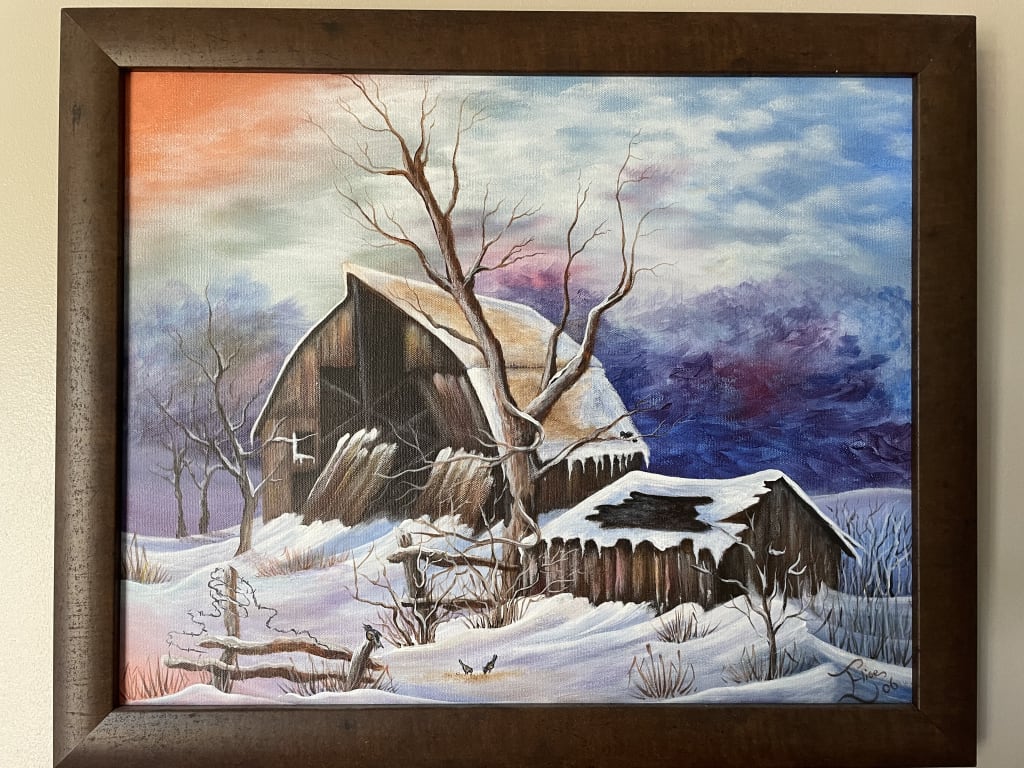
Woodburn, WV, October, 1864
Ruby had just finished her evening prayers and was about to pick up the oil lamp to go upstairs to her bedroom when some noise outside, on the porch, made her freeze on the spot. Alert, not daring to breathe, she listened as something slid just outside her door.
“Knock, knock!” on the glass of the main door. It was dark on this early October evening. All Ruby could see was a gloved hand.
“Ma’am! Please, open the door! I’m injured. I need help. I promise I won’t hurt you or your son!” came a rough man’s voice, crippled by pain. Ruby’s heart was beating a thousand miles an hour! Summoning her courage, she asked:
“Who are you? Yankee or Confederate?
- Neither. I’ve broken my leg riding when my horse died of exhaustion. I was going far away from the war in the Shenandoah Valley.”
Ruby knew that both forces were head-to-head, less than a hundred miles from her home. Stories of war spread like wildfires. She stood rooted to her spot. The stranger implored:
“Ma’am, if you’re a good Christian, you’ll open the door. I shall repay the favor by helping you throughout winter.”
Her faith got the best of her, and she quickly unbolt the door and let the stranger in. He was crawling on all four, one leg dangling loosely behind him. He slid and crawled to a chair and managed, with Ruby’s help, to sit down. Ruby brought the oil lamp up close to the man. He was wearing a dirty pale grey uniform.
“You are Confederate!!”, exclaimed Ruby. The man held his hands up, shaking his head.
“Let me explain, in a thick southern accent. I was Confederate but there’s no way we are keeping Winchester. I bailed. I’m a messenger so I hopped on my horse and rode hard, west of the town. I can’t take it anymore! The stench of death, the bloodied bodies, the burnt flesh. I just can’t do it anymore. I know my clothes are confederate but I’m a Yankee at heart. I just want peace and live through this horrible war. It’s been four years of gruesome sights and horrendous smells. Ma’am, let me stay here so my leg can heal, and I will make myself useful this winter coming. I noticed you have very little wood chopped up and your barn could use some fixing.
- But they will kill us both if they find you here!
- We will burn my uniform; I’ll stay out sight when people come around. I know how to hide myself, believe me. I’ve made it through enemy territory a thousand times to deliver messages.
Ruby starred at the man: he could be useful. According to the onions, the winter was going to be harsh and cold this year.
“Fine! But I’m in charge here! You do as I tell you.
- On my soul, I will obey you, Ma’am.”
Ruby helped the man to a spare room on the second floor. She did what she could to reset the bone in place: gave the man some bourbon to drink, told him to bite hard on the belt, and replaced the bone in one swift move. Then, she bandaged him, cleaned him, and let him rest for the night.
Over time, Ruby Clarkson and Luke Montgomery became good friends. Once his leg healed, Luke made sure that there was enough wood for the winter, he fixed stuff around the house, he fixed the barn doors and became a father figure to young Charles, who was five years old.
Luke found out that Ruby had married a rich merchant just before the war and that her husband had been murdered for his money one evening in ’62 on his way back from a meeting in newly proclaimed Morgantown, WV.
Gratitude and friendship turned into love and soon, Luke had completely replaced Charles Sr. Clarkson. Ruby was expecting his child. She worried about what people would say, come this spring, once she would have to go to town and her belly would show.
For now, she still went to town once a week on her horse with little Charles to get some necessities and to go to church. The New Year had rung in, and that’s when she heard that the Yankees were due to come around to gather some food for the army. Just like everyone else, Ruby pictured her jars of pickled food gone, her horse taken away, her goat and chicken slaughtered. She hurried back home to Luke. Her little estate was a few miles away from town. Nobody bothered to visit her in winter. Too much snow but that would not keep the army from raiding her place.
“Luke! Luke! The Yankees are on their way! They’re coming to get food! Luke! We will die!”
Luke met her on the porch at her cries. He grabbed Charles and ushered him inside. The wind was blowing hard and cold. He went back outside to bring the horse in the barn and fed him. He covered the horse with a big wool blanket. He then ran up back to the house.
“Ruby, pack blankets, clothes, one pot, one skillet, a few silverwares, some medicines and some food.
- Now?” asked Ruby astonished.
“Yes, now. We are leaving this place before sunset. I’ll pack the wagon.
- Where will we go?
- East, by the Shenandoah Valley. The General burnt it to the ground last fall. No one will come looking for us over there.”
Crying, Ruby got to work: she packed fabrics, wool, some toiletries, and cooking stuff with bread and jars. Little Charles was crying too, not knowing what was going on, being scared, sensing his mother’s distress. Within an hour, the little family was on its way, Luke walking by the horse to guide him in the night, the moonlight his sole light through the winding road.
When daylight came, Luke hopped onto the wagon and gave Ruby instructions to keep going until she could find a little clearing off the side of the road, far away from any establishments or village.
They went this way for ten days, walking at night, resting during the day. They were getting close to the valley, they were still up high in the mountains. Luke surveyed the horizon. The valley, burnt, was below. The road was leaving the forest. On his right, Luke saw an old abandoned and lapidated barn. He pointed to it.
“We can spend part of the winter there.”
It was mid-January. A little abandoned house, which could have been a chicken coop, was sitting just in front of the barn. There were no windows, and the door was broken in. The floor was beaten down earth. The barn itself was half falling apart. The doors were skewed, but the roof was in good shape. Inside, there was a second level, filled with hay. There were a few barrels of oats, barley and wheat stored on the ground floor, under the second story area. Some tools were hung on the wall: a spade, a sickle, a hoe, a rake, a saw, an axe, and a few shovels. An anvil was sitting nearby with pliers and shears. There were also some buckets of various sizes. One was big enough to be used as a tub. One bucket was full of nails. Luke got to work on the small house. He brought in some wood, taken from the barn's second floor, and built a wooden floor. Then he built a bed. Ruby made a mattress of hay and covered it with a thick wool blanket and a cotton sheet. Luke built a door that they slid open and closed. They had supper in the barn, where they built a small fire to keep warm. Then, the three of them went to bed in the makeshift house, all in the one bed.
Within a week, Luke had built a makeshift hearth in the house. As well as two benches and a table. Melting the snow, Ruby cooked oatmeal in the barn in the morning and barley soup at night in the house. The main rule Luke had was not to light a fire in the house during daylight. He didn’t want someone seeing the smoke go up, thus revealing their position.
Slowly the days turned into weeks. The three chickens they had brought with them were feeding on the wheat and started to produce eggs again. If they were lucky, they had an egg each to eat per day. The horse simply stayed in the barn, munching on hay. Ruby would melt snow, make it boil then put it in her jars of eaten preserved food. Sometimes, Luke would go hunt with a makeshift lance. He’d bring back hares and pigeons to eat. Charles would spend his days playing in the barn and helping his parents. He was speaking more and had even picked up Luke’s accent.
The snow was starting to melt during the day, making their little trail from the house to the barn muddy. Ruby had started to step aside from the trail so she would walk on snow when she would go to the barn. With time, however, it brought her up to higher land which wasn’t muddied and had patches of yellow grass. That was her favorite route: from there, she could see the whole valley below. Her view wasn’t restrained to the depression in the ground on the side of the mountain. While Luke was in the forest hunting and trapping, she would bring Charles up the ledge in front of the house and barn to feel the warm sunlight on their skin, breathe in the fresh air and take in the view.
One early morning, just after daybreak, the door was shoved aside violently, and soldiers entered the tiny house. Luke and Ruby woke up startled. The Yankee soldiers pull them all out of bed and brought them roughly into the barn. Ruby was close to five months pregnant, and she was dragged more than she walked to the barn. Charles was picked up by a soldier and thrown over the shoulder while three more soldiers were on Luke to restrain him. Luke fought vigorously but he was quickly outnumbered and subdued. In the barn, he was thrown to the captain’s feet.
“Please, my wife and I don’t have much. Take the horse, we don’t need it!
- Do I hear a southern accent? A deserter! Guards, hang him!”
The soldiers threw a rope with a noose over one the beam of the barn. Charles was pounding the soldier's back, trying to kick him. The soldier bored himself fast of that behavior and put Charles down, as he is crying out to his father, and snapped his delicate neck with a swift movement.
Next, Luke had a noose around his neck and was quickly hauled up off the ground. Ruby could only cry and scream:
“My baby, Charles! Luke! NO!”
After what seemed to Ruby an eternity, Luke’s body stopped moving, his face purple. Ruby laid on her knees clutching her belly while her heart was shattered in a thousand pieces.
“Sorry Ma’am! Confederates and deserters are to be killed!”, declared the captain. “As for you, we will bring you to the convent in Winchester where you can have your child.”
*********************************************************************“
"On April 2nd, 1865, Ruby was admitted to the Winchester nunnery. The war was over by the end of that month. Had they not got caught, I believe they would have had a good life.
- Grandma! Did Ruby have her baby?
- Yes of course, she named her son Luke Jr Montgomery.” answered Ruby while looking at her twin grand-daughters Tiffany and Ashley.
“So that’s the story of that barn in the painting! How tragic!” said Ashley.
“And you were named after your great, great, grandmother!” whispered Tiffany.
About the Creator
Sylvie Gagné
I’m a high school teacher in a French Catholic board in Ontario, Canada.
I love traveling, cooking and listening to music.
I’ve always had a very imaginative mind since I was a child.
Keep reading
More stories from Sylvie Gagné and writers in Families and other communities.
Wise~Guys
— Look Behind what's in Front of You ~ Make Good Choices — Hey, So how you Doin'..! Made~Men — Mobster Movies romanticise a distinctive, elegant appearance, impeccable attire style, along with the 'Families' expressive lingo. Making their 'Bones' gave them Panache — with vintage fedoras, tailored pin-striped suits, mirror-polished wing-tip shoes adorned with tassels; with their 'Gun Moll' gorgeous dates on their arms.
By Jay Kantor13 days ago in Families




Comments
There are no comments for this story
Be the first to respond and start the conversation.