
The Night I Saw My Father Break
I had always believed my father was unshakable.
To the outside world, he was a man of quiet strength—stoic, composed, the kind who always knew what to do, even when everything else was falling apart. He had the kind of presence that made children sit straighter and strangers instinctively nod in respect. His hands were worn and calloused, his back a little hunched from years of hard work, but there was nothing weak about him.
Until that night.
I was twenty-one. Old enough to be trusted with secrets, but still too young to understand the weight of the world that adults silently carry. My mother had been in and out of the hospital for months, her illness an unwelcome guest that refused to leave. The doctors never used the word terminal, but their eyes said more than their mouths ever did.
That night, we were waiting—again. The sterile scent of antiseptic, the slow beeping of machines, the humming of fluorescent lights—it all felt so detached from life. Like time had curled up and fallen asleep in a corner, refusing to move forward.
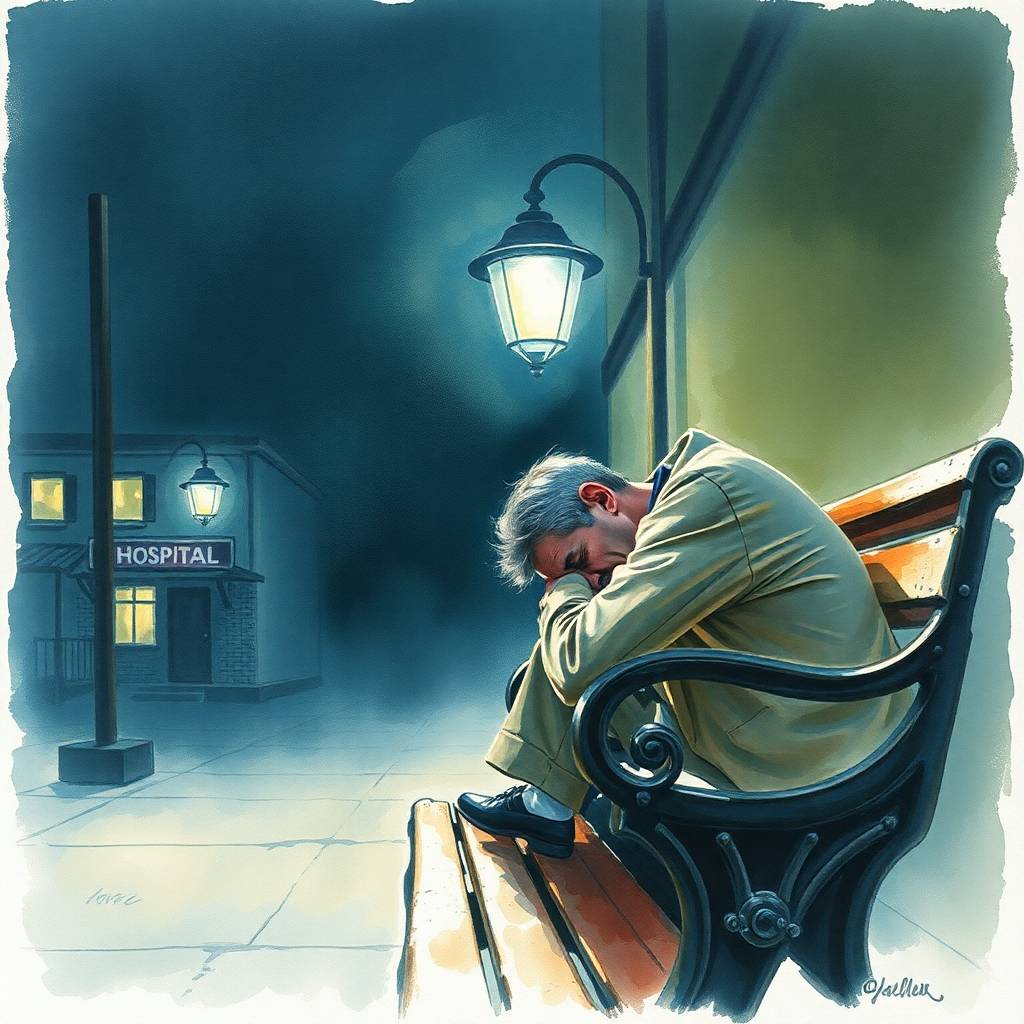
I stepped outside the hospital room for air. My father was already there, sitting on a wooden bench beneath a flickering street lamp. It cast long shadows on his face, carving the lines deeper than I’d ever noticed before.
He didn’t see me approach. His hands were clasped between his knees, and his shoulders hung low, like they carried the weight of every moment he’d ever had to be strong. I opened my mouth to speak, but something stopped me.
Then I heard it.
A sound I had never associated with him.
A choked sob.
And then another.
My father—this mountain of a man, who never cried at funerals, who told me scraped knees build character, who once stitched his own hand with fishing thread to avoid a hospital bill—was crying.
It was not just a tear rolling down a cheek. It was years of grief, exhaustion, helplessness, and fear crashing through a dam that had been holding them in for too long.
I stood there, frozen.
I didn’t know if I should walk away to protect his dignity or rush forward to protect his heart.
But my heart chose for me.
I sat down beside him and didn’t say a word. Instead, I placed my hand on his back, the same way he had done for me so many nights when I was little and couldn’t sleep. He didn’t flinch. He just kept crying—quiet, broken sobs that seemed to rise from somewhere deep, older than his age, older than this illness.
“I don’t know how to lose her,” he whispered.
And just like that, my heart cracked open.
We often think of our parents as indestructible until we see the very thing that makes them human: their breaking point. That night, I didn’t just see my father cry. I saw him as a man. A husband. A boy who once fell in love with a girl with bright eyes and a loud laugh and who couldn’t imagine life without her.
And in that moment, I realized something I hadn’t understood before: strength isn’t the absence of tears. It’s the courage to feel them fully. To let them fall without shame.
We talked for hours that night, mostly in broken pieces—memories, fears, silent nods. He told me about the first time he met my mother at a wedding in 1987, how he had rehearsed what to say for three hours but ended up just offering her a drink. How she laughed and said, "You had me at Pepsi."
We laughed. We cried. We held each other.
It was the most human conversation I’d ever had with him.
He told me he wasn’t afraid of death. He was afraid of forgetting the little things: the way she hummed while cooking, the way her fingers found his hand in the dark, the scent of her hair after a shower.
“I can’t hold on to her forever,” he said, “but I’m afraid of letting go.”
There are moments in life when the world stops being a blur and suddenly becomes painfully vivid. That night was one of them.
________________________________________
My mother passed away three weeks later.
It was quiet. Peaceful. She squeezed his hand twice, as if to say, I’m okay, and then she was gone.
My father didn’t cry at the funeral. Not then. Not in public. But I knew he would later, when the house grew silent and the bed too large.
We moved through the motions—guests, prayers, casseroles. Life’s cruel way of demanding normalcy while grief is still dragging you underwater.
But something shifted between us after that night on the bench.
He started telling stories more often—about her, about their youth, about the moments he once kept locked in his heart. He let me in. He let us in. Vulnerability became our new strength.
And I, in turn, began to see the beauty in brokenness.
________________________________________
Years have passed. The house still smells faintly of her perfume. My father still sets the table for two. And sometimes, when no one is looking, he hums the tune she used to sing while making tea.
But he smiles now when he cries.
There is grief in his tears, yes—but also gratitude.
He loved. Deeply. Fiercely. Fully.
And that, I’ve come to understand, is the bravest thing anyone can do.
________________________________________
To You, The Reader
If you have never seen your parents cry, don’t wait until pain forces it out of them. Sit with them. Talk. Ask about their dreams, their fears, their youth. Ask who they were before they became “Mom” and “Dad.”
Because one day, you will realize that they were human all along.
And if you’re lucky, you’ll get to hold them not just in your memory—but in the full, messy, beautiful truth of who they are.
Just like I did, the night I saw my father break.
About the Creator
Keep reading
More stories from Muhammad Adnan and writers in Families and other communities.
Old Lifestyle vs. Modern Lifestyle: A Journey from Simplicity to Speed
Introduction Life is a journey, and over the years, this journey has taken many different paths. From the quiet, peaceful rhythms of our grandparents’ days to the fast-paced, technology-driven life of today, a lot has changed. But in this race toward progress, one question continues to echo: Have we truly moved forward, or have we left behind something precious?
By Muhammad Adnan7 months ago in Wander
Punch the Macaque: The Baby Monkey Who Found Comfort in a Plush Friend
Today we look back at one of the most unexpected viral stories of 2025—a tale that began quietly in a zoo in Japan and grew into a global symbol of resilience and tenderness. It is the story of Punch, a Japanese macaque born in July 2025 at Ichikawa City Zoo in Chiba Prefecture. His life began with hardship, but what followed has touched millions across the world.
By Haroon Pasha7 days ago in Families




Comments
There are no comments for this story
Be the first to respond and start the conversation.