
The Mender of Broken Things
And the Song He Left Behind

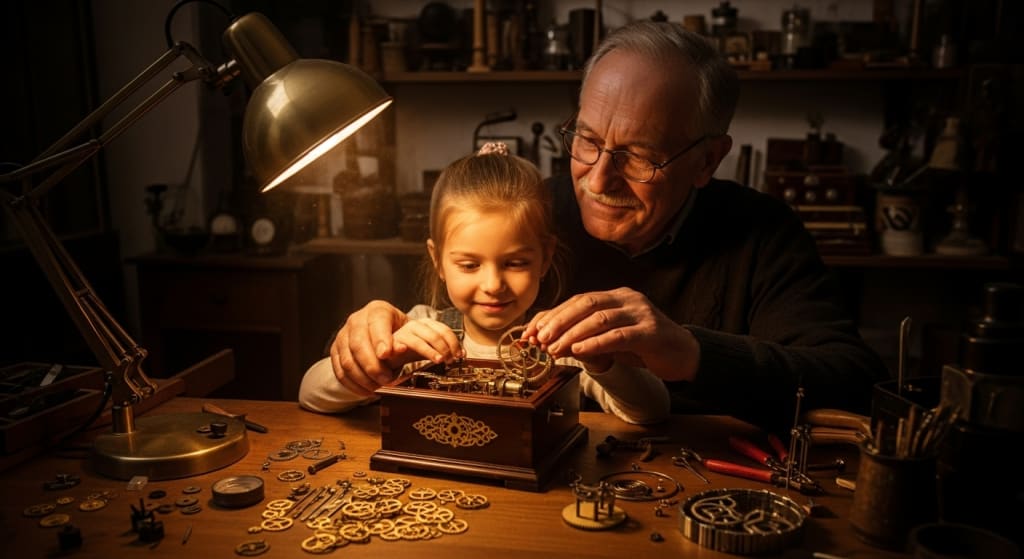
I inherited my grandfather’s hands. Not their appearance—his were broad and calloused, mapped with fine white scars, while mine are slender and unmarked. I inherited what they could do.
His workshop was a cathedral of silence and suspended time. It smelled of cedar oil, metal polish, and patience. On shelves and in drawers lay the wounded: clocks that had forgotten how to tick, dolls with vacant eyes, music boxes that had lost their song. He was a doctor for the broken, a mender of things others had thrown away.
As a child, I was his reluctant apprentice, sent to his house every summer. I’d rather have been with friends, but my mother insisted. “It’s important,” she’d say, a strange weight in her voice.
So I sat on a high stool, watching him work. He never explained with words. He’d simply hand me a tiny screwdriver and point to a stubborn screw. Or he’d hum a tune—da-da-dum-dum—and wait for me to find the corresponding note in a music box’s comb. His teaching was a language of gestures and intuition. I learned to listen with my fingertips, to feel the subtle catch in a gear train, to hear the faint protest of a rusty spring.
The summer I turned sixteen, I arrived angry. A friendship had shattered in a storm of cruel words and betrayals. My own heart felt like one of the broken things on his shelf—a music box with a cracked mainspring, unable to play its song.
Grandpa took one look at me, his eyes soft and knowing behind his magnifying visor. He didn’t offer advice. Instead, he went to a high shelf and brought down a small, rosewood box, its finish dull with age.
“This one,” he said, his voice a low rumble, “is the hardest fix I’ve ever attempted.”
He opened the lid. Inside was the most complex mechanism I’d ever seen—a symphony of tiny levers, star-shaped cams, and interlocking gears. It was utterly silent.
“It’s not just a music box,” he explained. “It’s an automaton of a ballerina. A man brought it in, fifty years ago. He said it belonged to his wife. They’d had a terrible fight, and in her anger, she’d thrown it against the wall. She died before they could make amends. He asked me to fix it. I’ve been trying ever since.”
Fifty years. I looked at the silent, tangled guts of the thing. “Why? It’s impossible.”
“Nothing is impossible,” he said, handing me a pair of tweezers. “It just requires the right kind of attention.”
So we began. For weeks, we worked on the ballerina. My teenage angst slowly bled away, replaced by the intense focus the task demanded. We decoded its logic, painstakingly straightened bent pivots, and polished tarnished gears. I learned its history not from Grandpa’s stories, but from the wear on its parts, the particular way a spring had fatigued.
We discovered its problem wasn’t the obvious damage. It was a single, hairline crack in a main bearing, invisible to the naked eye, that threw the entire timing sequence out of alignment.
The day we found it, Grandpa let me mix the special adhesive, a formula he’d perfected over decades. My hands were steady as I applied the microscopic drop. We reassembled it, our movements a synchronized dance we’d learned without ever practicing.
He placed the final cover plate and nodded to me. “You do the honors.”
I held my breath and turned the key. There was a faint whirring, a series of delicate clicks, and then, music. A sweet, melancholy waltz filled the workshop. The ballerina on top, her porcelain face still chipped, began to turn. She was stiff, her movements a little hesitant, but she was dancing.
Tears I didn’t know I’d been holding back streamed down my face. It wasn’t just a toy we’d fixed. It was a gesture. A long-overdue apology. A piece of a love story, set back in motion.
Grandpa put a heavy hand on my shoulder. “Some things break clean, and you can glue them,” he said, looking not at the ballerina, but at me. “Some breaks are deeper. They change the shape of the thing forever. The trick isn’t to make it like it was. The trick is to help it find a new way to be whole. To find its song again, even if it’s a different song.”
I understood then why my mother had sent me here all those summers. She wasn’t just giving me a hobby. She was giving me a compass for when I felt lost.
Grandpa is gone now. The workshop is mine. People still bring me their broken things, and I mend them. But the most important thing I ever fixed was my own heart, in that quiet summer, with my grandfather’s guidance and the silent, stubborn faith of a dancing ballerina who refused to be forever broken.
About the Creator
The 9x Fawdi
Dark Science Of Society — welcome to The 9x Fawdi’s world.
Keep reading
More stories from The 9x Fawdi and writers in Families and other communities.
The Language of Seeds
My grandmother spoke a language without words. It was a dialect of soil and seasons, taught to her by her mother, who learned it from her own. It was a language I only started to understand the summer I turned twelve, the summer my world went quiet.
By The 9x Fawdi4 months ago in Families
Husbands With These 2 Bad Habits May Put Their Wives at Higher Risk of Breast Cancer
When people think about breast cancer risk, they often focus on genetics, diet, or personal lifestyle choices. While these factors are important, there is another influence that is often overlooked—the daily habits of a husband or partner. The lifestyle shared inside a home can shape long-term health outcomes for both partners.
By DigitalAddia day ago in Families


Comments
There are no comments for this story
Be the first to respond and start the conversation.