
The Last Unopened Gift
A Story of Time, Regret, and the Magic of the Final Midnight
Chapter 1: The Geometry of Silence
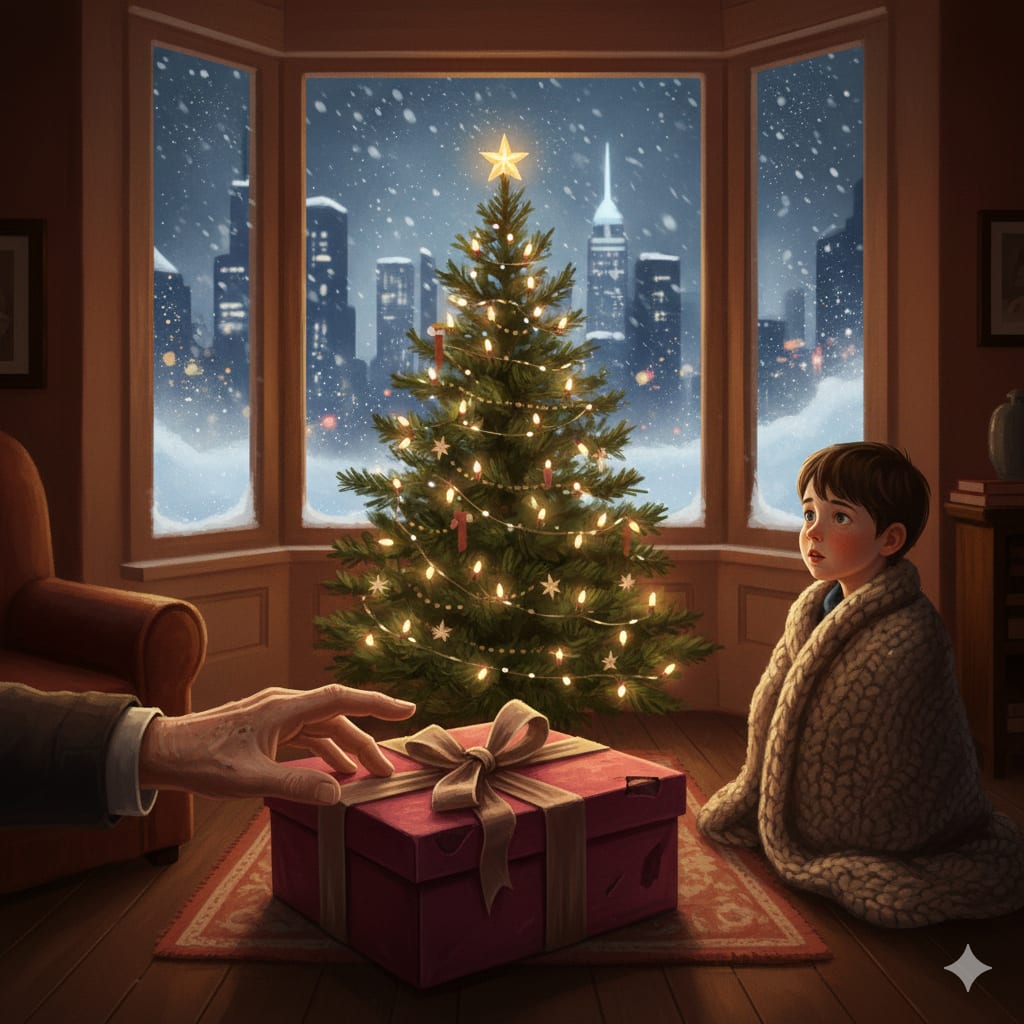
The snow did not fall in New York City that year; it descended. It came down in thick, heavy curtains of white that muffled the screaming sirens and the frantic honking of yellow taxis. By 10:00 PM on December 31st, 2025, the world had been erased, replaced by a monochrome landscape of frost and shadows.
High above the illuminated chaos of Times Square, in a small, pre-war brownstone tucked away in a corner of Brooklyn that time had forgotten, Elias Thorne sat by his fireplace. Elias was seventy-eight years old, his skin mapped with the geography of a thousand stories, his eyes the color of a fading twilight.
Every year, while the rest of the world looked forward, Elias looked down. Specifically, he looked at the space beneath his modest, pine-scented tree. There, wrapped in deep crimson paper and tied with a silk ribbon that had lost its luster decades ago, lay a box.
It was the size of a shoebox, but to Elias, it weighed as much as an anchor. It had sat there through forty winters. It had survived moves across the country, economic collapses, and the slow, agonizing silence of a house that had grown too large for one person.
Elias reached out, his trembling fingers hovering just inches from the ribbon.
"Not yet," he whispered to the empty room. "The clock hasn't struck. The ghost hasn't spoken."
The wind howled against the windowpanes like a wounded animal. Elias was about to pour himself a final glass of sherry when he heard it—a sound that didn't belong to the storm.
Thump. Thump. Thump.
It wasn't the rhythmic knocking of a guest; it was the desperate, fading beat of someone losing a fight with the cold. When he pulled it open, he found a boy, perhaps ten years old, collapsed against the frame.
Chapter 2: The Stranger at the Threshold
Elias pulled the child inside, the warmth of the hearth clashing with the icy breath of the night. For the next hour, the room was a blur of activity—warm blankets, a bowl of tomato soup, and the frantic rubbing of small, blue-tinted hands.
The boy’s name was Leo. He was a runaway from a nearby foster home, though he called it "the grey building with many beds." As Leo’s color returned, his eyes began to wander the room, landing with an almost magnetic intensity on the crimson box under the tree.
"Why is it still closed?" Leo asked, his voice still shaky. "Everything is supposed to open at midnight. That's the rule, isn't it? Out with the old, in with the new?"
Elias sat back in his wingback chair. "Sometimes, Leo, the 'old' is the only thing that keeps the 'new' from being empty. That box has been closed since 1985."
"1985?" Leo gasped. "That’s... that’s like a hundred years ago."
"It feels like it," Elias smiled sadly. "To understand the box, you must understand a night much like this one, forty years ago. A night when I believed that architecture was about steel, but learned it was actually about hearts."
Chapter 3: The Architecture of Memory
Elias closed his eyes, and the brownstone vanished. He was twenty-five again, standing on a scaffold in a skeletal skyscraper.
"I was an architect, Leo. I wanted to build towers that touched the stars. I thought immortality was made of glass and concrete. But then I met Sarah. She was a violinist who played in the subway stations. She used to say that people in a hurry needed a reason to stop, and her music was that reason."
He described Sarah in vivid, painful detail. Her hair was the color of autumn leaves, and her laugh could make a rainy Tuesday feel like a festival. They were poor, living in a flat where the heater rattled like a dying ghost, but they were happy.
"On New Year’s Eve, 1985, I bought that box. I spent months designing a gift that was supposed to be our beginning. I was going to propose at midnight. But Sarah got a call—her father was dying in London. She had to leave that very night."
They stood at JFK airport, the snow swirling outside. Elias had handed her the box, but she refused to take it.
"If I take it, it means I’m leaving you," she had told him. "If you keep it, it means I have to come back to open it with you."
She never came back. A car accident on a fog-thick road in England took her three days later. The box remained under the tree, its ribbon never pulled, its secrets never shared.
Chapter 4: The Museum of One
Over the next few decades, Elias became a curator of his own grief. He described to Leo how he kept the house exactly as it was. He polished the furniture Sarah touched. He kept her books in the same order.
"I thought I was honoring her," Elias said. "But really, I was just making sure I didn't have to face a future where she wasn't the lead character. I built dozens of towers after she died, Leo. Glass monoliths all over the globe. But every time I finished one, I felt shorter. Because the person I wanted to show them to wasn't there."
Leo looked at the red box again. "But if she left you the box to open with her, and she never came back... doesn't that mean the box is broken? Like a promise that didn't come true?"
Elias flinched. The boy’s honesty was like a surgeon’s knife. "A promise isn't broken just because it isn't fulfilled, Leo. Sometimes the promise itself is the gift."
"I ran away tonight," Leo said suddenly. "I thought if I disappeared, nobody would notice. I thought being 'unopened'—like your box—was better than being rejected again."
Elias realized that Leo wasn't just a guest. He was a mirror. He was the ghost of the son Elias never had.
Chapter 5: The Confrontation with the Self
The clock on the mantle was no longer a timepiece; it was a judge. 11:45 PM.
"Why do you want to die holding a closed box?" Leo shouted suddenly, his young face flushed. "Don't you want to know what's inside before you go?"
The silence that followed was absolute. Elias looked at the boy. He saw the wet socks, the oversized jacket, and the desperate need for a truth that wasn't a lie.
"You're right," Elias whispered. "I am tired. I am so incredibly tired of wondering."
He walked to the tree and picked up the box. It was dusty. The silk ribbon felt like dry skin. He sat back down and placed it on the table between him and the boy.
"If we open this," Elias warned, "the ghost leaves this house. I become an old man who lost his love, and you become a boy who has to go back and face his life. Are you ready for the truth?"
Leo reached out and placed his hand on top of Elias’s. "I'm tired of being a ghost, Mr. Thorne."
Chapter 6: The Unlocking of the Soul
11:59 PM.
Elias gripped the silk ribbon. He pulled. The knot came undone with a soft, sliding sound. He tore the crimson paper. Underneath was a plain wooden box made of dark cherry wood.
He lifted the lid.
The first thing that emerged was a scent. The smell of 1985—lavender, old paper, and fountain pen ink. Inside lay a hand-carved wooden model of a house. It was a replica of the home they had dreamed of building in Vermont.
But beneath the house lay something else: a small, black reel-to-reel tape.
Elias reached for an old tape player he hadn't touched in years. He threaded the tape. The machine whirred.
Then, a voice.
"Elias? I hope you're listening to this on New Year's Eve, just like we planned."
It was Sarah. Her voice was vibrant, full of the youthful arrogance of someone who thought they had all the time in the world.
"The house you’re looking at... it’s not just a model. I hid the deed to that land in Vermont inside the miniature. I bought it with the money I saved from playing in the subway. It was my surprise for you. But more than that, Elias... if I'm not there to open this with you... don't you dare keep it closed. Open the door. Let someone else in. Promise me."
Chapter 7: The Weight of the Deed
Elias sobbed—a raw, guttural sound that had been trapped in his chest since 1985. He pressed a hidden latch on the miniature house. A small compartment opened. Inside was a piece of parchment: the deed to a plot of land in the Green Mountains.
But attached to it was a note: “For the family we haven't met yet.”
Elias looked at Leo. The boy was shivering, his eyes wide.
"The earth doesn't disappear just because we ignore it, Leo," Elias said, his voice firming up. "The land is still there. Waiting."
"Is it still yours?" Leo asked.
"It belongs to the future," Elias said. "And I think... I think I still remember how to design a house that has enough room for a library, a music room, and a bedroom for a boy who likes to ask difficult questions."
Chapter 8: The First Breakfast of the New World
The sun began to bleed through the grey clouds of Brooklyn at 7:00 AM. The storm had passed, leaving a world that was blindingly white.
Elias and Leo hadn't slept. They spent the night talking about Vermont—the trees, the light, the silence that wasn't lonely. Elias fried eggs, a simple task that felt like a holy ritual.
"We have a lot of work to do," Elias told the boy. "We have to find a lawyer, a contractor, and a very large map."
Elias took the crimson wrapping paper and tossed it onto the embers. It flared up in a brilliant flash of red before turning to ash.
"Goodbye, 1985," he whispered.
He turned to Leo. "Pack your things. We are leaving this museum."
Chapter 9: The Legacy of the Open Door
In the years that followed, the story of the "Red Box Architect" became a legend in the small Vermont town. People spoke of an old man and a young boy who arrived with nothing but a wooden model. They built a house that wasn't a tower, but a home with windows that looked across the valley.
Elias Thorne lived to see Leo graduate from university—not as an architect, but as a musician. Leo played the violin, just like Sarah.
And every New Year’s Eve, they would sit by the fireplace in their Vermont home. They didn't put a box under the tree. They didn't need to.
Elias had finally learned that the most beautiful things in life are never wrapped in paper. They are lived in the light.
"The best gift," Elias would say to Leo every year, "wasn't what was inside the box. It was the courage to finally throw the box away and let the music in."
Epilogue: The Architect's Last Project
As Elias sat on his porch in Vermont, looking at the stars he once tried to touch with skyscrapers, he realized Sarah was right. Towers are for people who want to look down. But a home—a real home—is for people who want to look at each other.
He had finally finished his greatest project. He hadn't built a skyscraper. He had built a future.
The year 2026 was just the beginning.


Comments (1)
nice story