
The Human Cost of Inflation
Story Angle: Follow a family struggling to afford basic necessities as inflation drives up the cost of food, rent, and education. Emotional Core: The parents' desperation to provide, children giving up dreams, and the impact on their bond as a family

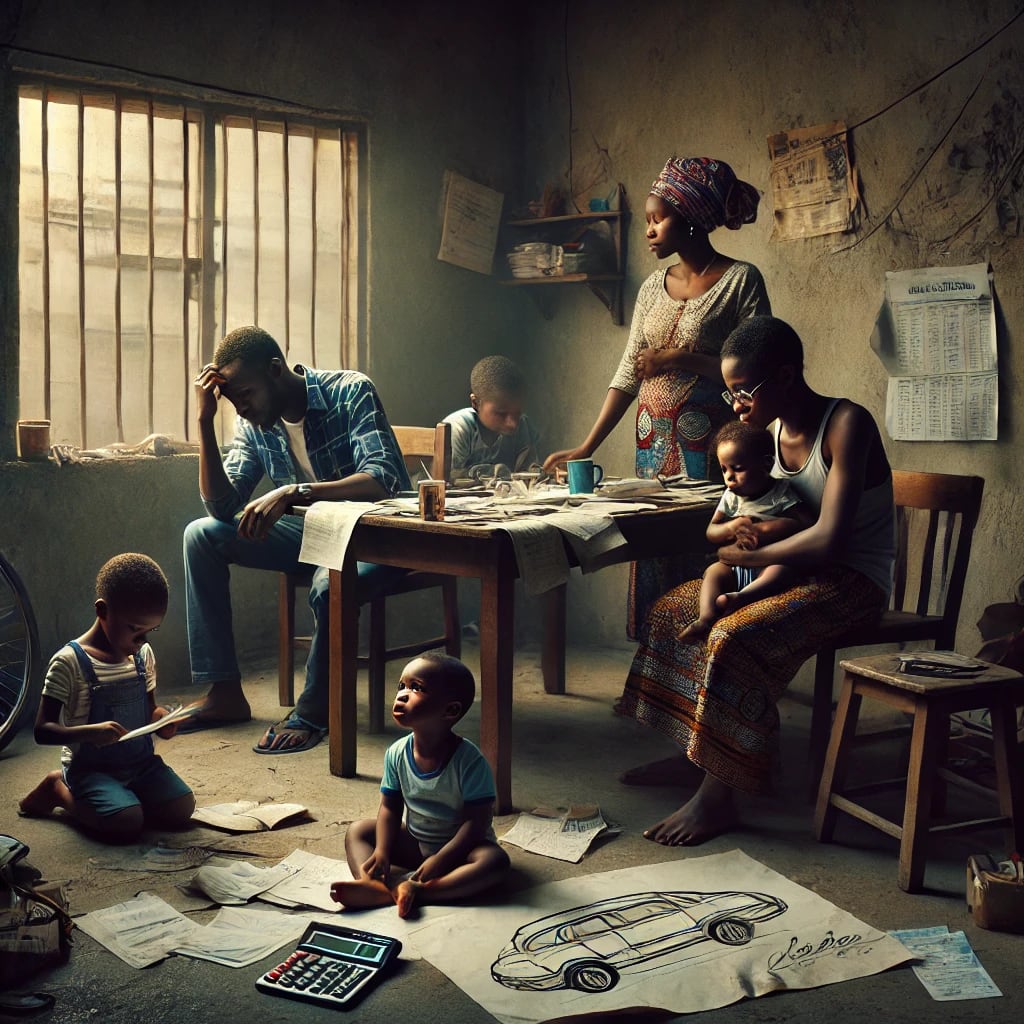
It was another sweltering afternoon in Lagos, and the power had been out for hours. Inside a cramped two-room apartment, Tayo wiped the sweat off his forehead as he sorted through a stack of overdue bills. The numbers were suffocating—rent had increased by nearly 40%, the price of food seemed to double every month, and his eldest daughter, Zainab, had been sent home from school for unpaid fees. His wife, Amaka, stood by the window, fanning their youngest child, David, who was crying from the heat and hunger.
“We can’t keep going like this,” Amaka said softly, her voice trembling. She rarely complained, but today, her exhaustion was palpable.
Tayo didn’t respond immediately. He leaned back in his chair, staring at the peeling paint on the ceiling. Just three years ago, life had been different. He worked as a mechanic at a busy shop, earning enough to provide for his family. Amaka ran a small food stall in the neighborhood, supplementing their income. They weren’t wealthy, but they were comfortable.
But inflation had crept into their lives like a thief in the night. The cost of basic items—rice, beans, oil—had skyrocketed. Amaka’s customers, many of whom were also struggling, couldn’t afford to buy from her anymore. Her stall now sat empty, the pots gathering dust. Tayo’s income was no longer enough to cover their needs, and every day felt like a battle to stay afloat.
That evening, as the family gathered around a meager meal of yam and palm oil, Zainab broke the heavy silence.
“Papa, when can I go back to school?” she asked, her voice hesitant but hopeful.
Tayo’s chest tightened. Zainab was just 15, but her dreams were already slipping away. She had always been a bright student, talking endlessly about becoming a doctor. Now, she spent her days at home, helping Amaka care for David and her younger brother, Chinedu.
“I’m working on it, my dear,” Tayo said, forcing a smile. “Just give me a little more time.”
But Zainab’s eyes dropped, and the light in her face dimmed. She had heard the same words for months. She didn’t cry or argue—she had grown too accustomed to disappointment.
After dinner, Amaka approached Tayo as he stood by the window, staring out into the bustling street below. “Tayo,” she began hesitantly, “I’ve been thinking… Maybe we should send Zainab to the village to stay with my mother for a while. At least there, she’ll have food and a roof over her head. And the schools are cheaper.”
Tayo’s jaw tightened. “You want to send our daughter away? Split our family apart because we can’t afford to keep her here?”
“I don’t want to,” Amaka said, tears brimming in her eyes. “But what choice do we have? She’s wasting away here, Tayo. She’s too young to lose hope like this.”
Tayo clenched his fists, anger bubbling inside him—not at Amaka, but at the situation they were trapped in. How had it come to this? A man should be able to provide for his family, yet every effort he made felt futile against the relentless tide of rising prices.
The next morning, Tayo woke before dawn, determined to find a solution. He left the house without eating, heading into the city to look for extra work. He spent the day moving from one construction site to another, offering to do anything—carry bricks, mix cement, clean up debris. By evening, he had earned a few thousand naira, barely enough to buy a bag of rice.
When he returned home, exhausted and drenched in sweat, he found Chinedu sitting on the floor, playing with a torn notebook. “What are you drawing?” Tayo asked, kneeling beside him.
“A car,” Chinedu said proudly, holding up the sketch. “One day, I’ll be a big engineer and make cars, just like you fix them!”
Tayo’s heart ached. He wanted to believe in Chinedu’s dream, but the weight of their reality made it hard. He ruffled the boy’s hair and forced a smile. “You’ll do great things, my son,” he said, though his voice lacked conviction.
That night, after the children had gone to bed, Amaka sat with Tayo at the small dining table. “The landlord came today,” she said quietly. “He says if we don’t pay the increased rent by next month, we’ll have to leave.”
Tayo buried his face in his hands. “Where would we even go?” he whispered.
“I don’t know,” Amaka admitted. “But we can’t keep living like this, Tayo. The children are suffering. We’re suffering.”
For the first time in months, Tayo let his tears fall. He had always tried to be strong, to carry the weight of their struggles without breaking. But now, the dam had burst. Amaka reached across the table, holding his hand tightly. “We’ll find a way,” she said, though her voice wavered. “We have to.”
The following days were a blur of desperation and small victories. Amaka reopened her food stall, selling smaller portions at lower prices to attract customers. Tayo picked up more odd jobs, working late into the night. They scraped together enough to keep the landlord at bay for another month, but the stress was relentless.
One evening, as the family sat together, Zainab spoke up again. “Mama, Papa,” she said, her voice steady despite the heaviness in her words. “I’ll go to the village. I don’t want to be a burden anymore.”
Tayo and Amaka exchanged a pained look. They had tried to shield their children from the worst of their struggles, but Zainab had seen through it all.
“No,” Tayo said firmly. “You are not a burden, Zainab. None of you are. We’ll figure this out together.”
For the first time in weeks, the family talked openly about their challenges. Zainab shared her fears of losing her education, Chinedu talked about missing his friends at school, and even little David clung to Amaka, sensing the tension.
In that moment, something shifted. The bond they shared, though strained, held them together. They were not just a family struggling to survive—they were a family fighting for each other.
Tayo knew their path wouldn’t be easy. Inflation continued to rise, and the cost of living showed no signs of slowing down. But he also knew that giving up was not an option. Together, they would endure.
As he lay in bed that night, Tayo held Amaka’s hand and whispered, “We’ll get through this. For them. For us.”
And though the future remained uncertain, the love they shared became their anchor in the storm. It was a reminder that even in the harshest of circumstances, hope could still take root—and grow
About the Creator
Esther Hambolu
As a passionate content writer, I bring fresh perspectives and engaging narratives to every topic I tackle. With a keen eye for detail and a commitment to clarity, I create content that not only informs but also resonates with readers.
Keep reading
More stories from Esther Hambolu and writers in Families and other communities.
Consumerism vs. Meaning
The Johnson family lived in a sprawling suburban home adorned with all the trappings of success: sleek cars in the driveway, high-end gadgets in every room, and a towering Christmas tree glittering with expensive ornaments. For years, their Christmas mornings were a blur of tearing wrapping paper, comparing price tags, and rushing through meals to visit malls for post-holiday sales.
By Esther Hamboluabout a year ago in Families
Wise~Guys
— Look Behind what's in Front of You ~ Make Good Choices — Hey, So how you Doin'..! Made~Men — Mobster Movies romanticise a distinctive, elegant appearance, impeccable attire style, along with the 'Families' expressive lingo. Making their 'Bones' gave them Panache — with vintage fedoras, tailored pin-striped suits, mirror-polished wing-tip shoes adorned with tassels; with their 'Gun Moll' gorgeous dates on their arms.
By Jay Kantor20 days ago in Families
Becoming a sleeve snake
The Treacherous Minister A long time ago, in the land of Greece, there was a wise and just king who ruled his kingdom with fairness. The king trusted all of his ministers and often consulted them on matters of governance. Among all his ministers, there was one whom the king favored above the others—a man named Faisal. The king valued Faisal’s advice and often sought his counsel for important decisions.
By Sudais Zakwan7 days ago in Families




Comments (1)
Keep soaring