
The Grammar of Marriage
Why My Wife Thinks I “Always” Do Everything
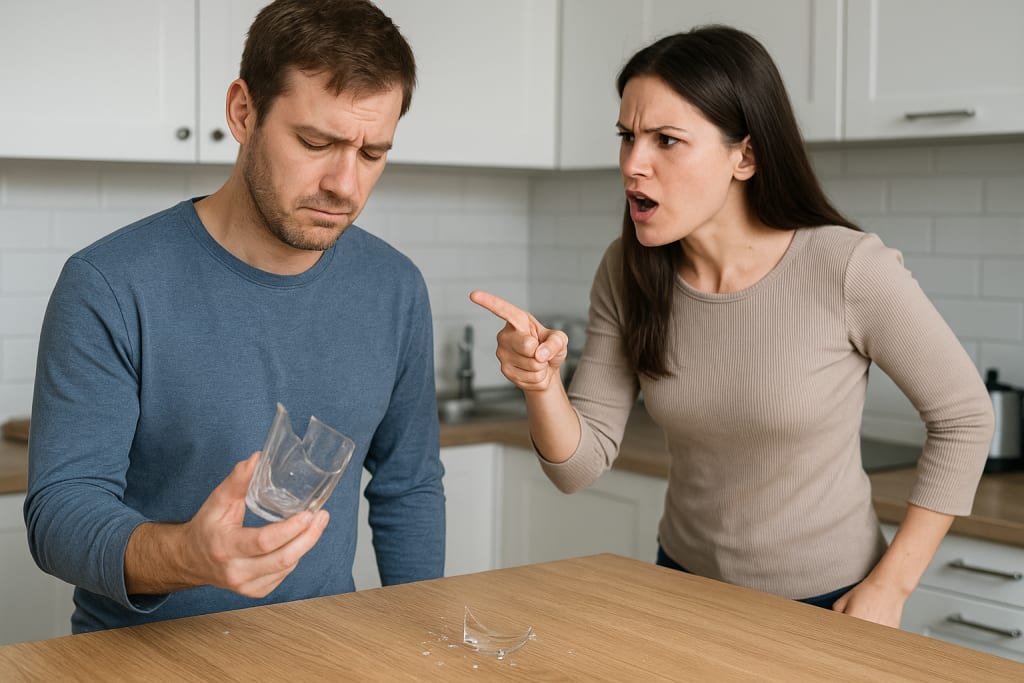
It happened on one completely ordinary evening — the kind where everything seems calm and predictable until life decides to prove you wrong. I was standing in the kitchen, glass of water in hand, thinking about nothing in particular. Then, out of nowhere, the glass slipped from my hand, hit the tiled floor, and shattered into a thousand sparkling fragments. Before I could even bend down to clean it, my wife appeared in the doorway like a prosecutor entering a courtroom. Her eyes narrowed, her voice sharp, her verdict immediate:
“You always break glasses!”
Now, I’ve been married fifteen years. In all that time, I can remember breaking two glasses — including the one lying on the floor at that very moment. Twice in fifteen years! I’m no mathematician, but even by the loosest standards, that hardly qualifies as “always.” But marriage has its own unique mathematics — a logic that doesn’t follow grammar, reason, or statistics.
The Misuse of “Always”
This wasn’t my first encounter with the word. My wife uses “always” as generously as a chef uses salt.
“You always leave the bathroom light on.” (That’s happened maybe four times in fifteen years — and half of those during load-shedding!)
“You always forget to lock the main gate.” (Once. And even then, it was locked — just not double-locked.)
“You always lose your socks.” (Pretty sure the washing machine eats them, but somehow, I’m the main suspect.)
It’s interesting how “always” becomes a permanent label for temporary mistakes. Yet the same word disappears when it could actually work in my favor.
The Missing Compliments
Every month, without fail, on the first date, I hand over my entire salary. It’s become as natural to me as breathing. But not once — not even once — have I heard: “You always bring your salary home faithfully.” Instead, she sighs dramatically and says, “God knows when the next salary will come. These few bills will swallow it whole.”
And it doesn’t stop there. Every weekend, I plan something — dinner, a movie, even a quiet drive. Still, she finds a way to say: “We haven’t gone out in ages!” Funny how “always” conveniently vanishes when it could make me sound good.
One evening, I spilled a drop of tea on the tablecloth. Instantly, I heard: “You always make a mess!” I tried to reason with her. “Darling,” I said, “always means something that happens regularly — not occasionally.” She looked at me like I was trying to argue with gravity.
The Turning Point
Then came the rainy day that changed everything. I came home drenched — shoes muddy, pants damp, hair dripping. I barely stepped into the drawing room when she yelled from across the room: “You always walk in with dirty shoes!” That was it. The final straw. Something in me snapped — or maybe awakened.
So I made a decision right then and there: if I was going to be accused of always doing something, then I might as well earn it. Now, I always leave one light on — sometimes two, if I’m feeling dramatic. I always forget the toothpaste cap. I always leave my shoes a little off from where they belong — just enough to test her patience but not enough to ruin her day. And guess what? She’s finally stopped saying “always.” Her new favorite phrase is: “You weren’t like this before.”
Well, maybe not. But some lessons in grammar are best taught through experience — and a little bit of mischief.
The Moral (and Mild Revenge)
Marriage teaches you many things — love, patience, compromise, and, most importantly, the creative misuse of adverbs. Over the years, I’ve learned that when a wife says “always,” it doesn’t mean always. It means “this irritates me more than it should.” So now, when she says, “You never listen,” I smile and think — oh, good, we’ve moved on from ‘always.’ Progress! Doing something once or twice doesn’t make you an “always” person — not in life, not in marriage, and certainly not in grammar.
Still, I must admit, my wife’s English has improved considerably since our little linguistic battles began. So in a way, you could say — I’m always teaching her something new. 😉
About the Creator
Keep reading
More stories from Murad Ali Shah and writers in Families and other communities.
The Algorithm of Lost Things
The 'Lost and Found' corkboard at the Corner Market cafe was, to Leo, a perfect example of existential clutter. It was a chaotic, faded mosaic of laminated gym cards, singular gloves, and yellowing flyers for pets that had probably found new homes years ago. Leo came to the Corner Market every Tuesday at 7:15 AM for the same reason—reliable Wi-Fi and the precise density of their whole-wheat bagel. He wanted order, and the bulletin board was an affront to his system.
By Murad Ali Shah4 months ago in Fiction
The Herbert Family Biography
The Herbert Family A photo posted from a fanpage. A throwback of the Herbert Family. The Herbert family is an American family known through the growing internet popularity of twins Keon Gerard Herbert and Kavon Sherard Herbert, whose humor, personality, and twin dynamic have attracted large audiences on social media. The family is led by their mother Monique Herbert and includes their older brother Dominique Herbert. Over time, the Herbert family has gained attention not only because of the twins’ online presence but also because of their connections to notable figures in entertainment.
By Kavon Herbert3 days ago in Families
TUS NUA - ch 53
TUS NUA – ch 53 New Beginnings – Mia and Midnight (*)(*)(*) Finola knew Ali’s brother-in-law needed to put his mind at rest. She fed her arm through his and led him outside. “We’ll sit here. If you like, I can put a block around us so our conversation will be private.”
By Margaret Brennan5 days ago in Fiction




Comments
There are no comments for this story
Be the first to respond and start the conversation.