
The Algorithm of Lost Things
A Coffee Stain, a Missing Dog, and the Unintended Geometry of Connection

The 'Lost and Found' corkboard at the Corner Market cafe was, to Leo, a perfect example of existential clutter. It was a chaotic, faded mosaic of laminated gym cards, singular gloves, and yellowing flyers for pets that had probably found new homes years ago. Leo came to the Corner Market every Tuesday at 7:15 AM for the same reason—reliable Wi-Fi and the precise density of their whole-wheat bagel. He wanted order, and the bulletin board was an affront to his system.
He was a data architect by trade, a man who saw the world as a series of input-output streams. He believed everything had a logical resting place, and the board, a repository of human carelessness, was his small, daily vexation.
This Tuesday, however, was different. He was distracted. He had left his favorite leather-bound notebook—the one he used for sketching complicated flowcharts, not poems—on the 4:45 express train home yesterday. He had mentally processed the loss: a $40 leather cover, a three-day delay in a project, and the minor, irritating admission that he was now the source of clutter somewhere in the MTA's sprawling, indifferent system.
He took his coffee and sat at his usual corner table, trying to reconstruct the last page of his missing notebook. As he did, his elbow struck his mug, sending a dark, steaming wave of latte across the table. It pooled, then dripped, finally settling in a perfectly shaped, accidental brown stain on the corner of his napkin. It looked, absurdly, like a tiny, stylized map of the Pacific coastline.
"That," a voice said, low and amused, "is exactly how my best ideas start: a mess."
Leo looked up. Standing beside his table was a woman he recognized only as the 'Artistic Type'—she was usually sketching furiously in the back booth. She had paint smudges on her jeans and a tangle of bright red hair.
"It's a failure of input control," Leo muttered, grabbing napkins.
She pulled out the chair across from him, gesturing to the coffee spill. "No, it's a fractal. Look closer. You have the fjords of the Northwest, right here. The chaos is the pattern."
Leo frowned, but he did look closer. She was right. The accidental lines were complex, repeating patterns. He felt the familiar, pleasant click of a new system falling into place in his mind, only this time, it was driven by chance, not design.
"I lose things when my mind is too full," she said, leaning forward. "My sketchbook, my keys... last week, I lost my sense of direction entirely trying to find a specific shade of ochre downtown."
Leo found himself confessing about his own lost notebook. The leather, the specific weight of the paper, the diagrams.
The woman, whose name he learned was Chloe, didn't offer a practical solution. Instead, she pointed a finger at the sprawling bulletin board. "Your notebook isn't truly lost. It's just waiting for the right algorithm to find it. The board is the same. It's not chaos, it's a slow-motion data dump of human need."
She reached up and pulled down one of the oldest, most faded flyers: a picture of a terrier named 'Barnaby.' "Barnaby isn't here because he was lost. Barnaby is here because someone loved him. This board isn't about losing things; it's about the emotional signature left behind."
For the next twenty minutes, Leo, the data architect, and Chloe, the artist, analyzed the bulletin board. They categorized the lost items by emotional value: keys (panic), wallets (crisis), pets (devastation), and single gloves (minor, fleeting annoyance). They saw how a missing dog flyer from 2018 still evoked a pang of sympathy, keeping the memory, and the search, technically "live."
As Chloe gathered her things, she smiled. "Go look for your notebook, Leo. But first, check the board. You might find something far more interesting than your diagrams."
Leo watched her leave. He didn't check the board. He checked his own inner database. He realized the real loss wasn't the notebook; it was the two years he’d spent avoiding the beautiful, illogical data stream of human connection. He stood up, grabbed his jacket, and headed not to his office, but toward the MTA lost and found, no longer searching for his system, but embracing the beautiful possibility of chaos.
By Murad Ali Shah
About the Creator
Keep reading
More stories from Murad Ali Shah and writers in Fiction and other communities.
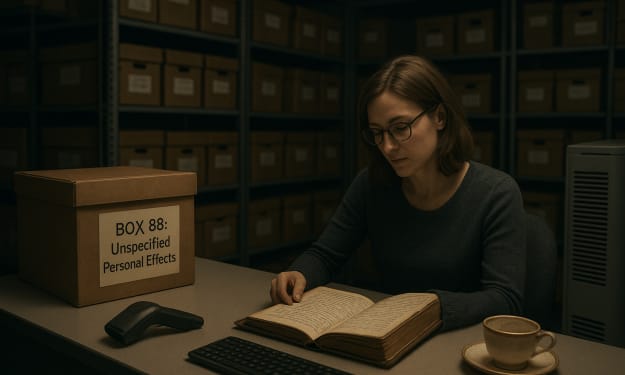
The Catalog of Forgotten Things
My job is, officially, the most boring job in the city. I am an Inventory Specialist for the Municipal Records Annex, which is just a pretentious way of saying I count boxes and make sure they match the number on the shelf. The Annex is a cold, dehumidified tomb of forgotten paperwork—old property deeds, decommissioned zoning maps, and decades of defunct library membership cards. My workspace is a small, gray cubicle next to a humming industrial air purifier; my soundtrack is the faint, rhythmic squeak of steel shelving under a heavy load.
By Murad Ali Shah4 months ago in Fiction
Becca
"Everything is so... flat." Denille said stupidly as she looked around her new neighborhood. She looked around at the muted desert where even the smallest sign of life seemed to have given up. The plant life was shrubs that were half cooked by the heat and where there should have been a lawn, a mess of white rocks laid glistening in the sun. Even the sky looked stretched thin, like the sun had ironed it smooth. She’d moved from Riverside, where at least there were hills, but here in Barstow, everything felt baked and brittle.
By Sara Wilson5 days ago in Fiction
The Last Lightkeeper of Lake Kivu
On the northern edge of , where the water turns molten gold at sunset and the fishing boats drift like shadows across the horizon, stands a lighthouse that most maps have forgotten. It is small, built of aging stone, and leans ever so slightly toward the wind. And inside it lives Emmanuel Nkuranga, the last lightkeeper.
By Nsengiyumva Benit Ricardo3 days ago in Fiction


Comments
There are no comments for this story
Be the first to respond and start the conversation.