
The Girl Who Raised Her Voice
How One Child’s Courage Transformed a Village

The Power of One Voice
There was once a small village, nestled in between green rolling hills and silver rivers, and within this village lived a girl named Maya. She was just like any ordinary child in a lot of respects—curious about the world, full of hopes and aspirations, and passionate about learning. But Maya was different from an ordinary child: she believed that her voice held power.
Maya's village was impoverished but lovely. Few families earned a decent wage, working full time on the fields or in market stalls hawking self-made products. There was no urgency for many to send children to school, for they had neither the funds for uniforms nor tuition fees. Hence, scores of children didn't set their soles into any classroom ever.
Learning wasn't just dear to her, though. Each night, after completing her chores, she would sit beneath the banyan tree outside her house with an old, worn-out book that had belonged to her deceased grandfather. It was full of tales of fearless heroes, intelligent kings, and enchanted lands far, far away. Her most favorite time of day was when her father returned from work. He would sit next to her and read from the book, defining tough words and responding to her seemingly endless questions.
One night, as the sun set below the horizon, dyeing the sky orange and pink, Maya questioned her father, "Why don't all the children in our village attend school?"
Her father sighed deeply. “Because life here is hard,” he said. “Many families can’t afford it, and even if they could, the nearest school is miles away.”
Maya frowned. “That doesn’t seem fair. Everyone should have the chance to learn.”
Her father smiled sadly. “You’re right, my dear. But sometimes, things don’t change unless someone speaks up.”
The following morning, Maya woke up early, her brain full of thoughts. She made up her mind to do something to stop the illiteracy in her village. Although she was just twelve years old, she felt that even her tiny voice could bring a change.
She started by speaking with her friends. While they played together on the riverbank, Maya spoke her mind. "What if we began teaching each other things we know? We could exchange books and learn from each other."
Her friends doubted her. "How will that do any good?" asked Rohan, the oldest of the group. "We're only kids. Nobody will listen to us."
"We're kids," Maya answered in a determined voice, "but we have voices as well. If we start small, maybe other people will join us."
Encouraged by her perseverance, her friends also decided to give it a try. They pooled together whatever books and notebooks they possessed and sat together under the banyan tree every day after school. Maya showed them how to read simple sentences, while Rohan, being familiar with some mathematics, taught them how to count and solve problems. Gradually but steadily, more kids joined their small group.
The news traveled fast in the village. Children were seen returning home enthusiastically, repeating new vocabulary and boasting about their artwork. Some grown-ups made it a point to visit. Initially, they stood by in silence, speculating as to whether this unofficial meeting would bear any fruit. But they noticed the smiles on the children's faces and realized that something was happening.
A few weeks after, Maya took a step further with her mission. She went to the village elders and asked for permission to utilize the community hall—a dusty, empty building on the outskirts of the village—for daily classes. The elders were hesitant, not knowing if such a venture would work. But Maya stood firm, meeting the elders' eyes, and said, "If you give us a chance, we'll show you that education is important."
Inspired by her bravery, the elders concurred. With their permission, Maya and her friends converted the vacant hall into a vibrant classroom. They swept the floors, fixed broken windows, and decorated the walls with vibrant drawings. Villagers contributed in whatever way they could, giving old chairs, desks, and lanterns. Even the skeptics of the project were moved to contribute, attracted by the energy of the children.
Soon enough, the improvised school became the center of the village. More and more children arrived each day, keen to learn. Adults started attending in the evenings to enhance their own literacy skills. For the first time, the village was filled with discussions of books, numbers, and aspirations of the future.
But not all people approved of Maya's work. There was a rich businessman, Mr. Gupta, who owned a majority of the lands in the region. He did not like the school. According to him, if the children of the workers were educated, they would become less submissive and more difficult to manage. He went to the community hall one day and rebuked the villagers.
"This is nonsense!" he yelled. "These kids should be working, not spending time on useless lessons.
His words hurt, but Maya would not retreat. Standing before the crowd, she spoke to him in a calm voice. "Sir, knowledge is never wasted. It equips people with the means to create better lives—not only for themselves, but for the people around them. Wouldn't you want your laborers to know how to cultivate crops more effectively or balance accounts correctly?"
Mr. Gupta sneered. "And who are you to decide what's best for my business?"
"I'm nobody special," Maya said. "I'm just a girl who thinks that every individual should be given an opportunity to learn. Perhaps one day, you'll realize the importance of that."
While Mr. Gupta marched off in anger, his visit unleashed a debate among the villagers. Some agreed with him, believing that economic insecurity was the worst that could happen. Others stood up for Maya, suggesting that education was the way to end the cycle of poverty. More voted to go along with the school, moved by Maya's unshakable determination.
Months went by, and the effect of Maya's work became self-evident. Children who used to wander the streets forlornly now spent their days reading, writing, and doing puzzles. Parents indicated that their children were healthier and happier, with better futures ahead. Even Mr. Gupta mellowed a bit when he realized that educated laborers were actually enhancing productivity on his farms.
One day, the government sent an official to the village to check on the school. He was impressed with what he saw and offered to provide funds for proper teachers, textbooks, and buildings. There was joy in Maya's eyes as she heard his declaration. All her efforts had borne fruit.
Years later, Maya became a teacher in her own right. She went to surrounding villages, teaching them that education is a right and not a privilege. Her experience motivated many others to speak up for change.
In retrospect, Maya would think of this moment under the banyan tree where she first had visions of being able to make a difference. She understood that the world doesn't always require huge acts or influential leaders to bring change. Sometimes all it requires is one voice—a voice bold enough to speak up and encourage others to do the same.
And so, Maya proved that no matter how small or insignificant you might feel, your voice has the power to transform the world.
About the Creator
kalu ram meena
Inventive narrator mixing creative mind and knowledge. From nature's excellence to life's examples, I create content to rouse, illuminate, and enrapture. Go along with me on an excursion of revelation, each story in turn!
Keep reading
More stories from kalu ram meena and writers in Families and other communities.
The Garden of Time: Is the Future Already Written?
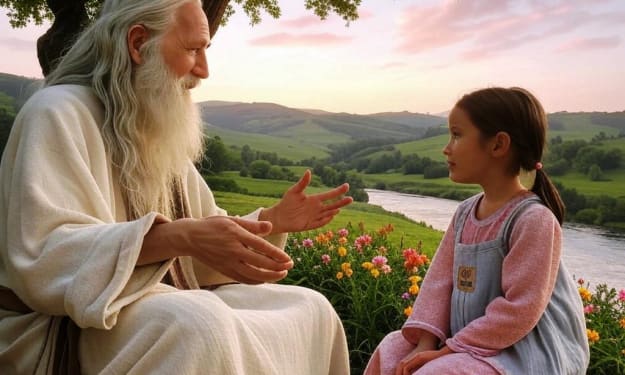
Is the Future Already Written? The Philosophy of Time Once upon a time, a wise old man named Eli lived in a peaceful little village nestled amongst the emerald hills. He was renowned for his interest in deep questions and his knack for explaining complex ideas in simple terms. One fine sunny afternoon, a curious girl called Mia went up to him with a question that had been on her mind.
By kalu ram meenaabout a year ago in Education
Carlton Jama Adams: Building Stronger Families Through Healthy Parenting Strategies
Professor Carlton Jama Adams is a licensed clinical psychologist and a professor of psychology who has dedicated much of his professional life to understanding how families grow, communicate, and overcome challenges together. His work focuses on healthy parenting strategies and the ways in which emotional awareness can strengthen relationships within the home. As an educator, he teaches courses on masculinities, human services and community justice, Africana intellectual thought, and the psychology of oppression and liberation. He has also worked extensively with individuals involved in the criminal justice system and has consulted with international, national, and community based organizations on leadership strategy and executive coaching. Through both his teaching and consulting work, Carlton Jama Adams has developed a perspective on family life that highlights the importance of communication, emotional safety, and consistent guidance in raising resilient children.
By Carlton Adams3 days ago in Families



Comments
There are no comments for this story
Be the first to respond and start the conversation.