
The Gift of Sacrifice: How My Father Taught Me the True Meaning of Eid
A heartfelt story of love, loss, and the legacy of Qurbani

I was ten years old when I truly understood what Eid ul Adha meant.
Before that, Eid was all about the fun parts—waking up to the smell of fresh bread, getting new clothes, counting crisp bills tucked into Eid envelopes, and, of course, watching my uncles skillfully prepare the Qurbani animals. I liked to call it the "festival of meat." The deeper meaning? It didn’t matter much to a child whose world was still small and safe.
But that year, everything changed.
It was the year my father lost his job.
We lived in a modest home in Lahore. My father, a schoolteacher, had always managed to keep things running with dignity, even when times were tight. He had a strong back and a quiet kind of strength that made me feel like nothing could go wrong. But when the school abruptly closed due to budget issues, the paycheck stopped coming. And so did the meat, the new clothes, and the Eid envelopes.
I remember seeing my father sitting on the rooftop, staring into the distance. It was just a week before Eid. I had come to ask if we would still be getting a goat. He looked at me, eyes tired, and said, "Insha'Allah."
As a child, I didn’t understand the weight of that word. Insha'Allah.
A few days later, we walked to the market together. I was excited, thinking we were going to buy a goat after all. But instead, we stopped at the home of one of our neighbors—an elderly widow named Amma Rehana. My father handed her an envelope. She looked surprised and emotional. I saw her eyes moisten.
"May Allah bless you," she whispered, her voice trembling.
On our walk home, I asked my father, "What was in the envelope?"
He smiled, and said, "Enough for her Qurbani."
I blinked in confusion. "But what about our Qurbani? We didn't buy a goat."
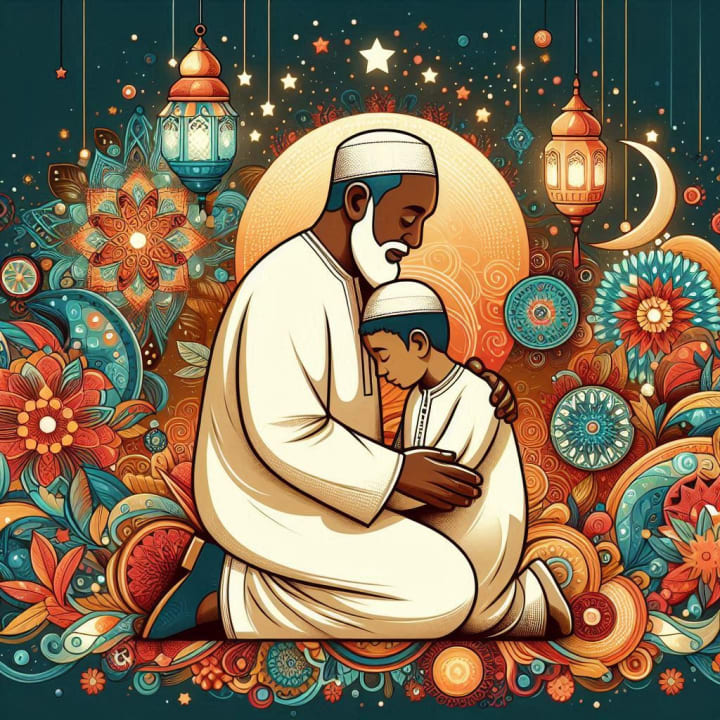
He stopped walking and knelt in front of me. "Son, Qurbani is not just about meat. It's about sacrifice. Today, we gave up our Qurbani so someone else could feel the joy of it. That’s also a gift to Allah."
I didn’t know what to say. My heart felt heavy and full all at once.
On Eid morning, instead of helping to prepare an animal, my father and I helped distribute meat with a local charity. We carried heavy bags of meat through narrow streets, delivering them to families who couldn’t afford to sacrifice their own animals. At one home, a little girl about my age hugged the bag tightly, as if it were treasure.
That hug stayed with me for years.
Later that afternoon, we returned home empty-handed, our clothes stained with sweat and dust. My mother had cooked a small but delicious meal with what little we had. As we sat together on the floor, my father looked at me and said, "You gave Qurbani today too."
"How?" I asked.
"You gave your expectations, your comfort, your idea of what Eid should be. That's a sacrifice."
It took me many years to understand the full wisdom of that moment.
Years passed, and by Allah's mercy, things got better. My father found work again. Our Eids became more abundant, filled with laughter, food, and animals we could afford. But that one Eid remained my favorite.
Not because of what we had.
But because of what we gave.
Now, I’m a father myself. This year, as Eid approached, I watched my own son play with toy goats and talk excitedly about the "Eid meat feast." I smiled, remembering my younger self. But I also knew it was time to pass on the lesson.
So, I took him to visit a shelter where families were preparing to receive donated Qurbani meat. I explained how some people depend on the kindness of others to celebrate this holy day. My son listened quietly. Then he surprised me.
"Can we give one of our goats to them?" he asked.
Tears pricked my eyes. I nodded, unable to speak.
Sacrifice, I realized, is not just the slaughter of an animal. It's the surrender of comfort for compassion, the letting go of luxury for love, and the willingness to give so that others may feel the joy you once took for granted.
This, my father taught me.
And now, it lives on in my son.

Moral of the Story:
Eid ul Adha is not only about ritual. It's about remembering the spirit of Prophet Ibrahim (AS)—his trust in Allah, his willingness to sacrifice what he loved most, and his deep compassion. The real Qurbani lies in the heart. When we give from what we love, even when it hurts, we offer the most meaningful sacrifice of all.
Let this Eid be about more than meat. Let it be about mercy.
Eid Mubarak. ✨
_____________________
Thank you for reading...
Regards: Fazal Hadi
About the Creator
Fazal Hadi
Hello, I’m Fazal Hadi, a motivational storyteller who writes honest, human stories that inspire growth, hope, and inner strength.
Keep reading
More stories from Fazal Hadi and writers in Families and other communities.
Bridges Rebuilt: A True Story of Forgiveness and Healing
For the better part of a decade, I told myself I was fine with never speaking to my father again. We hadn't spoken in nine years. Not a phone call. Not a holiday text. Nothing. I had built my life around his absence, convincing myself that distance was better than disappointment.
By Fazal Hadi8 months ago in Families
Wise~Guys
— Look Behind what's in Front of You ~ Make Good Choices — Hey, So how you Doin'..! Made~Men — Mobster Movies romanticise a distinctive, elegant appearance, impeccable attire style, along with the 'Families' expressive lingo. Making their 'Bones' gave them Panache — with vintage fedoras, tailored pin-striped suits, mirror-polished wing-tip shoes adorned with tassels; with their 'Gun Moll' gorgeous dates on their arms.
By Jay Kantor19 days ago in Families
Bettijo Hirschi
Introduction Bettijo Hirschi is a multi‑talented creative professional from the United States. She works as a designer, art director, photographer, writer, and event planner. Bettijo has built a long career in creative work and media. People know her for her artistic skills, her work in magazines and television, and her lifestyle blog. She is also known in recent news because of changes in her personal life.
By Farhan Sayed4 days ago in Families
How to Succeed at the Benson Directory®
Congratulations and welcome to the Benson Directory® employee #22391! As our newest call handler, you will have the privilege of speaking with dozens of unique and interesting people on a daily basis as well as the opportunity to earn bonuses for high performance. Contained within this handbook you will find a set of ease to follow instructions designed to help you settle in to your new role and begin paving the way to success.
By S. A. Crawford3 days ago in Fiction


Comments (1)
My eldest daughter is Muslim this is a lovely written piece 💙🙏💙