
The Ghost Village in My Bones
He’d never set foot on its sun-baked earth, but the memory of Fiumedinisi lived in him, hot and real, a place he yearned for with a stranger's ache.

Marco felt it most on Sundays. Not the lazy Sunday afternoon quiet of his own suburban street, but a different kind of quiet, one that hummed with cicadas and the distant clang of a church bell. He felt it in the smell of his Nonna Emilia’s kitchen, a mix of tomato, garlic, and something ancient, something that smelled of dusty sunshine and sea salt. He’d be sitting at the chipped Formica table, pushing around pasta, while Nonna, gnarled hands kneading dough on the worn wooden board, would talk. Always talk about Fiumedinisi.
Fiumedinisi. A village in Sicily, tucked into the hills above the Ionian Sea, a place he knew only from faded photographs and the relentless retelling of stories. Nonna would close her eyes, her face smoothing out the wrinkles, and suddenly she was there. Not here, in this cramped kitchen in Queens, but there, a girl with braids, running barefoot on cobblestones hot enough to blister. Marco would listen, spoon still, breath held, and the words would build the village around him, brick by brick, sunbeam by sunbeam.
She spoke of the market, a riot of sound and smell. The fishmonger’s call, sharp and insistent. The plump purple figs, sticky sweet, bursting in your mouth. The way the light hit the ancient church tower at noon, making the stone glow like molten gold. He pictured it so clearly, the narrow alleys, the geraniums spilling from every window box, the old men playing cards in the piazza, their laughter echoing off the centuries-old walls. He felt the phantom warmth of that sun on his skin, the gritty dust under his feet, a sensation so real it made his palms sweat.
It wasn’t just a story, not anymore. It was a memory. His memory, stolen and absorbed, replayed in his head with such vividness it sometimes overshadowed his actual life. His friends talked about their summer plans, their college applications, and all Marco could think about was the way Nonna described the fishermen hauling in their nets at dawn, the sea a bruised purple, the air tasting of salt and anticipation. He’d nod, smile, but his mind was miles away, across an ocean, living a childhood that wasn’t his.
One afternoon, Nonna told him about the fig tree. The one in their yard, massive and gnarled, its branches a spiderweb of shade. How she and her brother, Giuseppe, would climb it, sticky sap on their fingers, and watch the tiny boats drift out into the vast blueness. She described the taste of the figs, sun-warmed and almost liquor-sweet, dripping down their chins. ‘It was everything, Marco. Everything, that tree.’ Her voice cracked a little, a raw edge of longing he understood too well. He understood it because he felt it. A hollow ache in his chest, a longing for that specific tree, that specific taste, that specific childhood moment, none of which he had ever experienced.
He’d tried to explain it once, to his mother. ‘It’s like… I miss it. Like I miss home, but it’s not my home.’ She’d just patted his hand, a little bewildered. ‘That’s your Nonna’s memory, honey. It’s sweet that you listen.’ But it wasn’t just listening. It was inhabiting. It was a phantom limb, an entire village he felt attached to, a ghost that walked in his dreams, beckoning.
He kept an old, sepia-toned photograph under his mattress. Nonna, maybe ten years old, standing with Giuseppe under that very fig tree, her dark eyes bright, a shy smile playing on her lips. Behind them, the stone wall of a house, and a glimpse of the cobalt sea. He’d trace her face, his finger lingering on the rough texture of the paper. This was it. The genesis point of his peculiar nostalgia. He stared until the edges blurred, until he could almost hear the rustle of the leaves, the distant bleating of a goat, the faint murmur of the Italian language carried on a breeze.
‘Nonna,’ he asked one day, ‘Did you ever go back? After you came here?’ She shook her head slowly, stirring a pot of simmering ragù. ‘No, figlio mio. Too much work. Too expensive. And, when my Papa died… what was left there for me?’ She sighed, a deep, rattling sound that came from her very bones. ‘Sometimes, it’s better to keep it in here,’ she tapped her temple, ‘than to see it changed. To see it… not what it was.’
Marco understood that too. The fear of discovery. The fear that the real place could never live up to the glorious, sun-drenched, fig-sweet Fiumedinisi he carried inside him. The Fiumedinisi built not just from Nonna’s words, but from his own longing, his own imagination, his desperate need for something authentic, something rooted, something more ancient than the plastic sheen of his own upbringing. He ran a hand over the rough, sun-baked crust of the bread on the table, closing his eyes, and he could almost feel the rough stone walls of a house he’d never seen, taste the salt on the wind from a sea he’d never known.
He pictured it then, a small, unassuming spot on the map, a dot. But in his mind, it was a whole world, vibrant and alive, humming with the ghosts of his Nonna's youth. The clang of the church bell. The market’s clamor. The taste of figs. It was a story told so well, it had become his own past, pressing against the present. He picked up the bread, tore a piece off, and brought it slowly to his lips.
About the Creator
HAADI
Dark Side Of Our Society
How Much Does Memory Care Cost in the U.S.? Average Monthly Prices Explained
With the onset of memory loss in a loved one as a result of some conditions such as dementia or Alzheimer disease, families tend to start to seek specialized care services. The first question that one would want to have answered when undergoing this process is very basic, yet significant, and that is how much is the cost of memory care?
By Patrica Overton5 days ago in Families
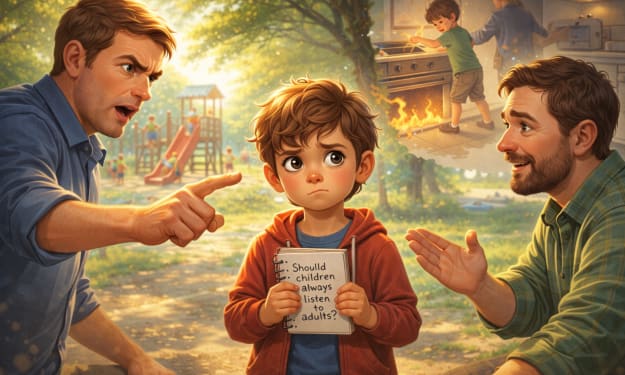
Should Children ALWAYS listen to Adults?
Many people believe children should always listen to adults because adults have more experience and knowledge about life. Adults have faced many situations and learned from their mistakes over time. Because of this, they often try to guide children and help them avoid problems. However, others argue that adults are not always right and that children should also learn to think for themselves. Children are individuals with their own thoughts and ideas, and sometimes they may see things differently from adults. This text will explore both sides of the argument to understand whether children should always listen to adults.
By *+*+*~Teja~*+*+*3 days ago in Families


Comments
There are no comments for this story
Be the first to respond and start the conversation.