


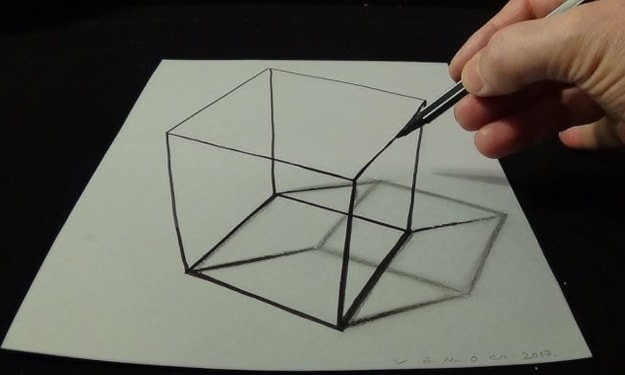
Once you notice the hidden center of the cube, it’s hard to unsee it. The drawing no longer feels like a static object with six faces; it becomes a system. Lines converge. Directions collapse inward. A square appears where nothing was explicitly drawn. That emergent center isn’t decoration—it’s functional. It exists because perspective demands it.
What’s striking is how often this same center shows up elsewhere, long before anyone starts talking about dimensions, consciousness, or symbolism.
The cube is just the beginning.
The Center as a Structural Necessity
When you draw a cube in perspective, six directions lead the eye inward. Their convergence implies a flat inner square—an interface that bridges outer space and inner space. If that square is treated as a plane with two sides, the structure naturally suggests eight sectors, mirroring the eight cells of a tesseract. You don’t need to “see” four dimensions to recognize the logic. It’s already encoded in the projection.
This isn’t mystical. It’s how geometry behaves under perspective.
And once you see that center as an interface rather than an illusion, it becomes easier to recognize the same logic elsewhere: wherever multiple possibilities exist, something must stabilize them long enough for choice, perception, or meaning to occur.
That stabilizing point is what many traditions call “the eye,” but here it doesn’t need a belief system. It’s simply the point where relations converge.
Folding, Not Linear Thinking
This is where the model quietly shifts from geometry into cognition.
We often talk about a “train of thought,” as if thinking moves along a single track in one direction. But that metaphor breaks down quickly in real experience. Thoughts don’t arrive neatly. They flip, reverse, recombine, and loop. Old beliefs reassert themselves. Intentions lag. Decisions feel unstable.
A better model is folding.
Thought behaves less like a line and more like origami. The same elements—memories, beliefs, emotions, intentions—fold and refold into new configurations. Nothing new is added; the pattern changes.
In this model, delay makes sense. If thought were linear, intention would instantly arrive. But when thought folds, intention must survive multiple refolds before it becomes dominant. Manifestation lag isn’t failure—it’s the time it takes for a configuration to stabilize instead of flipping back.
The work, then, isn’t finding a final arrangement. It’s staying centered while the folds change.
Childhood Geometry as Training
This folding logic isn’t learned in adulthood. It’s practiced early, often unconsciously.
Consider the simple paper fortune teller—the cootie catcher. Laid flat, it reveals a precise crease pattern: a central square with midlines and diagonals forming an eight-line grid.

Four corner squares act as stable anchors. Each splits into two triangles, creating eight directional vectors that funnel outward into a ring of twelve sections.
Nothing about this is random.
The structure follows a clean progression:
- Four grounded entry points (corner squares)
- Two-way splits (triangles)
- Collapse into one revealed state
It’s a working model of superposition and collapse, built entirely from paper and play. When you refold it, everything returns to center. No loose ends. Infinite replay from finite creases.
This is the same logic as the cube’s emergent center—just flattened.
The Eye as Orientation, Not Symbol

Symbolically, an eye often represents awareness. Structurally, that metaphor holds because the “eye” is where collapse happens. It’s the reference point that allows multiple possibilities to exist without chaos.
In the cube, it’s the implied inner square.
In the cootie catcher, it’s the central grid.
In thought, it’s attention.
In choice, it’s observation.
Meaning doesn’t live at the edges. It lives in the overlap.
That’s why the pattern echoes forms like the Flower of Life or the ichthys. Not because of shared mythology, but because overlapping structures naturally create centers. Humans notice them because they’re where orientation becomes possible.
A Personal Proof of Concept
As a child, I learned this without language. To avoid bad dreams, I built a roller coaster in my mind—a structured descent with ticking tracks, climbs, loops, and endless dips. Each dip carried me deeper into sleep. It wasn’t escape; it was guidance.
That mental structure worked because it folded attention in a controlled way. Rhythm stabilized awareness. Repetition deepened the fold. Eventually, consciousness had enough stability to let go.
The same logic applies everywhere else in this model. Stability doesn’t come from freezing reality. It comes from learning how to ride the fold.
Why This Matters?
This perspective reframes “higher dimensions” as shifts in how we read projections, not places we have to reach. It reframes manifestation as stabilization, not wishing. It reframes thought as folding, not marching.
Most importantly, it returns agency to perception.
Change the perspective, and the structure you’re inside changes too—not because reality moved, but because the fold did.
And the center?
The center is where you stay oriented while everything else refolds.
That’s not mysticism.
That’s geometry, cognition, and lived experience agreeing in the same place.

Author’s Note
This piece is not a claim about hidden knowledge or a declaration of ultimate truth. It’s an observation drawn from lived experience, geometry, and how the human mind interacts with structure.
The ideas here emerged organically—from childhood visualization practices, from drawing simple cubes, from folding paper, and from noticing how perception behaves when multiple possibilities exist at once. No single tradition owns these patterns. They appear wherever humans play, build, imagine, and try to make sense of space, choice, and awareness.
When I reference symbols like the “eye,” higher dimensions, or folding, they are used descriptively, not doctrinally. The goal is not belief, but recognition—seeing how the same structural logic repeats across geometry, cognition, and everyday perception.
If any of this resonates, it’s likely because you’ve encountered these patterns too, perhaps without naming them. This work is an invitation to notice what’s already there, to experiment with perspective, and to trust that insight often begins with simple forms we’ve been overlooking since childhood.
About the Creator
Aja Truth
What feels like mass deception is the collision between buried history and real-time exposure.(INFJ Pattern Recognition with Data Driven Facts)
Why the MBK Center is a Must
Over the years, MBK Center has built up a reputation for offering more than just trendy fashion and electronics. In fact, this mega mall is now known as one of the most versatile dining destinations in the city, offering an array of mouthwatering experiences for everyone, from budget solo travellers to foodies craving Michelin-worthy street food. Here’s more on why the MBK Center is a must-visit culinary destination in Bangkok.
By haritha gunatilakaabout 24 hours ago in Families
We Grew Up as “Siblings”… Then Fell in Love—What Happened Next Changed Everything
When my parents decided to adopt a child, I was old enough to understand what it meant—but too young to grasp how much it would change my life. I remember the day they brought them home. Everything felt different overnight. Suddenly, I wasn’t an only child anymore. I had someone to share my space, my routines, and eventually, my life with.
By Lukáš Hrdlička7 days ago in Families



Comments
There are no comments for this story
Be the first to respond and start the conversation.