
You’ve Been Drawing the Fourth Dimension Since Childhood
The Hidden Center of the Cube

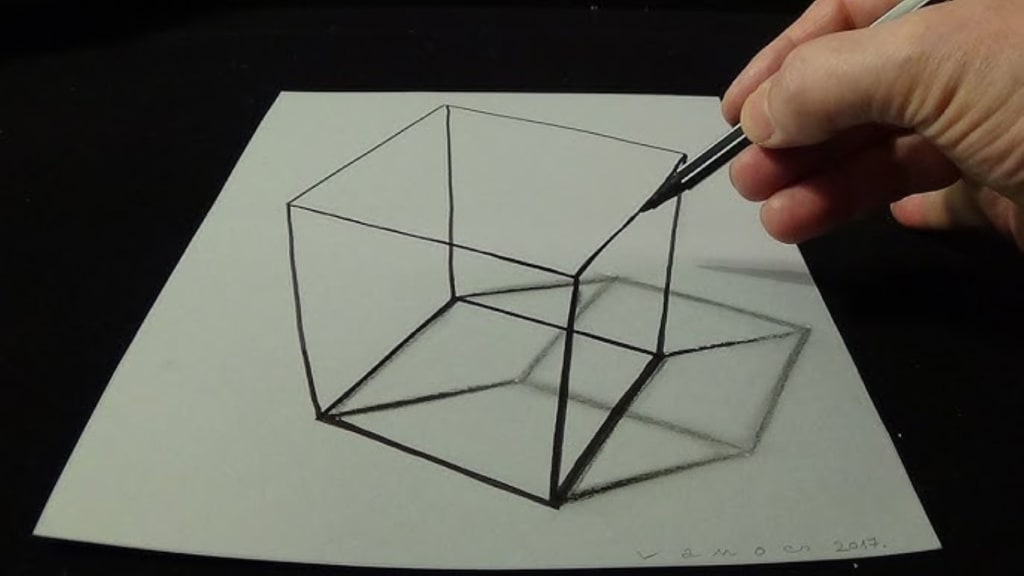
That simple cube sketch you learned in school isn’t just a way to fake depth on paper. Embedded in its lines is the logic of higher dimensions—an emergent center that appears only when perspective does the work.
Most of us were taught to see the cube as six flat faces stitched together. But when you actually look at a cube drawn in perspective, something else happens. The lines don’t just define surfaces. They converge.
And where they converge, something appears.
1. The Ordinary Cube Isn’t Ordinary
Draw a cube in perspective and notice what your eye does.
You see:
- Six faces
- Six dominant directions pulling inward
- An implied square at the center of the drawing
That inner square is never explicitly drawn, yet it’s unmistakable. It emerges naturally from the geometry. No symbolism is added. No imagination required.
Structurally, this gives us:
- Six outer directions
- One emergent inner center
A seven-layer structure: six around, one within.
Already, the cube is doing something subtle. It isn’t just a static object. It’s a system that produces an interior relationship purely through perspective.
2. The Center Is Not a Point — It’s an Interface
Here’s the step that changes everything.
That inner square is flat—but any flat plane has two sides. Front and back. Inside and outside. Interface, not endpoint.
So the “center” of the cube is not a dot or a void. It’s a two-sided layer bridging directions.
Recount the structure:
- 6 outer directions
- 1 central plane × 2 sides
That gives 8 structural sectors.
This is where the cube quietly mirrors higher-dimensional logic.
3. What a Tesseract Really Is
A tesseract—the four-dimensional cube—is often treated as mystical or unknowable. But mathematically, it’s very simple.
A tesseract is:
-A cube extended the same way a cube extends a square.
- Extend a square → you get a cube (6 faces)
- Extend a cube → you get a tesseract (8 cubic cells)
Nothing magical is added. The pattern continues.
The key realization is this:
You don’t need to see four dimensions to understand them.
The counting logic and relational structure of the tesseract is already present in a single cube once you recognize the center as a two-sided interface rather than empty space.
The cube is a seed. A shadow that already carries the rules of extension.
4. 4D Is Not a Place — It’s a Perspective Shift
For humans, “4D” is almost never about literally living in an extra spatial direction. We never perceive higher dimensions directly.
What we experience instead are:
- 2D drawings of 3D objects
- 3D projections of 4D structures
So accessing higher dimensions is really about how we read projections.
It’s the ability to hold multiple perspectives at once. To notice overlaps, interfaces, and implied centers instead of only outer faces.
That’s what this cube insight is.
You didn’t leave 3D.
You changed how you interpreted its shadow.
5. Everything Is Flat — Until Perspective Creates Depth
From a higher viewpoint, everything is flat.
- A cube on paper is 2D
- Your mind projects it into 3D
- A tesseract appears as distorted 3D shadows
Depth is not inherent. It is produced by perspective.
This idea sits at the core of geometry, physics, and consciousness. Reality doesn’t change first. The frame does.
Which is why this same pattern appears everywhere:
- Projection in mathematics
- Observer-dependence in physics
- Maya (illusion of appearance) in spirituality
Meaning doesn’t live at the edges.
It lives in the overlap.
6. The Eye at the Center

When geometry and symbolism are allowed to speak to each other, the cube reveals something striking.
That inner square reads visually like an eye.
Geometrically:
- Six directions converge inward
- The center acts as a two-sided interface
- It hints at 8 paths and higher extension
Symbolically:
- An eye at the center represents consciousness
- Not a force, but the point where forces meet
- The same pattern found in the Flower of Life and the ichthys
Across cultures, meaning is placed at intersections, not boundaries.
The cube does this without symbolism being added.
Perspective alone produces the eye.
Consciousness sits at the crossing.
7. Seven Layers, One Seeing Point
This reframes ancient ideas about layered reality.
Instead of stacked heavens or hells, the cube suggests:
- Six surrounding layers
- One central depth
The deepest layer is not the farthest away. It’s the most central.
The place of seeing.
8. Folding, Not Fixed Structure
Once you see the cube this way, something becomes unavoidable:
There is no final configuration.
Every perspective is a snapshot.
Every interpretation is a temporary fold.
The structure itself is dynamic.
What remains constant is the center.
The eye stays, even as the configuration flips.
9. Consciousness Is the Folding Mechanism
If the structure keeps folding, then consciousness is not a thing inside it.
It’s the mechanism that keeps folding it.
Like a paper fortune teller or cootie catcher:
- The same corners exist
- The same paths repeat
- But each fold recombines them
Reality isn’t static architecture.
It’s dynamic origami.
The mistake isn’t failing to find the right layout.
The mistake is thinking there is one.
10. There Is No Train of Thought
We talk about a train of thought—as if thinking moves linearly on tracks.
But that metaphor is wrong.
There is no train.
Thought doesn’t travel.
It folds.
Ideas flip, invert, overlap, recombine. The same elements return in new pairings.
A better instruction isn’t:
“Follow your train of thought.”
It’s:
“Notice how your thoughts fold.”
“Stay centered while the pattern refolds.”
11. Why Manifestation Has Lag
If thought were linear:
- Decide → arrive → result
No delay.
But in a folding system, intent immediately folds against:
- Habits
- Doubts
- Emotional memory
- External conditions
Manifestation lag is not failure.
It’s the time required for repeated folds to stabilize into one dominant configuration instead of flipping back.
The work isn’t thinking something once.
It’s holding the same orientation through multiple folds until the system defaults to a new shape.
That’s not magic.
That’s geometry of mind.
12. Focus Is Orientation, Not Control
Focus isn’t forcing thoughts into order.
It’s remembering where you are while everything keeps changing.
You don’t stop the folds.
You stay centered within them.
13. A Childhood Proof: Riding the Folds
As a child, I built a roller coaster in my mind to escape bad dreams.
It had:
- A ticking ascent (tick-tick-tick)
- Forward motion
- Endless dips that carried me deeper into sleep
Each dip folded awareness downward, farther from intrusive imagery.
I wasn’t running from my mind.
I was riding the folds.
I built a self-programmed descent sequence:
- Rhythm to stabilize attention
- Structure to replace chaos
- Repetition to deepen safety
Once the entry stabilized, my awareness was free to explore.
Dreams stopped happening to me.
They became places I could go.
I built myself a launch ramp.
14. The Whole Model, In One Word
Everything snaps together in a single word:
Folding.
That word connects:
- Thought
- Dimensions
- Consciousness
- Perspective
- Manifestation
- Focus
Not “find the final state.”
But:
-Stay centered while the folds stabilize.
Final Thought
The fourth dimension isn’t hidden behind equations or sci-fi.
It’s hiding in a cube you’ve been drawing since childhood.
Change the perspective.
Notice the eye.
Stay centered as the folds continue.
The cube already knew.
About the Creator
Living the Greatest CONSPIRACY Theory. By RG.
Not because nothing is real—but because power has spent centuries deciding what you’re allowed to believe is. What feels like mass deception is the collision between buried history and real-time exposure.(INFJ Pattern Recognition with Data)
Keep reading
More stories from Living the Greatest CONSPIRACY Theory. By RG. and writers in Families and other communities.
Christmas Abroad: Celebrating the Holidays Without Family
I moved to South Korea in 2017. I was twenty-two years old and excited to start my career as an English Second Language Teacher. With a Bachelor's degree and six hundred dollars in my bank account, I set off for Busan.
By Kera Hollow27 days ago in Families
A Heartfelt Family Gathering: Celebrating Dad’s Birthday with Those Who Truly Matter
Celebrations come in many forms — some grand and elaborate, others quiet and deeply meaningful. For Dad’s birthday this year, we chose the latter: a heartfelt family gathering filled with love, memories, and the simple joy of being together. It wasn’t a huge affair like some big birthday parties you see on social media. Instead, it was a celebration rooted in connection — a true family gathering that reminded us what matters mostMost of Dad’s coworkers couldn’t attend. Many of them live overseas or in different states, so they had planned their own smaller gatherings for him in their local areas. This was their way of honoring a loved one from afar, sending birthday wishes and thoughtful messages from miles away. Another bittersweet reality we faced was that so many of Dad’s older relatives and cherished family members could only participate in spirit — attending the celebration in our hearts rather than in person. It’s always a little sad to acknowledge that some loved ones are now celebrating with us from Heaven, watching over us instead of singing “Happy Birthday” beside us.
By Yassine Loufti5 days ago in Families
Center Stage with Gina C.
*** I'm keen to republish the interviews I did for my series with Vocal creators. It's been a few years and I thought it might be nice to revisit these wonderful conversations. I'll be releasing them one at a time for a few weeks/months.
By Heather Hubler5 days ago in Interview


Comments
There are no comments for this story
Be the first to respond and start the conversation.