
The Echo of the Hearth
When the warmth of the past calls, the soul of the house listens.

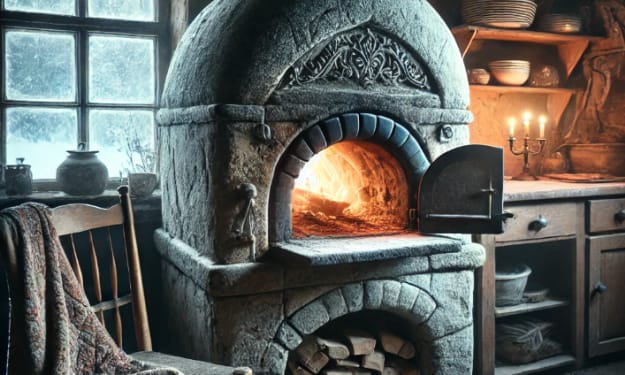
The bread oven had been cold for years. Its cracked stones, once rich with the glow of warm embers, now sat in silence at the heart of the farmhouse kitchen. The iron door, weathered by time, had been sealed shut. No longer did it hum with the life of bread rising, nor did the air carry the scent of rosemary and thyme.
I remember my grandmother, Mamó, telling me stories of the oven’s soul. “The oven keeps the heartbeat of the house,” she’d say with a smile, her hands working the dough with a tenderness that seemed to speak of generations before her. “When the fire’s warm, the house is full. It remembers.”
But Mamó was gone now, and the oven lay dormant, as if the very house had forgotten how to breathe without her.
It was during that harsh winter after Mamó’s passing that I first heard it.
The house had grown quiet, the kind of quiet that presses down on your chest, heavy with memories. The wind outside was fierce, rattling the windowpanes and curling around the house like a lost spirit. I was alone, save for the flicker of a candle on the kitchen counter, the only light in the dim room.
And then, it came—a soft, steady hum.
At first, I thought it was the wind, or perhaps the creaking of the old house settling in the cold. But the sound grew clearer, deeper, almost like a melody, the kind that stirs something deep inside you, a sound you recognize but can’t place.
I stood, my heart pounding in my chest, and slowly made my way to the oven. The iron door, which had not moved in years, shifted. It creaked open with a groan, as if the oven was waking from a long slumber.
Inside, there was light.
Not the harsh orange flames of a normal fire, but a silver glow, gentle and alive, swirling like liquid moonlight. It bathed the room in an eerie warmth, like the sun had come to rest inside the walls.
And then I heard her voice.
“Bread carries the soul of a house.”
It was Mamó’s voice, soft and familiar, as if she had never left.
I stepped back, my breath catching in my throat. “Mamó?” I whispered, afraid the words would shatter the moment.
Her voice echoed again, faint but clear. “Feed the house. It remembers.”
Tears welled up in my eyes, and for the first time in months, I felt something stir within me—a connection, a spark of warmth. “How?” I asked, choking on the words. “How can I feed it? You’re not here anymore…”
“The fire remembers,” she said, her voice like a breeze through the trees. “The fire listens. Feed it.”
I didn’t sleep that night. Instead, I spent hours in the dim light of the kitchen, tracing Mamó’s old recipe book, its pages worn with time. Flour, water, yeast. Her hands had kneaded the dough with such care, as if every fold was a prayer.
By the time dawn’s first light filtered through the frost-covered windows, the dough had risen, and I felt the stirrings of something—something that had been lost, but was now found again.
I cradled the loaf in my hands, and with a steadying breath, I approached the oven. The silver fire flickered, welcoming the bread. I hesitated, unsure if I could do this. Could I really bring life back to the house?
The fire pulsed.
I placed the loaf inside.
Hours passed, and when I finally pulled the bread from the oven, it was golden, its crust kissed by the light of the flames. It was more than bread—it was a promise, a rekindling of something that had never truly died.
The house sighed.
That evening, the first visitors came. Neighbors, drawn by the scent of fresh bread, came to the door. They shared stories of Mamó, of the house, of times long past. The oven hummed softly in the background, as if listening, as if remembering.
And as the days grew warmer and the snow began to melt, I found myself baking more and more, each loaf a link in the chain of memories that bound us all together. The house was no longer just a building. It was alive, breathing, and full of stories.
Some nights, when the wind is still and the house is quiet, I hear Mamó’s voice in the hum of the oven. “Bread carries the soul of a house.”
And I whisper back, “I know.”
Author's Note:
A hearth is more than just a fire; it’s a symbol of memory, warmth, and connection. It represents the heart of a home, where stories are shared, meals are prepared, and traditions are passed down. In this story, I wanted to explore the idea that the spaces we inhabit—especially those filled with history—carry the essence of the people who once lived there. The bread oven, once forgotten, becomes a reminder that even the quietest parts of a home yearn for life, for fire, for purpose. This is a story of rediscovery and the magic that can be found in honoring the past while forging new connections. It’s about finding warmth in places we least expect, and understanding that the soul of a home is carried in every loaf of bread baked, every story shared, and every quiet hum that echoes through the walls.
About the Creator
Keep reading
More stories from GoldenSpeech and writers in Families and other communities.
The Silver Flame of Memory
The bread oven had been cold for years. It sat in the heart of the old farmhouse kitchen, its stones cracked and crumbling, its iron door rusted in place. Once, it had been the lifeblood of the house. My grandmother, Mamó, told me stories of the loaves it birthed—golden and round as a summer sun, steaming with warmth, perfumed with rosemary and thyme.
By GoldenSpeechabout a year ago in Families
Christmas Abroad: Celebrating the Holidays Without Family
I moved to South Korea in 2017. I was twenty-two years old and excited to start my career as an English Second Language Teacher. With a Bachelor's degree and six hundred dollars in my bank account, I set off for Busan.
By Kera Hollowabout a month ago in Families
The quiet sound of families breaking
There is a kind of silence that is louder than any noise. It is the silence of a child waking in the night and realizing their parent is gone. It is the silence of a kitchen table with one chair suddenly empty. It is the silence of a home that still looks the same, but no longer feels the same. Across the United States, thousands of families live inside that silence. Not because of war. Not because of disaster. Not because of death. But because of policy.
By Kaylee Souther3 days ago in Families



Comments (2)
😍😘
What a beautiful story! “Bread carries the soul of a house.” As a passionate baker of bread, I have experienced this. Thank you for sharing this heartfelt story. 🏠🥖🍞🔥🤎