
The Debt of Gratitude
A wealthy man’s quiet secret reveals why generosity goes beyond appearances.

The Debt of Gratitude
BY: Ubaid
“Sir, my younger son has been running a fever for several days. After some tests, the doctor said it’s typhoid. I need to show him to a good specialist, but the treatment is very expensive. Sahib, I urgently need three thousand rupees,” pleaded Karim Din, his eyes filled with desperation as he stood before Seth Abrar.
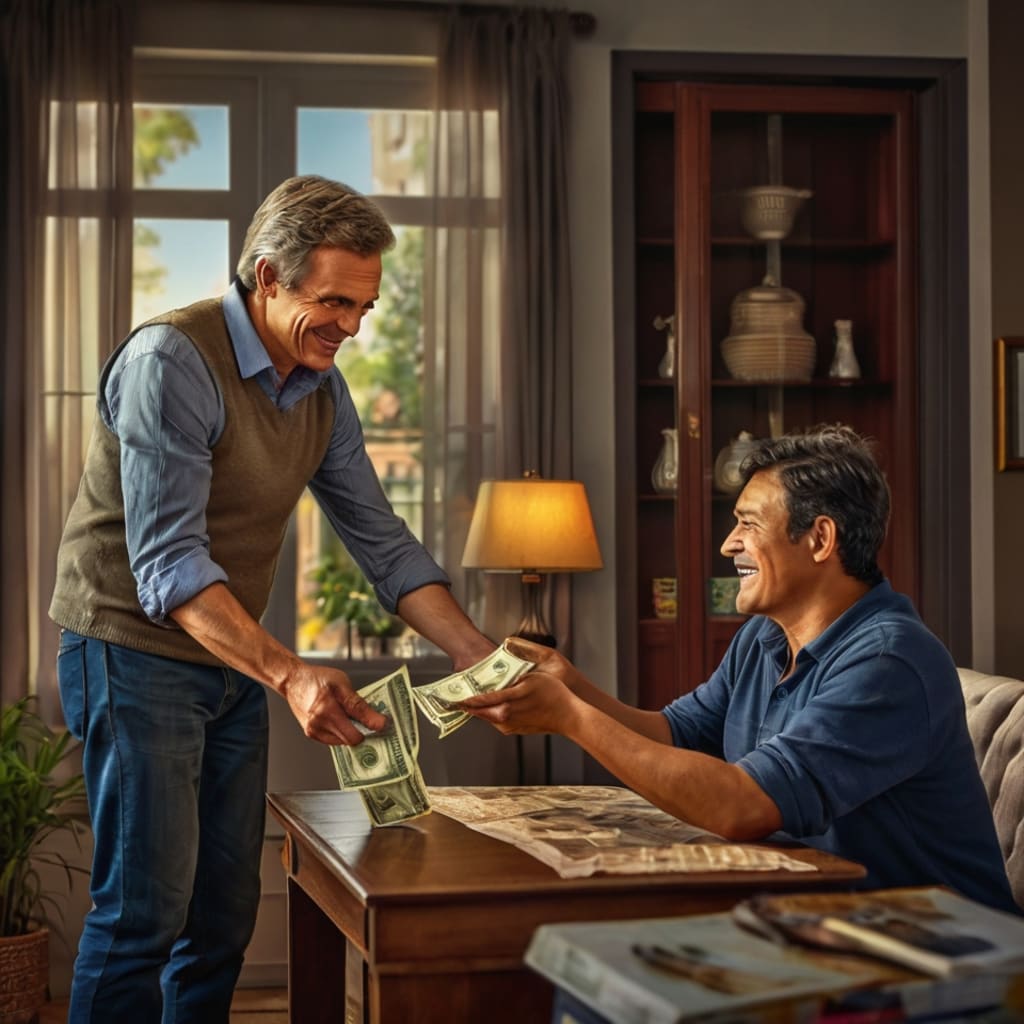
“May Allah grant your son health and recovery,” Seth Abrar replied kindly. He reached into his wallet, pulled out three crisp thousand-rupee notes, and handed them over. Karim Din clutched the money tightly, offered heartfelt prayers for his employer’s well-being, and stepped out of the room.
Unbeknownst to Karim Din, Seth Abrar’s wife had witnessed the entire exchange. As soon as Karim Din left, she entered the room, visibly displeased.
“I’ve told you before, keep this man in his limits. Don’t spoil him like this,” she said sharply. “Every other week, he comes up with a new excuse to squeeze money out of you. Just some months ago, he said his elder son had an accident and needed stitches in the hospital—you gave him five thousand rupees. Before that, he asked for money claiming his wife needed surgery for kidney stones. And you, as if you were Hatim Tai himself, just keep handing him money as though it grows on trees!”
Seth Abrar listened quietly, his calm demeanor unaffected by her irritation. When she finally paused, he spoke softly, “Wife, helping the needy never decreases one’s wealth. In fact, it increases blessings, and most importantly, it pleases Allah. Now calm down, it’s almost dinner time.” He walked away to wash his hands.
Karim Din was a thirty-year-old energetic but talkative man, employed at Seth Abrar’s home only six months ago. When he first joined, he had shared that he was supporting two small children, his ailing father, and living in a rented house. Out of curiosity, Seth Abrar had privately checked into the man’s background. The inquiry revealed that while some of his story was true, other parts were exaggerated or even false.
That evening, when Seth Abrar returned from his factory, his wife was waiting impatiently. After the usual greetings, she exploded with frustration.
“Didn’t I tell you? I always suspected this man was a fraud, making up stories just to grab your money!”
“What happened now?” Seth Abrar asked calmly.
“What happened? Better to ask what hasn’t happened!” she snapped.
“Alright,” he said gently, “then tell me what hasn’t happened.”
“When Karim Din left with the money today, I secretly sent Abdul Qayyum, our old servant, to follow him. He came back and told me the truth. Do you know what he found out? That man isn’t even married! He doesn’t have a wife or children. He has been fooling you all along!” She folded her arms, looking triumphant, expecting her husband to be shocked.
But instead of anger or surprise, she noticed a quiet smile forming on his lips.
“Perhaps you don’t believe me,” she said, annoyed by his reaction.
Seth Abrar continued to smile for a moment, then replied, “My dear wife, the truth you have just discovered today, I already knew when I first hired him.”
She was stunned. “What? You knew? And still…?”
“Yes,” he interrupted gently, “I knew he was lying about certain things. Yet I still helped him—because I also knew he was truly in need. He creates excuses because he feels that without them, I might refuse him. But the reality is different. His father is gravely ill, and most of the money he asks for goes toward his father’s treatment.”
Seeing the confusion on her face, he continued, “There’s another reason. Years ago, when I was struggling to establish my business, I was short of funds. Karim Din’s father was a classmate of mine. Though he didn’t have cash at the time, he gave me one of his prize bonds. By the grace of Allah, that bond won a huge sum—enough for me to begin my business. I tried to return the money to him, but he refused, saying, ‘This fortune is destined for you.’ Everything we own today—the house, the factory, our comfort—is tied to that one act of generosity. Tell me, how can I ever repay such a debt?”
His wife’s stern expression softened, though she remained quiet.
“I know Karim Din’s methods are wrong,” Seth Abrar admitted. “I’m simply waiting for the right moment to guide him and correct his ways. But until then, helping him is not charity—it is me honoring an old debt I can never truly repay.”
His wife sat in silence, her earlier anger melting into thoughtfulness. For the first time, she understood the depth of her husband’s quiet generosity and why he treated Karim Din with such unusual patience.
The story leaves us with an important lesson: before we judge someone harshly or accuse them of deceit, we should try to understand the hidden circumstances of their lives. Sometimes, what looks like manipulation or dishonesty on the surface has roots in deeper struggles—and in debts of gratitude that bind hearts together.
About the Creator
Wings of a Lioness: The Geology of Inherited Pride
People often ask me where I get the strength to pack my entire life into two suitcases and head into the unknown. Where do I get that step that never falters, neither in the cold Canadian North nor under the elegant skies of France? The answer doesn't lie in geographic maps, but in an old photo album, my mother's oversized ring, and that blue flight attendant's cap that is worth more to me than any crown. My courage is not my own doing – it is the dowry left to me by my mother, a woman who conquered heights with airplanes, and the earth beneath her feet with her unwavering character.
By Magma Star4 days ago in Families




Comments
There are no comments for this story
Be the first to respond and start the conversation.