
The Cow We Named Barakah: A Child’s Eid ul Adha Memory
A heartwarming story of love, sacrifice, and the lesson a little girl never forgot

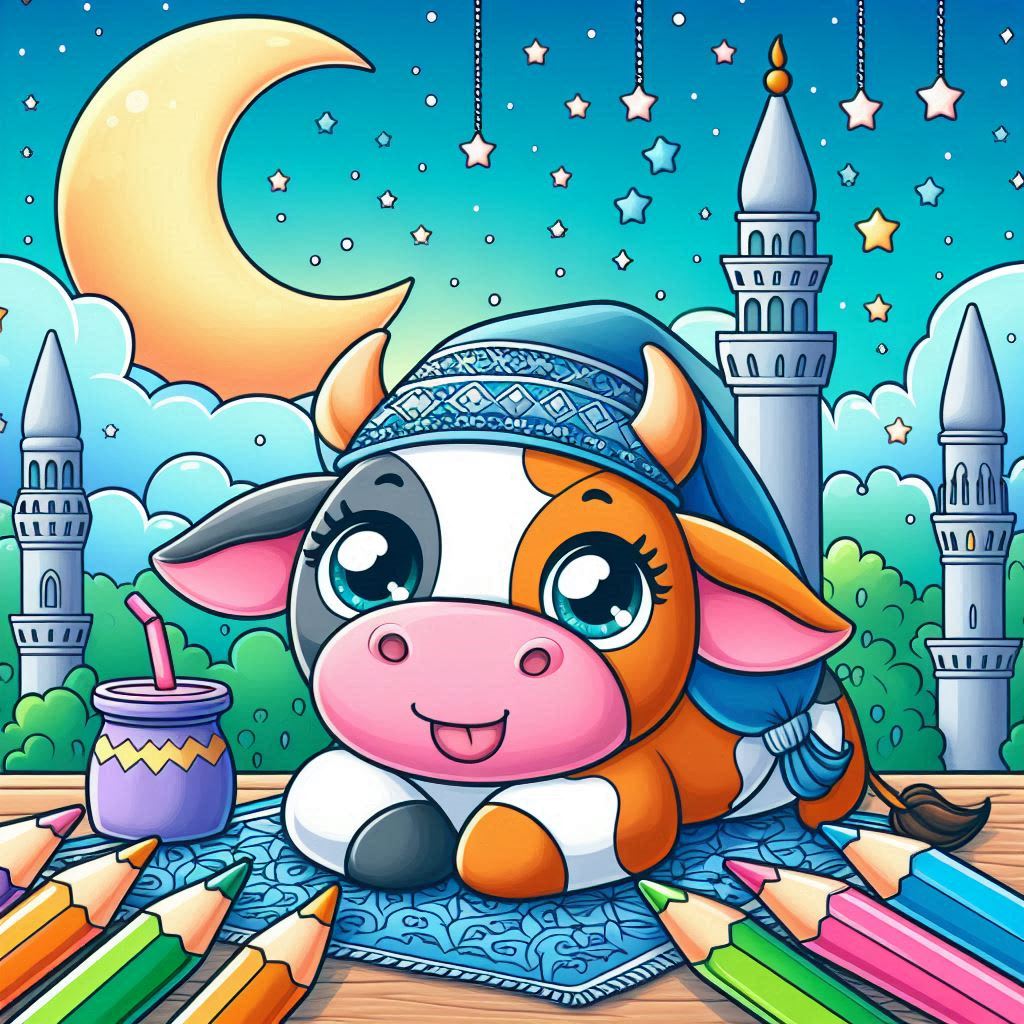
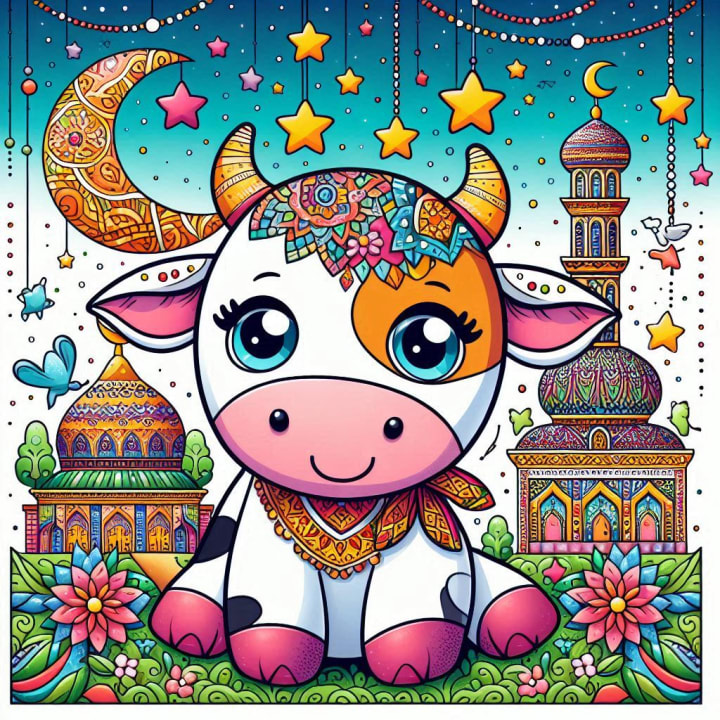
I was eight years old when I first learned what the word "Barakah" meant. Not from a book, not from a sermon, but from a cow.
Yes, a cow.
Her name was Barakah. And she changed how I understood Eid ul Adha, sacrifice, and love.
It was a hot August afternoon in Karachi, just a week before Eid. The streets were already full of the sounds and smells of preparation. Butchers were sharpening their knives, children were showing off their goats, and neighborhoods echoed with the bell-jingling of animals brought in for Qurbani.
In our small compound house, I stood barefoot in the sun, squinting down the lane as Abba returned from the animal market. My brothers were buzzing with excitement. This was our first time getting a cow instead of a goat.
And there she was.
Tall, light brown with white patches, soft eyes, and a slow, gentle way of walking, like she understood she was being watched. Abba had tied a red ribbon around her neck. I was the first to touch her—I placed my hand on her side and whispered, "Barakah."
"What did you say, beta?" Ammi asked.
"Her name," I said, proudly. "Barakah. It means blessing, right?"
Abba smiled. "Yes, it does. That’s a beautiful name."
From that day, Barakah became part of our home.
Unlike goats, cows don’t adjust easily to small homes and noisy kids. But Barakah did. Every morning before school, I would feed her grass and talk to her as if she could understand. My brothers would clean her pen, and my mother started saving vegetable peels just for her.
She had the gentlest eyes. She would nuzzle my hand, and when I cried one day after falling down, she licked my face. I was convinced she loved me.
As Eid came closer, I heard more and more whispers.
"Who’s going to be there for the Qurbani?"
"Don’t let the children watch."
"She’s such a calm cow... it’s going to be hard."
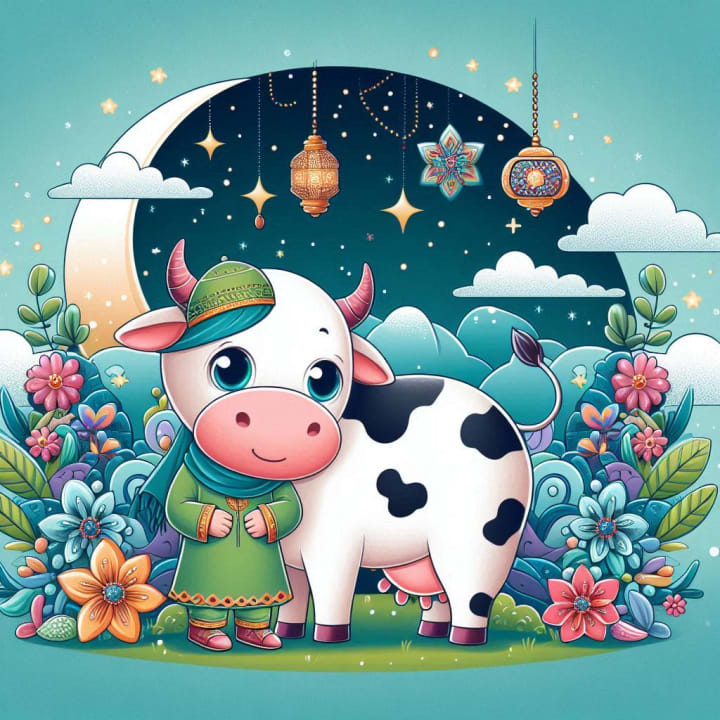
I didn’t understand.
"Why is everyone acting like something bad is going to happen to Barakah?" I asked Ammi.
She looked at me, her face soft. "Because it is."
That’s when it hit me.
Barakah wasn’t staying. She was here for Qurbani.
I didn’t sleep that night. I sat near her, feeding her bits of roti, crying silently. She licked my face again. I hugged her tightly. I didn’t want to let go.
The morning of Eid ul Adha was bright and full of celebration. The neighborhood smelled of spices and soap. People wore their best clothes. But I felt empty.
"Don’t cry," Abba said gently, brushing my hair. "You gave her so much love. That counts too."
I wasn’t allowed to watch the Qurbani. I sat inside with Ammi, who held me close as I sobbed.
When it was over, I refused to eat the meat. It felt wrong.
But Ammi said something I’ll never forget.
"The Prophet Ibrahim (AS) was willing to give up what he loved most for Allah. That’s what Qurbani means. Barakah was a gift. She came into your life to teach you what it means to love, and what it means to let go for the sake of something bigger."
That evening, Abba took me with him as he went to distribute the meat.
We went to families who had nothing. A woman with four children who hadn’t eaten meat in months. An old man who lived alone and wept when he saw the package. A teenage boy who insisted we sit and drink chai with him in gratitude.
At the last home, a little girl no older than me took the bag of meat, held it like a treasure, and said, "We prayed for this."
That night, I finally ate. Not because I stopped missing Barakah, but because I understood.
Years passed.
We had other cows for Eid. Other animals. But none like her.
Barakah became part of our family stories. Whenever someone talked about Eid, my siblings would smile and say, "Remember Barakah?"
And I did.
Now I’m grown, with a family of my own. This Eid, my own daughter named our Qurbani goat "Noori." She feeds it every morning, hugs it, and talks to it just like I did.
Yesterday she asked me, "Mama, do we have to let Noori go?"
I knelt beside her and said, "Yes. And that’s what makes her so special. We love her, and we let go, for Allah."
I saw the tears in her eyes, and I hugged her tight.
Love, I realized again, isn’t in holding on. It’s in giving with your whole heart.
Just like Barakah taught me.
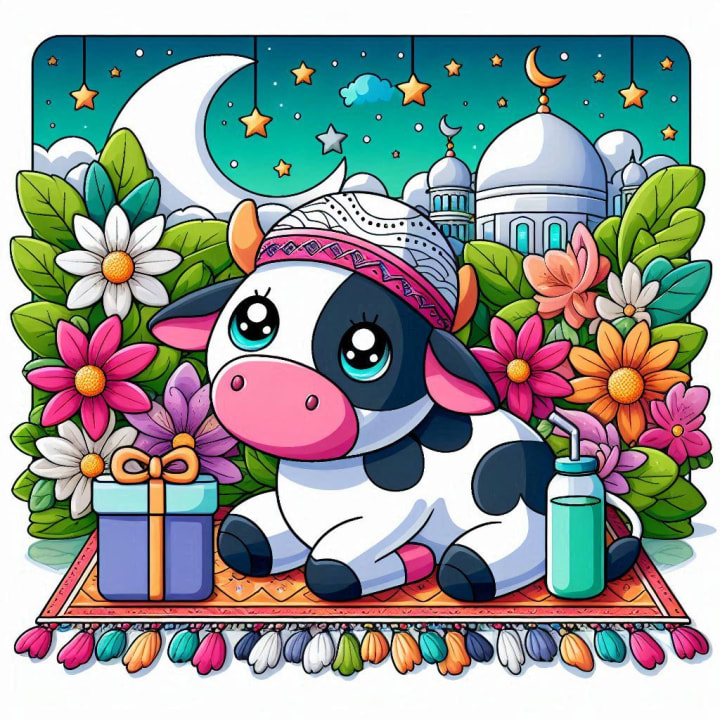
Moral of the Story:
The spirit of Eid ul Adha lies not just in the ritual of sacrifice, but in the meaning behind it. It teaches us to surrender what we love, to give with sincerity, and to understand that the blessings of Barakah often come in the form of lessons we carry forever. Sometimes, the biggest gift we can give is letting go.
Eid Mubarak.
_________________
Thank you for reading...
Regards: Fazal Hadi
About the Creator
Fazal Hadi
Hello, I’m Fazal Hadi, a motivational storyteller who writes honest, human stories that inspire growth, hope, and inner strength.
Keep reading
More stories from Fazal Hadi and writers in Families and other communities.
The Gift of Sacrifice: How My Father Taught Me the True Meaning of Eid
I was ten years old when I truly understood what Eid ul Adha meant. Before that, Eid was all about the fun parts—waking up to the smell of fresh bread, getting new clothes, counting crisp bills tucked into Eid envelopes, and, of course, watching my uncles skillfully prepare the Qurbani animals. I liked to call it the "festival of meat." The deeper meaning? It didn’t matter much to a child whose world was still small and safe.
By Fazal Hadi8 months ago in Families
Wise~Guys
— Look Behind what's in Front of You ~ Make Good Choices — Hey, So how you Doin'..! Made~Men — Mobster Movies romanticise a distinctive, elegant appearance, impeccable attire style, along with the 'Families' expressive lingo. Making their 'Bones' gave them Panache — with vintage fedoras, tailored pin-striped suits, mirror-polished wing-tip shoes adorned with tassels; with their 'Gun Moll' gorgeous dates on their arms.
By Jay Kantor17 days ago in Families
The Clever Old Woman
As far as the eye could see, a pea crop was spread across the land. In the surrounding fields, the harvest had already been completed, and in fact, a second crop had begun to grow. However, this particular field had not yet been harvested. Irfan was passing through this area for the first time. When he saw the fully grown crop, he decided to negotiate a deal with its owner.
By Sudais Zakwanabout 8 hours ago in Families
Miss Persephone's Manual to a Seemingly Ordinary Life
Miss Persephone was found at the dining table, her blue eyes swollen, her tears arriving and retreating like the tides of the ocean. Earlier that day, her family had visited her in the retirement home where she had lived for eight years. It was her eightieth birthday.
By Imola Tóth3 days ago in Fiction



Comments
There are no comments for this story
Be the first to respond and start the conversation.