
The boat, treasures, and the beach
Memories of things that happened and also of those that never did
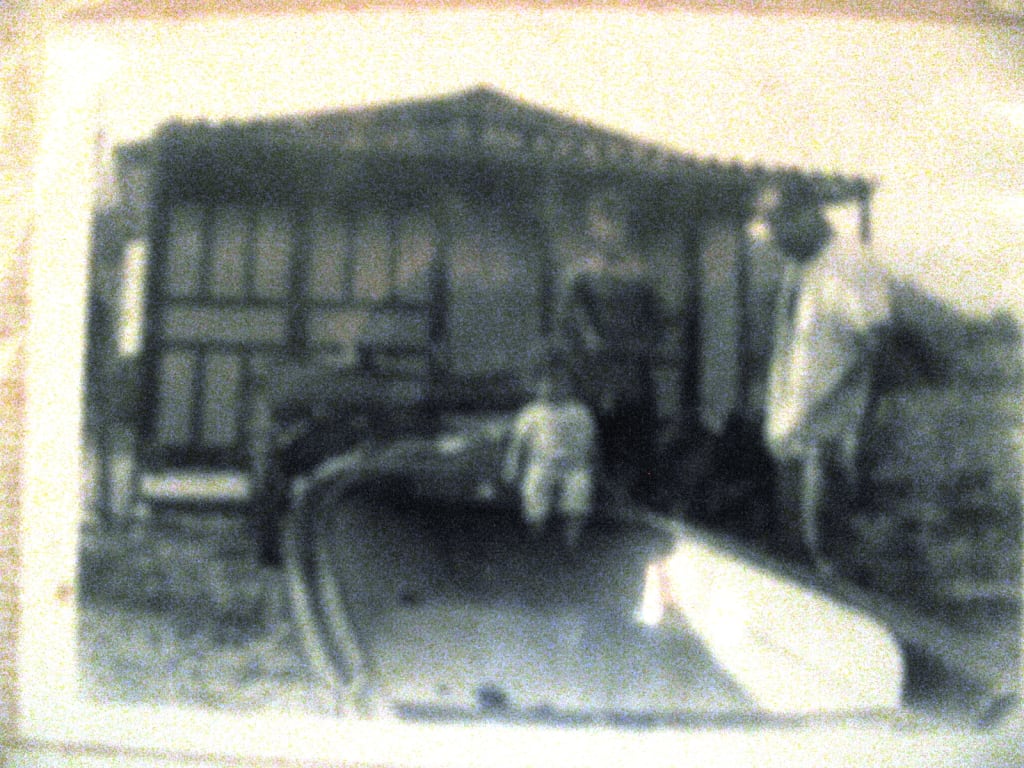
The red and white boat that dad shouldn’t have bought, according to mom, had a purpose: adventures at a semi-desert beach at the São Paulo Northern coastline. I believe that, at the time, Juquehy was a division of the city of São Sebastião.
The beach house already existed when I was born. That’s where I took my first unassisted steps, towards the ocean, at 9 months old. Mom always said that my name is a combination of Ocean and Island (“mar” is Ocean or sea in Portuguese; “ilha”, which sounds like the “ilia” in my name, means island). I think she meant to say that I belonged there, in Juquehy.
“Beach house” is not an adequate term for that place. It was a simple wooden cabin. In the late 1950s, that was not a place where people built beach houses. As far as I know, a group of physicians from a medical school in São Paulo (Escola Paulista de Medicina, now part of UNIFESP) decided to buy land there and divide it among them, probably for development. My dad’s brother-in-law was one of them and had no interest in his lot. He sold it to my dad.
From the standpoint of rich or middle-class white people then, it was a desert island. Like everything in the New World, it wasn’t: there was still an Indigenous village, which we weren’t supposed to approach, and several smaller caiçara villages. Caiçara is the Brazilian term for traditional peoples living in the coastal part of the country, usually of Indigenous descent with an economy based on fishing and some extractivist activity. I was old enough to remember that. Their products were heart of palm, bananas and fish. Fishing was their chief economic activity and everything else revolved around fishing. The heart of palm was not processed. Mom bought chunks of the palm trunk and carved them herself. She would give me the rings because I could make drawings over the smooth white surface with a sharp object. The etches oxidized fast but there were those seconds until the drawing darkened. It was pretty amazing to my 3-year-old self. There was a different banana there, a tiny, darker, orange, and delicious fruit.
Fishing was the core of social life. Mom knew the days when the boats spent the night out in the Ocean. We woke up early the next morning and waited for them at the beach. I think it was Wednesday, Friday, and some other day. The sun had just risen, the men were busy pulling the nets, organizing the catch of the day, and discarding the rest.
I loved those treasure hunting mornings. The fishermen pulled all sorts of animals and objects from the sea. There was an incredible variety of crabs. Most readers are unfamiliar with ghost crabs that dig holes on the beach, or the flat belly Callinectes, one-plane-only joints crabs, and that while it’s safe to pick up one type at the trunk-leg joint, doing that with Callinectes would get you bitten. It was safe to pick up a Callinectes with one finger on its back and the other on its belly. Doing that with other crabs, especially large ghost crabs, resulted in a fast bite from them. There were sea anemones e and jelly-fish, seashells, squids, and an eventual octopus. Mysterious eggs, jelly-like eggs, and pieces of wood colonized by all sorts of different animals were my treasures.
My mother bought the fish for our next meals and then stopped at each new treasure I found, explaining what they were and telling me their names. Names are important. Things need names. The names I learned were their scientific ones, except if I had learned the caiçara term before. It was a shock, or, rather, confusing, to learn that other people didn’t use the “proper name of things”. Their reaction to the proper name of things was an emotion for which I had no name. It was scary, they seemed angry with me. I suppose it took me years, too many years, to understand that these other (dangerous) people considered my way of speaking pedantic.
The “beach house” was one of the 13 visible buildings on the dirt road that coasted the beach. It was a wooden cabin with no electricity, a well, and a shower outside. The ride was long and involved two ferry-boat crossings. We usually went to stay longer than a casual weekend. I remember dad having to go back to Sao Paulo and mom and I would be there by ourselves.
About life with no electricity, the first things I remember are the stars. It’s such an ancient memory that it never looked amazing to me. The absence of stars in São Paulo was an issue. Where did all the stars go? I don’t remember understanding pollution then.
We had gas lights and a kerosene refrigerator. It was a simple and adventurous life, where exploring the ocean, the rocky coast, and the rain forest were our mission. The gas lights were strong enough to read or draw at night.
We interacted quite a bit with the caiçara village. I played with some of the kids. They spoke a peculiar dialect using some verbs in Old Portuguese form, or so I was told by mom.
Those kids and my own inability to care for the living animals I caught were a source of anxiety. Firstly, because I ended up killing all of them. I wanted to have a ghost crab colony, see them grow into full adults, perhaps breed them. Instead, all the young crabs I caught died in their jars. I felt a lot of guilt and frustration. The second source of anxiety was related to the culture clash: those animals that I was trying so hard to preserve were food to the caiçara children.
We used to visit the village where mom bought produce. The people dressed differently and smelled of smoke. Their houses usually had dirt floors and they cooked in fascinating wood stoves. The old women had dark, wrinkled skin, and that was also fascinating in a strange way.
Little by little, as more white people's houses were built, the caiçaras disappeared. I either overheard or my mom tried to explain to me that one of the older girls I knew became a prostitute. Mom said, looking sad (or outraged, or powerless) that her body became deformed by "what they did to her". I think she was trying to explain to me that the girl was so brutally raped as a prepubescent that she retained irreversible internal organ damage. That went way over my head.
The Indians, too, were gone. Where to, I don’t know. Or, rather, I didn’t know. I have a good guess now.
What about the boat, the one dad was not supposed to have bought? I went on one adventure with dad and my siblings, and only once. We went to one of the rocky islands, I was given a diving mask and a snorkel. Using them came naturally to me. I quickly realized that there was something missing since strong waves kept throwing me over the sea urchin-covered rocks, I got spines on my feet and I screamed through the snorkel, producing a weird sound. The others were unimpressed, and that probably meant that it was not a big deal.
I never went on boat adventures again. The boat stayed there, first outside the house, collecting water and dirt. Eventually, dad bought the neighbor lot and built a better cabin. The boat was then kept inside the old, decaying cabin, a sad reminder of things I couldn’t properly understand and didn't have the opportunity to experiment. Later it was parked under the new cabin, which was built over pillars.
I think, without any evidence, that dad bought that boat for my siblings. I suppose they did have fun and adventures. But that might be another distortion I cooked up in my head. For a long time, I thought dad didn’t like me and that I was a burden, something he needed to drag along when he would much rather be alone with mom. After all, I was born ten years after their last child, Lena. I suspected that I was not supposed to be born. It took me decades to understand that this perception, too, was just another of the many alternate realities that our memories keep making and remaking.
Instead of riding the boat to the islands that were too far to swim to, dad and I swam to the smaller, closer one to catch mussels. We both loved mussels in tomato sauce, and mom prepared them deliciously. Catching mussels was certainly an adventure.
We swam to the island with a Styrofoam box, wearing sneakers and t-shirts over our swimsuits. This way I didn’t get sea-urchin spines on my feet and climbed the slimy rocks faster and with less hesitation. The abundance of treasures on that small rocky island was amazing. However, we were on a mission: to catch the largest, juiciest mussels we could find. And those were always on the breaking part of the island, facing the ocean, struck by the biggest waves.
Dad climbed up to the top of the island and chose the best spot to collect mussels. He then climbed down to where they were, which was also where the waves beat the rock, pulled them out, and threw them to me. I was up on the dry, holding the Styrofoam box, and would pick up his catch and put it in the box.
Then he was struck by a particularly vicious big wave. The wave made him lose his footing and pulled him out of the rock. As he struggled to gain control, another wave threw him back on the rock like a jelly ball. He tried to hold on to the rock and another wave pulled him back. On and on the sea played jelly-ball with dad.
I stood there, watching. I’m not really sure how to define my thoughts or feelings. Was I horrified? I don’t know. I may have been too young to be horrified. I do clearly remember thinking that he could die there, and that I would be an orphan. Also, what would I tell mom? How would I tell her that I had lost dad in the Ocean? It’s not like losing an earring, which made her annoyed with me. She was fond of him, possibly more than she was fond of me. She would be really mad at me. While my mind was entertained with these anxious conjectures, he managed to hold on to the rock and climb above the breaking spot. He climbed up to where I was, all covered with bloody scratches, caught his breath, and sat down for a while. Then we examined the catch of the day, which was pretty good, and he said: “let’s not tell this part to mom”. That was a big relief. I certainly didn’t want to tell this part to mom.
This may have happened once or several times. I don’t know. I did discover that it happened with all of my siblings, one at a time and that all of us thought that it happened only to us. We all agreed to never share this adventure with mom and eventually we didn’t share it with anybody else.
I did follow dad as he climbed the rocky coast like a goat - the animal, not the Greatest Of All Time. He would go to “the other side” of things and that was surely an adventure. Mom was not a fan but as long as I was with dad, I was allowed to go to “the other side”. Again, that may have happened dozens of times on dozens of different rocky coasts. Or not. Who knows. I think it happened quite a bit because I remember different treasures - pebbles, seashells, and some truly mysterious objects. It was a time for mysteries.
One day we arrived at the beach and the sand was reddish-brown, ugly, and it looked trashed. I felt a nameless sadness, almost despair. It was all Maluf’s fault. Maluf was a Brazilian politician allied to the far-right dictatorship. Along decades of a corrupt political career, he held many positions, from representative to governor of São Paulo and presidential candidate. His corrupt behavior was so shameless and open that his name became synonymous with corruption. It was also synonymous with pharaonic public projects like roads, buildings, bridges, and anything that could be overpriced enough so that his 20% corruption fee was worth it. One of these projects was the road that destroyed my beloved rocky coasts and trashed the Juquehy beach forever. My treasures were gone, forever. Life became less mysterious, less magical and I said good-bye to my early childhood.
In my mind, the original, untainted, undisturbed Juquehy beach was a magical place. Maybe, just maybe, this memory suffered enough weathering to become way more attractive and adventurous than it really was. It was the first thing I thought when I watched Agents of Shield for the first time and Agent Coulson described his recovery from death in Tahiti, “a magical place”. That, too, was a reconstructed memory.
About the Creator
Marilia Coutinho
Marilia is a multi-disciplinary scholar who publishes on health, politics and culture. Her background include biology, biochemistry, ecology and sociology. She also writes memoir pieces about her unusual life and fiction pieces based on it.
Keep reading
More stories from Marilia Coutinho and writers in Families and other communities.
Lila, I bought a boat
Dad got home: his way from parking the car in the garage, opening the living room door, walking through the aisle into the dining room had the same sounds, light, colors and maybe smells. At the end of the aisle was the dining room and kitchen and people just appeared from the darker aisle into the light.
By Marilia Coutinho5 years ago in Families
Wise~Guys
— Look Behind what's in Front of You ~ Make Good Choices — Hey, So how you Doin'..! Made~Men — Mobster Movies romanticise a distinctive, elegant appearance, impeccable attire style, along with the 'Families' expressive lingo. Making their 'Bones' gave them Panache — with vintage fedoras, tailored pin-striped suits, mirror-polished wing-tip shoes adorned with tassels; with their 'Gun Moll' gorgeous dates on their arms.
By Jay Kantor19 days ago in Families
We Agreed to Wait a Year Before Divorcing
I was sat in my car outside Tesco, engine off, shopping list forgotten, when it properly hit me: I had no idea where I'd be living in six months. Rachel and I had decided to separate three weeks earlier, but beyond "we'll sort it out amicably," we'd done precisely nothing. The girls were in the middle of their A-levels, we were both exhausted from years of low-level bickering about money, and now I was having a minor panic attack in a car park because I couldn't answer basic questions about my own life.
By Jess Knauf7 days ago in Families


Comments
There are no comments for this story
Be the first to respond and start the conversation.