
The Blue Door of Ard na Mara
Some places live inside you before you ever step foot on their soil.
Clara sat on her worn-out couch, the city hum a dull ache behind the thin walls of her apartment, a ceaseless, indifferent drone. Another Tuesday, another takeout container cooling on her lap, the plastic lid sweating condensation. She scrolled through meaningless feeds, her thumbs moving on autopilot, a restless current under her skin, a craving for something real. Everything felt… temporary, provisional. Like she was just passing through, waiting for a life she hadn't quite grabbed hold of yet. The only constant, the only thing that felt truly rooted, was an ache in her gut, a deep-seated yearning for a place she’d only seen in faded photographs and heard in her grandmother’s lilting, memory-softened voice.
Maeve had been gone six months now. Six months and the scent of lavender and peat smoke still clung to the old wool shawl draped over Clara's desk chair, a relic from the boxes her mother had insisted on 'sorting through' after the funeral. Maeve had spent her last decades in a tidy suburban bungalow, its manicured lawn a stark contrast to the wild coast she’d been born from. But her stories, those were a portal. She'd talk about Ard na Mara like it was just down the street, not an ocean away, a tiny fishing village in Ireland, tucked into the cliffs like a seagull’s nest.
Clara could see it. Not just picture it, but *feel* it. The wind, sharp with salt and promise, whipping her hair. The relentless crash of waves against ancient rock, a sound Maeve had said was the heartbeat of the world, never stopping, never resting. The whitewashed cottages, their roofs heavy with slate, huddling together against the gales. And always, always, the cottage with the bright, impossibly blue door, Maeve’s childhood home. A splash of defiant color against the muted greens and grays of the Atlantic sky. Clara knew the smell of the turf fires, the taste of brackish water on a blustery day, the feeling of cold, damp stone underfoot, all from stories alone, imprinted on her mind like her own memories.
After the funeral, while her mother, Patricia, meticulously cataloged antique teaspoons and argued with her uncle about who got the good crystal, Clara had retreated to the dusty attic, Maeve’s haven of forgotten things. There, amongst hatboxes and yellowed newspapers, she’d found it: a small wooden chest, intricately carved, smelling faintly of cedar. Inside, not jewels or gold, but a carefully folded collection of letters, tied with faded ribbon, and a single, thick, leather-bound journal. Maeve’s handwriting, spidery and elegant, filled the first few pages, but then it shifted, bolder, hurried, clearly a younger hand.
It wasn't Maeve's journal. It was her mother's. Clara’s great-grandmother, Áine. Written in hurried Gaelic mostly, but with English translations scrawled in the margins by Maeve, notes for her own future children, maybe, a bridge across generations. Clara spent weeks deciphering it, the words bleeding onto the page with a raw honesty Maeve, for all her storytelling, had never quite conveyed. Áine's worries about the catch, the storms, the price of fish. Her quiet grief for a child lost too young to the sea. Her fierce love for the land and the turbulent water, a love that was both burden and blessing. It was a brutal, beautiful account of survival, of a life clawed from the unforgiving edge of the world.
Clara started dreaming in the rhythmic crash of waves, in the smell of woodsmoke and damp earth. She’d wake up, heart hammering, tasting salt on her tongue, convinced for a split second she was there. She’d spend hours online, poring over old maps, satellite images, trying to match the specific blue door, the exact curve of a rocky inlet, to the mental map Maeve and Áine had etched into her soul. “Are you alright, honey?” Patricia had asked one night, finding Clara hunched over her laptop, tracing a coastline with a fierce concentration. “You’re looking a bit… pale. Still thinking about Grandma’s old place? It was just a wee cottage, you know, not a palace.” Patricia meant well, but her tone was dismissive, a slight shrug in her voice, like it was a quaint hobby, a passing fancy, not a vital organ thrumming in Clara's chest. For her mother, it was just a story, a nostalgic anecdote. For Clara, it was a piece of her own missing history.
Clara tried to explain it once to her best friend, Leo, over lukewarm beers at their usual dive bar. “It’s like… it’s home, you know? Like part of me is missing until I go back there.” Leo, bless him, had just nodded, munching on chips, his eyes polite but distant, not really getting it. How could he? How could anyone truly understand this ache for a home you'd never known, a longing for something that wasn’t even a memory of her own? It wasn't just a place on a map. It was the grit of the people, the resilience forged by the wild Atlantic, the stubborn joy found in defiance of harsh elements. It was a lineage of stoic strength and quiet passion that hummed in her own veins, a whisper from the past, a call to a future she couldn't yet articulate, but knew, somehow, was tied to those distant, rugged shores.
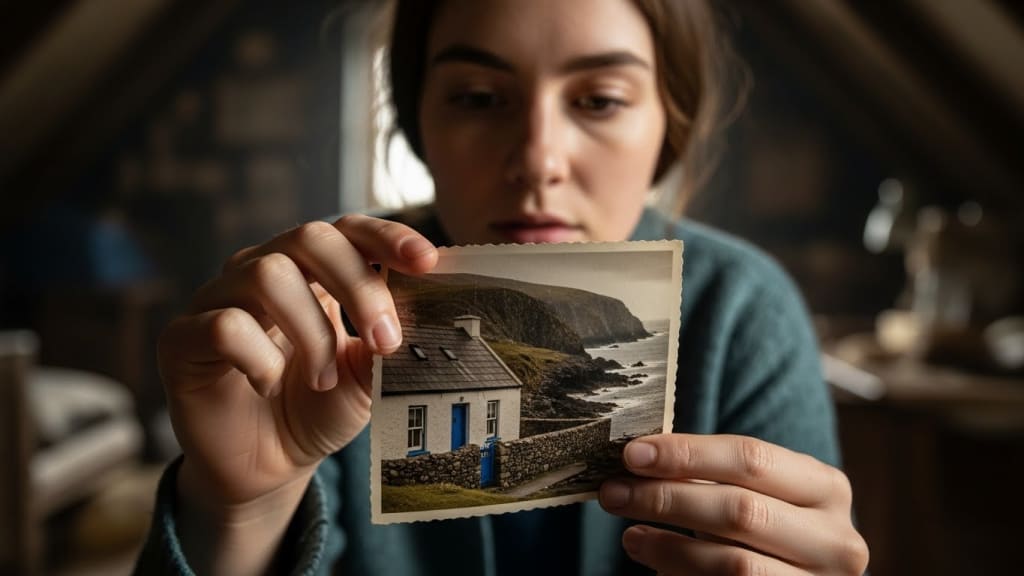
One afternoon, amidst a stack of old photos Maeve had tucked away, Clara found it. A tiny, sepia-toned picture, curled at the edges like ancient parchment. A woman stood in front of a cottage, her face obscured by shadow, a sturdy figure against the harsh light, but Clara knew it was Áine. And behind her, unmistakable, weathered by time but still vibrant even in black and white, was that door. The same blue Maeve had described, the same exact shade that Clara had seen in her dreams, now solid, undeniable. It was real. It was concrete. It existed, still, beyond the stories and the letters. The photo wasn't just a piece of paper; it was an invitation, a permission slip.
Clara ran her thumb over the image, a tremor in her hand, the paper almost translucent in places. The city outside, with its blaring sirens and anonymous faces, felt distant, unreal, a hollow stage set. This—this faded image, this deep, soul-stirring memory of a place she’d only known through words and worn paper—this was real. More real than her perfectly proportioned apartment, more real than her perfectly adequate job. The wind-swept cliffs, the incessant, ancient crash of waves, the smell of turf smoke on a damp evening, the defiance of that singular blue door against the vast, gray sea. They waited. And she knew, with a certainty that settled deep into her bones, silencing the city's drone, that the ache wouldn't vanish until she answered the call. She pulled out her phone, her fingers finding the browser icon almost instinctively. She typed, "flights to Shannon." The cursor blinked.
About the Creator
HAADI
Dark Side Of Our Society
Wise~Guys
— Look Behind what's in Front of You ~ Make Good Choices — Hey, So how you Doin'..! Made~Men — Mobster Movies romanticise a distinctive, elegant appearance, impeccable attire style, along with the 'Families' expressive lingo. Making their 'Bones' gave them Panache — with vintage fedoras, tailored pin-striped suits, mirror-polished wing-tip shoes adorned with tassels; with their 'Gun Moll' gorgeous dates on their arms.
By Jay Kantor17 days ago in Families
The quiet sound of families breaking
There is a kind of silence that is louder than any noise. It is the silence of a child waking in the night and realizing their parent is gone. It is the silence of a kitchen table with one chair suddenly empty. It is the silence of a home that still looks the same, but no longer feels the same. Across the United States, thousands of families live inside that silence. Not because of war. Not because of disaster. Not because of death. But because of policy.
By Kaylee Souther6 days ago in Families




Comments
There are no comments for this story
Be the first to respond and start the conversation.