
The Back of His Hand
On knowing a father years later


The boy knew his father like the back of his hand.
The back of his hand, the front of his hand, the father's palm connects with the boy's leg in multiple, wild swipes. He’s a man possessed by his own inadequacy. His short temper and busted ambition turn him to a frenzy of hate, barely held, with eyes that betray his fear. Nobody knows in the moment, least of all him, whether it’s fear of who he is or how far he could go. Something inside of him wants the boy to feel it too.
It’s fear stoked by bitterness. By petty betrayal. By guilt of what he had become. By the midnight vodka visits to the garden shed. By promises broken in the fire of life. The fuel for fear is always plentiful.
Cowering in a corner is how it ends or, rather, is adjourned. The boy curled into a ball with his hands over his head. Disassociating from fear by ordering perfectly rational numbers around in his head to prove some kind of perfect relationship that marries up the geometry of the wallpaper with a series of numbers. Abstracting his world into a stream of nonsense mathematics like a human log table. Calculating inverses, primes, the square root of 2, anything. His mind races in the search for constants, continually dropping streams of thought, then picking up others, looking for the plan that unites the numbers with the reality of this room. Drawing comfort from the sense that something adds up in the Universe. But it doesn't.
Years later, the man can’t remember what he had done as a 13-year-old to cause such pain and anger. Years later, when the dad is safely sprinkled over a landscape, he tells his mum that he thinks that his father was depressed, but she was insulted by the suggestion. Years later, she doesn’t want to besmirch his memory, much less invalidate her choice. But then again, she watched as he all-but beat up his kids. Years later, the boy-turned-man thinks, there’s something that she seems to have already forgotten.
The boy grew, became more physically capable, taller than his father and smackings stopped.
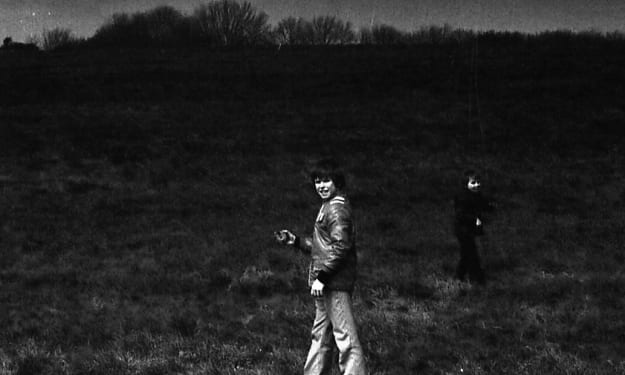
The boy got his first proper job as a 16-year-old. The dad would come and visit him on payday and take most of his wages away.The bullying was now passive-aggressive. Pathos was deployed. The lad was selling ice creams from a beachside hut. The old man would park his rent-a-wreck white Hillman Avenger by the road and go to visit the boy in the kiosk and begin the big-sell-sob-story, normalising everything, overturning the expected order. The boy-almost-man never saw any of the cash back, but he knew that the moment the notes left his hand. The mother never found out until years later. Years later, when the father’s omissions and commissions became clear in his absence. The father never held his hands up in admission. He told everything they needed to know, to understand him, in the mess he left behind.
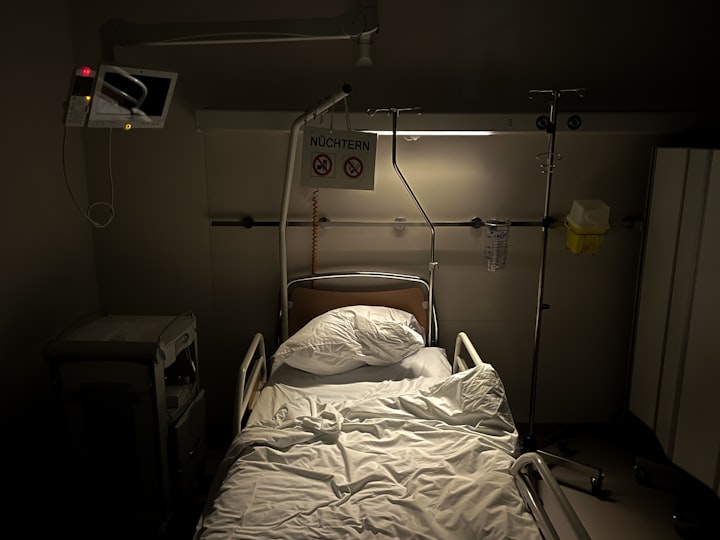
So why would the boy-who-became a-man talk about it now? The boy, the lad, the teen, the victim has grown away from the man he became; into memories like a different person. The man rejected the boy he was. The ice-cream kiosk was forty years ago. The palms of the father’s hands and his tobacco-stained knuckles are long-gone. The father died in hospital years ago, surrounded by grief and unresolved anguish. The man-who-was-the-boy watched his father's heartbeat on the monitor. He calculated the number of beats per minute into beats per second then seconds per beat slowing in a logarithmic way. He divided the fractions because division never reaches zero. He saw the open hands on the clock and marked a memory: 7.05 pm.
There was an interval. There was a sickening little room after everything changed. The quotient became zero. The nurses turned off the monitors, removed the tubes and wires and folded those hands across the father's still chest. They placed an innocent little yellow flower between the back of one hand and the palm of the other. His hands, his hands. The head’s hair was combed. The body was no longer full of the father as if it, too, had grown tired of the association. The body’s hands held a flower. No rage. Just a ridiculous little flower that the mother swiped off in fury as soon as she saw it. She rejected the innocence of the body with rage and stroked the back of its hand.
About the Creator
Ian Vince
Erstwhile non-fiction author, ghost & freelance writer for others, finally submitting work that floats my own boat, does my own thing. I'll deal with it if you can.
Top Writer in Humo(u)r.
Carlton Jama Adams: Building Stronger Families Through Healthy Parenting Strategies
Professor Carlton Jama Adams is a licensed clinical psychologist and a professor of psychology who has dedicated much of his professional life to understanding how families grow, communicate, and overcome challenges together. His work focuses on healthy parenting strategies and the ways in which emotional awareness can strengthen relationships within the home. As an educator, he teaches courses on masculinities, human services and community justice, Africana intellectual thought, and the psychology of oppression and liberation. He has also worked extensively with individuals involved in the criminal justice system and has consulted with international, national, and community based organizations on leadership strategy and executive coaching. Through both his teaching and consulting work, Carlton Jama Adams has developed a perspective on family life that highlights the importance of communication, emotional safety, and consistent guidance in raising resilient children.
By Carlton Adams2 days ago in Families



Comments
There are no comments for this story
Be the first to respond and start the conversation.