

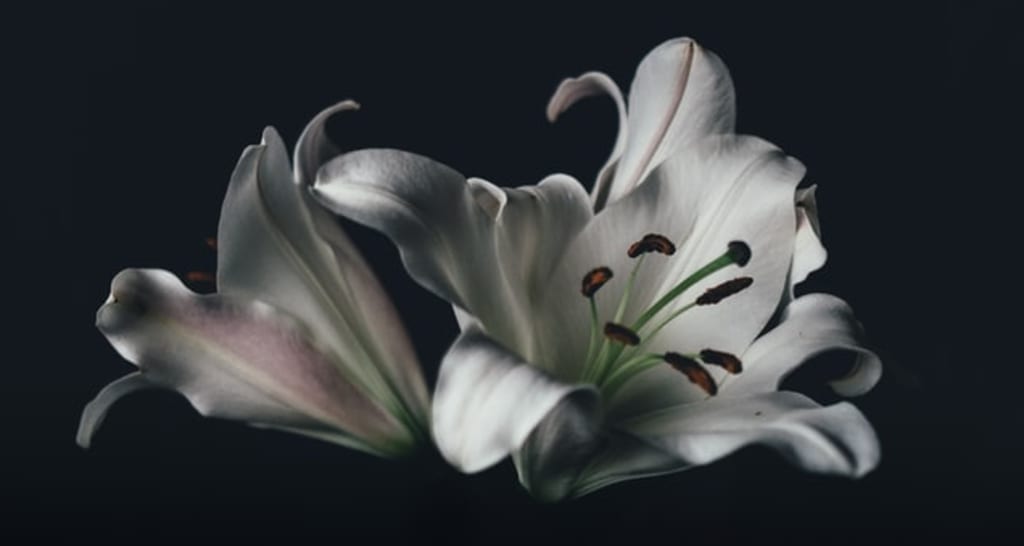
The funeral was the picture of taste and grotesque wealth. It was equal parts my mother’s intricate, overbearing hand and my stepfather’s wallet. That’s what a long-term battle with cancer affords you: the gift of micromanaging your own farewell. The chapel stank of lilies, my mother’s namesake and favorite flower. Personally, I think they smell like a urinal, but nobody asked me. Naturally, it was her dying wish that I take home the most obnoxious of the arrangements, her last opportunity to saddle me with a reminder that I wasn’t her, that I’d never be her.
She didn’t always hate me. When I was little, she was my best friend. My dad ran off when I was two, so for five years, it was just me and her. I know now that we struggled financially, but at the time, I didn’t see it. She made sure I didn’t. What I remember of those early years was hours spent role-playing in disguises pulled from the recycling bin, mom staging elaborate mysteries for me to solve, scavenger hunts, and Agatha Christie novels read aloud before bed. But everything changed when she met my stepfather. Seemingly overnight, my mother became someone I didn’t recognize: a Stepford Wife, a perfect, porcelain doll. My stepfather is loaded and descends from a long line of pompous assholes. I never understood why he chose my mother—because he knew she’d be grateful to him? Beholden to him for pulling her and her child out of poverty? I was eight years old when they married. By the time I was a teenager, I was certain I’d dreamed the woman she used to be, because since their nuptials, I have been nothing but a disappointment. He poisoned her against me.
And now that she’s dead, he’s going to cut me off. He never legally adopted me, so he has no obligation to keep paying for my tiny studio apartment. I loathe that I rely on him for anything, but with his help, I’m able to focus on my art. He thinks it’s all bullshit; he sees it—he sees me—as a useless waste of a life, and though my mother wasn’t the biggest fan of my career choice, she somehow convinced him to keep me in heat and hot water. I guess that was one thing she did for me. In 16 years. I worked furiously the whole time she was sick to build a following so that when this day came, I could tell him to fuck off, that I didn’t need his money anyway. But the galleries aren’t biting, and I haven’t sold a painting in months. It’s not enough that I’ve lost my mother; I’m about to lose everything else, as well.
I chose to go home after the funeral rather than spend another minute with my pretentious stepfamily. Wrestling the bouquet of lilies into the passenger seat of my Honda had been a comedy show of epic proportions. Where in the hell does she think I’m going to put these? She had been vocal about the small size of my apartment: “Your stepfather can more than afford that penthouse overlooking the park. Why on earth would you instead chose something so…commonplace?” “Because I’m commonplace, Mom,” I had said. And you used to be, too. (I didn’t say that part out loud.) Juggling the bouquet and my tote, I shuffled up the front walk, the putrid stench of piss flowers infiltrating my nostrils. Balancing them on one hip, I shoved my key into the lock, twisted, and shouldered the door open. I started across the lobby toward the stairs but faltered. All of sudden, I was overcome by exhaustion. I pivoted, made a beeline for the trash room, lifted the lid on the nearest can, and threw the lilies inside. Bye, Mom.
I plodded up the five winding flights of stairs to my apartment to find a cardboard box sitting on the mat, two words scrawled on top: “For Maggie.” I brought it inside. What could possibly be in it that would make my life worse? I set it on the kitchen counter and tossed my bag and coat on a bar stool. Then, I pulled a wine glass from the cabinet above the sink and armed myself with cheap merlot. Provisions in place, I removed the top of the box. I let out the breath that I hadn’t been aware I was holding. Mom. I took a long swig from the glass in my hand and set it down next to the box. Any practical person would be wondering who left this box and how they got into my building, but I was too busy staring at the photo. I picked it up and brought it closer, felt my stomach tighten. It was a picture of my mother and I dressed as Agatha Christie’s premier detectives, Hercule Poirot and Miss Marple. We held magnifying glasses made from cardboard tubes and plastic wrap. Mom sported a construction paper mustache, and I, a pair of glasses made from twist ties. But why is the picture all wet? I hadn’t even realized I was crying. Wiping the traitorous water from my cheek, I put the photo on the counter and blotted it with the sleeve of my dress. I reached into the box and closed my fingers around a second item: a small black notebook. Oh my God. I had completely forgotten about these! My mother always had one on hand for collecting clues when we played detective. I braced myself for—what? More hurtful memories? Maybe her last words to me? I swallowed a sip of merlot and cracked the cover. Blank. As was the next page. And the next. I flipped through the entire book, all blank. Annoyed at myself for romanticizing, I tossed the book back into the box and took my glass of comfort into the living room. I curled up in my favorite spot on the couch that molded reassuringly to my form. Taking another sip, my gaze traveled to my sketchpad and pencil on the coffee table. I promptly choked on my wine. It was like my mother’s hand reached out of the past and grabbed me by the collar. I set my glass down and snatched up the pencil on my way back to the kitchen. When I was maybe five or six years old, my mother taught me that old trick to revealing what was written on a pad of paper after the sheet had been torn away. I opened the notebook again, and sure enough, there was an imprint on the first page! With an excitement and anticipation my body remembered from years ago, I carefully rubbed the side of the pencil over the seemingly blank sheet of paper until my mother’s message to me appeared like magic:
“The season where you’ll find no thaw,
And merry made us peasants,
We drank of life as through a straw,
How green the inner presence.
So, when you feel that all is lost,
And I am but a ghost,
Look to lily for the way
To that which you need most.”
It was a riddle like so many of hers I’d read before. I read it again. I read it until I’d memorized the curve of her letters and the tilt of her hand. I felt a mix of confusion and grief that was all starting to feel like rage. “She was GONE!” I yelled at the ceiling. “This woman,”—I shook the notebook furiously—“the person you used to be, WAS GONE WITHOUT A GODDAMN TRACE!! Why did you let me think I’d imagined her?? Where was she when I needed her?? When I needed YOU??!!” My face burned hot, and my heart felt like it was going to beat out of my chest. I ripped the page out of the notebook and tore it into pieces. Opening the kitchen window, I let a gust of wind take the last of my mother away into the night. I grabbed the wine bottle by the neck and dragged myself over to the bed. Part of me hoped I wouldn’t wake up.
I bolted upright gasping for air after what might have been 30 minutes or three hours. I had resigned myself not to try to solve my mother’s riddle, but my damned unconscious mind had different ideas. Sweaty, I threw back the bed covers, discovering I was still fully clothed in funeral attire. “We drank of life as through a straw.” My mind buzzed as I shoved my feet into my sneakers. She didn’t capitalize her name. Lily. The word wasn’t capitalized. I staggered toward the door, tripping on the empty wine bottle. Head pounding, I made my way down the five flights of stairs to where I had discarded them. I stood almost reverently in front of the trash can, and with a breath, lifted the lid. There they were, undisturbed. Her lilies. Her message from beyond the grave. “That which I need most.” I pulled the giant bouquet from the refuse and set it down on the cold, cement floor. I steadied myself. Could it be? When I was little, my mother sent me on a treasure hunt every Christmas Eve to find a handful of $1 bills she had hidden somewhere in the house. It was my favorite part of the holiday, not for the money, but for the adventure. One year, they were taped to the blades of the ceiling fan, another, tucked into the pages of Agatha Christie novels on the bookshelf. But one year—my favorite year—it took me hours and hours to find them. She had meticulously rolled them and stuck them inside plastic straws that she then placed with great cunning into the Christmas bouquet on the kitchen table. It was the only time of year we spent money on live flowers. I kneeled down now beside the huge floral arrangement, and with a deep breath, I pulled apart two of its stems to expose…a straw. My pulse raced as I pinched it between my fingers and turned it to look inside. I could see there were bills packed tightly within. My fingers flew, extracting straw after straw until I had 40 of them on the floor in front of me, all numbered with permanent marker. I scooped them up and took the stairs two at a time back up to my apartment. I didn’t get farther than the kitchen floor before dropping to my hands and knees and spreading the straws before me. I grabbed the scissors from the junk drawer and snipped the straw labeled “1” in half, being careful to avoid the bills inside. With the tip of the scissors, I pushed the roll of bills until it poked out the top and I could pull it from its casing. I unrolled what turned out to be five $100 bills. I repeated the procedure, snipping each straw in numerical order and harvesting $500 rolls from inside until I had on the floor in front of me a staggering sight: $20,000 in $100 bills. And there was something additional inside straw #40. A handwritten note from my mother.
“I thought I was making a decision that was best for both of us. I’m sorry I wasn’t strong enough. I will always love you, Miss Maggie Marple.”
Tears ran down my face like a faucet I couldn’t turn off. My mother knew that my stepfather would abandon me as soon as she was gone. She had to have been siphoning this money for the better part of her illness. My stomach cramped with anguish, and I cried until there was nothing left. My mother had given me a parting gift that would ensure my survival, but she was wrong about one thing. Money was never what I needed most. It wasn’t then, and it isn’t now. I only ever needed her.
And now, she’ll never know it.
About the Creator
Whitney Stone
Hi! I'm a theater artist who is new to writing fiction. I've always enjoyed expressing myself through writing, and as a huge fan of mystery and crime novels, it feels great to have taken the plunge! I hope you enjoy my work :-)
Keep reading
More stories from writers in Families and other communities.
Wise~Guys
— Look Behind what's in Front of You ~ Make Good Choices — Hey, So how you Doin'..! Made~Men — Mobster Movies romanticise a distinctive, elegant appearance, impeccable attire style, along with the 'Families' expressive lingo. Making their 'Bones' gave them Panache — with vintage fedoras, tailored pin-striped suits, mirror-polished wing-tip shoes adorned with tassels; with their 'Gun Moll' gorgeous dates on their arms.
By Jay Kantor24 days ago in Families
The Donald Trump Family: From Business Power to Political Legacy
Introduction The Trump family is one of the most talked-about families in modern American history. What began as a real-estate business empire eventually transformed into a powerful political brand that reshaped U.S. politics. From towering skyscrapers to the White House, the Trump family’s journey reflects ambition, controversy, influence, and lasting impact.
By shaoor afridi2 days ago in Families



Comments
There are no comments for this story
Be the first to respond and start the conversation.