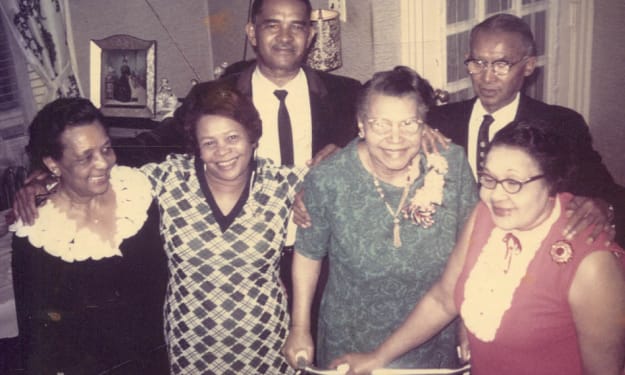
extended family
All about how to stay connected, strengthen ties and talk politics with your big, happy extended family.
The Story of Family Bonds
The sun was slowly setting in the western sky, casting a golden glow over the small town of Riverside. In a cozy, old house at the corner of Maple Street, the Bennett family gathered for their traditional Sunday dinner. It was a ritual they had maintained for years, a way to stay connected despite their busy lives.
By Niranjon Chandra Roy11 months ago in Families
A Smile, A Family
A family is not just a group of people connected by blood; it is a home where love, trust, and happiness reside. Among all the emotions that bind a family together, a smile is perhaps the most powerful. A simple smile can brighten a dark day, heal wounds, and strengthen relationships. It is a universal language that conveys love, warmth, and reassurance. In a family, a smile has the magical ability to turn a house into a home filled with love and harmony.
By Niranjon Chandra Roy11 months ago in Families
Meet Your Padre: i want to meet your padre
Starting a journey to reconnect with family can change your life. Especially when you meet your partner's parents, especially the father. Wanting to meet your partner's parents is a big step in any relationship. It's important to do it with care and respect.
By Sophia Wilson11 months ago in Families
My Family Story
I noticed her since I was in 6th grade. At that time, I was very shy because I played with more boys than girls in school. When I was sick, many girls came to visit me, but I was too shy to go out. The next times, I just went somewhere else and pretended that I wasn't home. It was funny!
By My Life Story 11 months ago in Families
Motherhood
Motherhood is a journey of growth, challenges, and self-discovery. At the start, I used to ask myself if I was doing enough, if I was patient enough, or if I was doing the right things. But along the way, I've come to love the mom I am becoming, imperfect, learning, and changing each day.
By Usman Zafar11 months ago in Families
Origins of the Qarsherskiyan People: Triracial Isolates, The history of the Ethnic Qarsherskiyan Tribe
The history of the Ethnic Qarsherskiyan Tribe is traced by some to the late 1400s during the era of Christopher Columbus, while others trace it back to the founding of Jamestown. Many trace it back to the first Muslims in North America. Starting around 1513, Spanish colonizers began bringing enslaved African Muslims to what is now Florida, Mississippi, Alabama, Louisiana, Texas, New Mexico, and other parts of the USA that were formerly controlled by the Spanish empire. Mustafa Azemmouri, often called Estevanico, was sold into slavery in 1522 by the Portuguese. Spanish conquistador Andrés Dorantes de Carranza ended up keeping Estevanico enslaved, and Estevanico became one of the first Africans to step foot on North American soil. He explored Florida, the Gulf Coast, and even the American Southwestern deserts. The USA didn't even exist back then. Not even Jamestown had been founded yet. Estevanico would end up forming amazing relationships with Native American tribes in Texas, becoming a Medicine man, and even traveled so far as to see the Pacific Ocean, all before Jamestown had ever existed or been founded. An African Muslim man did all this and more long before the American ideology of manifest destiny carried Anglo-American settlers to the Pacific coast, as they hadn't even arrived to successfully colonize what would become USA. Islam has been part of the religious make-up of America since the first colonial settlers arrived in North America. African Muslims played key roles in the founding of the United States, mapping it's borders and fighting against British rule. Around 1 in 5 of all African people brought to the USA via the transatlantic slave trade were adherentd to Islam, and nearly all Black Americans who live today are descended from one of these African Muslims. One famous Black Muslim slave was Abdul Rahman Ibrahima. Abdul Rahman Ibrahima ibn Sori was a Fulani man born in West Africa in 1762. Ibrahima left Futa in 1774 to study in Timbuktu, Mali. He was kidnapped at the age of 26 in 1788 and sold to British slave traders stationed on the River Gambia. Ibrahima was eventually sold to Thomas Foster in Natchez, Mississippi, becoming first a field hand, then rose to become the plantation overseer. He was known as the “Prince among the Slaves.” As a young man, Ibrahima was a Prince and a captain of his father’s army. In 1794, Abdur Rahman married a woman named Isabella, having a large family, nine children, 5 sons and 4 daughters. Ibrahima was known for being a knowledgeable and devout Muslim. In 1828 Ibrahima raised 3,500 dollars touring the northeast and Cincinnati to free his family. In February 1829, Ibrahima and his wife sailed to Africa. Shortly after arriving in Liberia Abdur-Rahman got cholera and died six weeks later. The following year, Thomas Foster also died and his heirs sold 2 of Rahman’s children and 5 of his grandchildren to the American Colonization Society, which in turn reunited them with Isabella in Liberia. Ibrahima’s sons Lee, Simon, Simon’s wife Hannah, and their 5 children, Simon, Susan, Cresy, Nancy, and Hester all made it to Liberia. Omar Ibn Said was a Black Muslim and was born around 1770 in Futa Toro by the River Senegal. He was raised by his uncle after his father died when he was only 5 years old. He became a devout Muslim and made the Hajj pilgrimage to Mekkah. He went there on foot! Omar Ibn Said married and had a son before being abducted and sold into slavery in America when he was about 40 years old. Omar was enslaved for 56 years and wrote at least 15 surviving texts in Arabic, including letters, Islamic verses, and his autobiography. He died in 1864 and he was subsequently buried in Bladen County, North Carolina, USA during the time of the Confederate States. Omar Ibn Said became famous for writing in Arabic on the walls of his jail cell, which contradicted the belief that enslaved Africans were illiterate. His autobiography is the only known surviving American slave narrative written in Arabic by an African while he was still enslaved in what would become the USA. Although it is said that ibn Said converted to Christianity on December 3, 1820, his conversion to Christianity was a cover-up, and there were devotional praises to Muhammad written in his Bible, and also a card dated 1857 on which he wrote Surat An-Nasr, a short surah (chapter in the Quran) which refers to the conversion of non-Muslims to Islam 'in multitudes.' The back of this card contains another person's handwriting in English misidentifying the surah as the Lord's Prayer and attesting to Omar's status as a "good Christian". While others writing on Omar's behalf identified him as a being a Christian, his autobiography and other writings offer more of an ambiguous position. In the autobiography, he still praises Muhammad; he references "Jesus the Messiah", the same way as the Quran's descriptions of Jesus (who is called المسيح 'the Messiah' 11 times in the Quran), and describing Jesus as 'our master' (سيدنا sayyidunā) employ the typical Islamic honorific for prophets and is not to be confused with Lord (ربّ rabb); description of Jesus as 'bringing grace and truth' (a reference to John 1:14) is equally appropriate to the conception of Jesus in Islam. It was most likely that he stayed a Muslim his whole life but was believed to have converted to Christianity by people at the time when he simply loved Jesus since he was considered a prophet in Islam. This was stated in his auto-biography. African Muslims helped the British and their colonies militarily expand West from the East Coast. During the a war called the French And Indian War, with "Indian" being a term referring to Indigenous Americans, the British and their American colonies had a war with New France, the French colonies in North America. The British succeeding in gaining control of territory the French formerly held, with different Native American tribes aligning with different sides. British Major-General Edward Braddock was defeated in 1755 at Fort Duquesne. The British had to retreat to the East, building a line of forts running North to South along the new battleground in what is now Huntington County, Pennsylvania. One of these forts, called Fort Shirley, had to be quickly abandoned. It wasn't abandoned before a Blacksmith made a small circular charm with the phrase "there is no God except Allah" on it in Arabic. This proves that Muslims served in the British military during the French And Indian War. Impressively, during the 1730s, Ayuba Suleiman Diallo wrote multiple copies of the Quran, which he had completely memorized, and wrote from memory! He used these for devotion and education.
By William Penn Kurdskiy11 months ago in Families
My Family, My World
Family is the foundation of love, care, and support. It is where life begins and where we find comfort, no matter what happens. My family is my world because they give me strength, happiness, and a sense of belonging. No matter how difficult life becomes, I know I have a place where I am always accepted and loved.
By Niranjon Chandra Roy11 months ago in Families
“The #1 Psychological Trick to Make Anyone Instantly Like You”. AI-Generated.
Have you ever sat down with someone and immediately clicked with them—without even realizing why? Or perhaps you've struggled to make a good first impression and found yourself wondering, "What's their secret?"
By Zeeshan Haidar11 months ago in Families